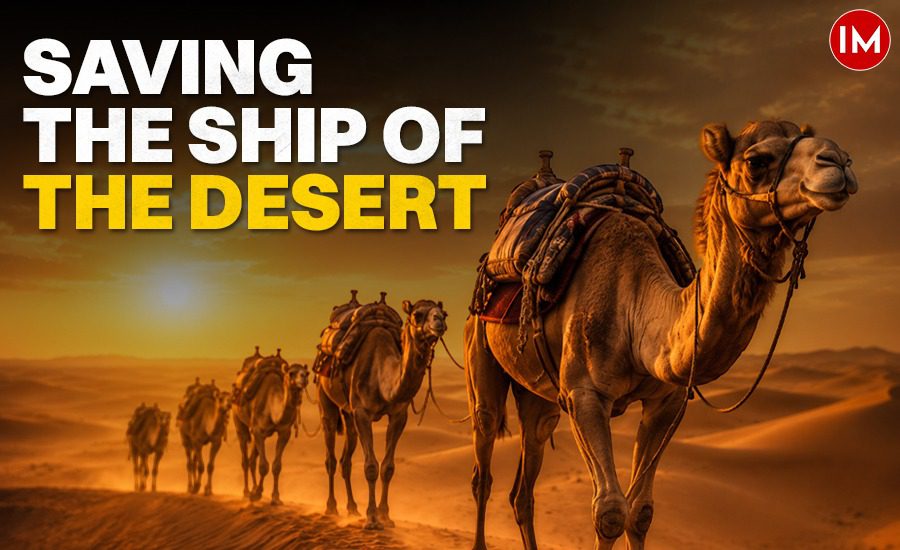
For centuries, the camel has been more than just an animal in Rajasthan. It has been the lifeline of the desert, carrying people across the Thar, sustaining pastoral communities, and becoming an enduring symbol of the state’s identity. Yet, this “Ship of the Desert” is now facing one of the biggest survival crises in its history. While the global camel population continues to grow, India’s camel numbers have collapsed by nearly 80% over the past six decades—from around one million in 1961 to just over two lakh today. Rajasthan, home to nearly 86% of India’s camels, stands at the centre of this challenge.
Recognising that saving the camel also means protecting livelihoods, traditions and fragile desert ecosystems, the Rajasthan Government has launched a multi-pronged conservation strategy. Through financial incentives, veterinary care, free insurance, legal protection and awareness campaigns, the state is attempting to reverse decades of decline. On the occasion of World Camel Day, Indian Masterminds looks at how Rajasthan is working to secure the future of its iconic state animal.
WHY INDIA’S CAMELS ARE DISAPPEARING
The decline of camels has been driven by multiple factors.
Mechanisation has replaced camels in agriculture and transport. Tractors, highways and motor vehicles have reduced their traditional role. Grazing lands have steadily shrunk as common pastures have been converted into farmland and fenced private properties, making seasonal migration increasingly difficult for pastoral communities.
Economic realities have made camel rearing less attractive. Camels have a long gestation period of nearly 15 months and are expensive to maintain. At the same time, limited markets for camel milk and other camel-based products have reduced their commercial value.
Legal restrictions on slaughter and interstate transport, though introduced to protect the species, also reduced market demand, making camel breeding financially challenging for many families.
The result has been a dramatic fall in camel numbers, threatening not only biodiversity but also the livelihoods of thousands of Raika, Rabari and other traditional camel-rearing communities.
Also Read – From a Forgotten River to a Flowing Lifeline: How Shahjahanpur Revived the Bhainsi Through Collective Will
A COMPREHENSIVE CONSERVATION STRATEGY
Instead of relying on a single intervention, Rajasthan has adopted a comprehensive conservation model.
The Department of Animal Husbandry is implementing the Camel Conservation Scheme (Ushtra Sanrakshan Yojana) under the state’s Camel Conservation and Development Policy. The programme combines direct financial support, veterinary services, livestock insurance, legal safeguards and public awareness to encourage people to continue camel rearing.
“Our objective is not only to conserve Rajasthan’s state animal but also to make camel rearing economically sustainable for livestock owners through financial support, healthcare, insurance and strong policy protection,” says Dr Suresh Meena, Director, Animal Husbandry Department, Rajasthan.
FINANCIAL SUPPORT FOR CAMEL BREEDING
The biggest intervention has been direct financial assistance for camel owners.
Introduced in the 2022-23 Budget, the Camel Conservation Scheme initially provided ₹10,000 for every newborn camel calf.
Recognising the need for stronger incentives, the present government doubled the assistance to ₹20,000 per camel calf in the 2024-25 Budget. The revised benefit applies to registrations made from October 16, 2024 onwards.
The assistance is transferred directly into the camel owner’s bank account in two instalments.
The first instalment is released when the calf is between birth and two months of age. The second instalment is paid after the calf completes one year, ensuring owners continue caring for the animal during its most vulnerable stage.
Applications, tagging, verification and payments are carried out online through the IOMMS portal, making the process transparent and efficient.
Each Jan Aadhaar family can receive assistance for up to five newborn camels in a financial year.
THE IMPACT IS ALREADY VISIBLE
The scheme has expanded rapidly.
During 2022-23, over 4,000 camel calves benefited.
In 2023-24, the number increased to 7,552.
The biggest jump came after the incentive was doubled.
In 2024-25, 15,894 newborn camels belonging to 5,963 camel owners received financial assistance worth ₹876.10 lakh.
During 2025-26, the government supported 18,862 camel calves, benefiting 6,564 owners, with assistance touching ₹1,698.15 lakh.
Even in the first two months of 2026-27, assistance has already been provided for 603 newborn camels owned by 283 beneficiaries.
The state has earmarked ₹1,500 lakh for the scheme during 2026-27, signalling continued commitment to camel conservation.
KEEPING CAMELS HEALTHY
Financial incentives alone cannot conserve camels. The government has therefore launched dedicated camel disease diagnosis and treatment camps across the state. These camps are organised every quarter, particularly in areas where camel-rearing communities live.
The results have been significant. In 2024-25, 129 veterinary camps diagnosed diseases in over 7,100 camels and treated 24,651 animals, benefiting 2,135 camel owners. The programme expanded sharply in 2025-26, when 542 camps treated 64,439 camels, helping more than 6,300 camel owners.
By May 2026, another 133 camps had already benefited 13,754 camels.
FREE INSURANCE FOR CAMEL OWNERS
To reduce financial losses caused by camel deaths, Rajasthan has also extended insurance coverage under the Mukhyamantri Mangla Pashu Bima Yojana.
Each Jan Aadhaar family can now insure up to 10 camels free of cost. Every camel receives insurance coverage of up to ₹40,000.
So far, 18,448 camels owned by 11,846 camel rearers have been insured. Insurance claims worth ₹118.80 lakh have already been paid to owners whose insured camels died, providing much-needed financial security.
STRONG LEGAL PROTECTION
Financial incentives are backed by legal safeguards.
The Rajasthan Camel (Prohibition of Slaughter and Regulation of Temporary Migration or Export) Act, 2015 prohibits camel slaughter in the state and prevents camels from being transported outside Rajasthan for slaughter.
The accompanying Rules, notified in 2025, allow movement outside the state only for grazing, agriculture, dairy activities or participation in livestock fairs through a permit or special permit issued by authorised officers.
This legal framework aims to curb illegal transport and protect camel populations while allowing legitimate movement for livelihood purposes.
MAKING CAMELS POPULAR AGAIN
The government is also trying to restore the camel’s cultural significance.
Every year, state and district livestock fairs organise camel competitions, including contests for the best breeding male and female camels, superior breeds, camel milk production and camel decoration.
These events encourage breeders, celebrate traditional knowledge and help keep camel rearing socially relevant.
SAVING A SYMBOL OF THE DESERT
The camel is far more than Rajasthan’s state animal. It represents the state’s history, culture and resilience in one of the world’s harshest landscapes.
Its disappearance would not only mean the loss of an iconic species but also the decline of traditional pastoral lifestyles that have existed for generations.
Through direct incentives, healthcare, insurance, legal protection and community participation, Rajasthan is attempting something few regions have managed successfully—making conservation economically viable for the people who live alongside the species.
Whether these efforts can fully reverse decades of decline will become clear in the coming years. But one thing is already evident: Rajasthan is no longer treating camel conservation as a symbolic exercise. It is investing in the future of its “Ship of the Desert” through one of the country’s most comprehensive livestock conservation programmes.
Also Read – The Rudranath EDC Model: How IFS Officer Tarun S Balanced Conservation, Tourism and Spiritual Heritage