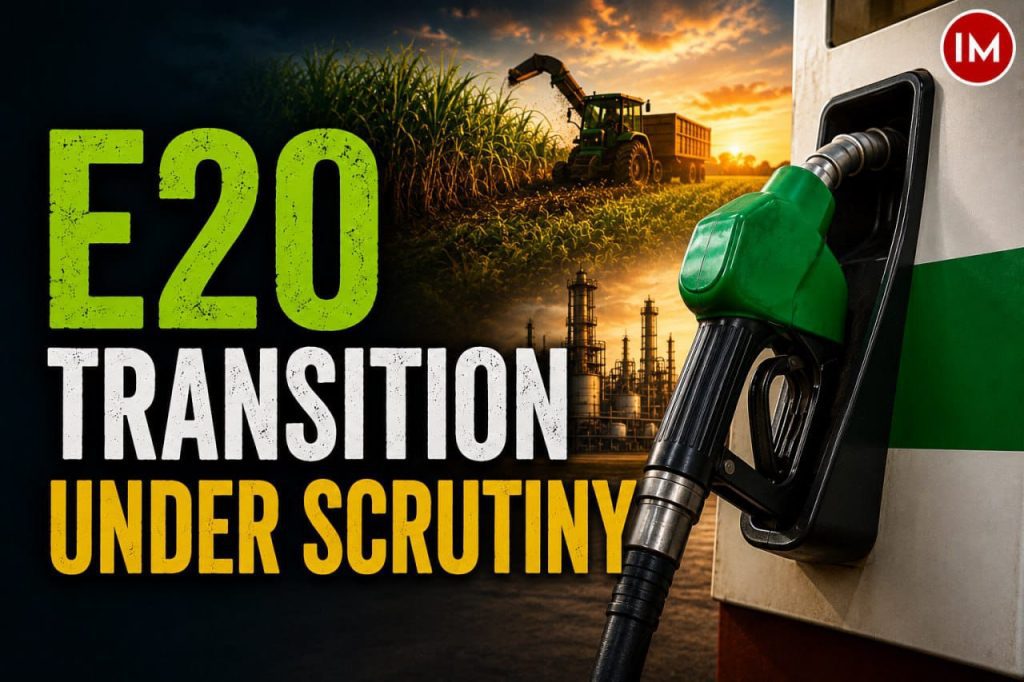
India’s shift to E20 fuel has erupted a full-scale national debate, showing conflicting narratives of sustainability, economics, and technological readiness. What the government describes as a transformative step toward reducing crude oil imports and boosting farmer incomes has, on the ground, resulted into growing concerns over mileage loss, engine compatibility, and lack of consumer choice. As India positions ethanol at the centre of its energy future, the E20 debate is no longer just about fuel; it is about how large-scale transitions are implemented, communicated, and accepted in a complex economy.
Ethanol as a Fuel: Composition, Production Process and Energy Dynamics
Ethanol is a renewable biofuel derived from biomass such as corn, sugarcane, and agricultural residues. Unlike fossil fuels, it can be produced annually and is widely blended with petrol to improve combustion and reduce emissions. In the United States, over 98% of gasoline contains ethanol, primarily as E10 (10% ethanol), which lowers pollutants like carbon monoxide, while higher blends such as E15 are approved for newer vehicles and E85 (up to 83% ethanol) is used in flexible fuel vehicles capable of running on varying ethanol-petrol combinations.
Ethanol production involves cultivation of feedstocks, their transport to processing plants, and conversion through fermentation and distillation into fuel-grade ethanol. The final product is transported via rail, trucks, or barges to fuel terminals where it is blended with petrol. Chemically represented as CH₃CH₂OH, ethanol is a clear, colourless liquid also known as ethyl or grain alcohol. It has a high Octane rating, which improves engine performance by preventing knocking and enabling smoother combustion, allowing lower-octane petrol to meet standard requirements such as 87 Octane. Its chemical structure remains the same regardless of whether it is derived from starch, sugar, or cellulosic feedstocks.
Also Read – How Nagaland’s CMHIS is Making Healthcare Affordable for Every Family
However, ethanol has about 30% lower energy per unit volume than petrol, meaning higher blends can reduce fuel efficiency depending on engine design and ethanol proportion. While ethanol-optimised engines can mitigate this through better combustion and higher compression ratios, conventional engines may experience noticeable mileage drops as ethanol content increases.
In terms of sustainability, ethanol show a positive energy balance. This balance improves further with cellulosic ethanol made from non-food biomass like crop residues, wood waste, or energy crops such as switchgrass and miscanthus, which require less water and fertiliser and can use biomass energy during production to further reduce fossil fuel dependence. Beyond technical aspects, ethanol plays a crucial environmental and strategic role by reducing emissions and enhancing energy security through lower dependence on imported oil. However, its long-term sustainability depends on feedstock selection, land and water use, and production methods, which is why global focus is increasingly shifting toward second-generation ethanol technologies that use waste materials instead of food crops, ensuring a more balanced and sustainable fuel future.
Policy Vision: Energy Security, Import Reduction and Agricultural Support
The E20 rollout is rooted in the long-term strategy of India to reduce its dependence on imported crude oil, which currently meets nearly 85% of the country’s total demand, exposing the economy to global price volatility and geopolitical risks. By blending ethanol, a domestically produced biofuel, India aims to save billions in foreign exchange while also lowering carbon emissions. Estimates suggest that ethanol blending could help India save up to U.S.D. 4 billion annually in crude import bills, while cumulative savings over the past decade have already crossed I.N.R. 1 lakh crore.
India’s ethanol production has expanded sharply, rising from about 38 crore litres in 2013-14 to over 400 crore litres by 2021-22, with blending levels increasing from 1.5% to 20% by 2025, achieving the target five years ahead of schedule. This expansion has also created a stable demand for agricultural produce such as sugarcane and maize, strengthening rural income streams and helping manage surplus production in the sugar sector.
Government defends the policy, emphasising its long-term benefits. Petroleum Minister Hardeep Singh Puri has maintained that ethanol blending is essential for India’s energy future, even acknowledging that “mileage may drop a little” as part of the transition. This dual objective, energy security and agricultural support, forms the backbone of the government’s argument in favour of E20.
Mileage Loss Debate: Data, Perception and Ground Reality
The most visible and widely discussed issue surrounding E20 fuel is its impact on vehicle mileage, that is in terms of fuel economy, the distance an automobile can travel on a specific amount of fuel. Ethanol has a lower calorific value than petrol, nearly 30-35% lower energy density, resulting in reduced fuel efficiency. Government-backed studies, including those by ARAI, Indian Oil Corporation, and SIAM, indicate that fuel consumption increases by 2-6% with E20 compared to E10, translating into an approximate 3-4% drop in mileage. Other estimates, including those cited by NITI Aayog, suggest the decline could be closer to 6% on average, while some real-world reports indicate 6-7% for cars and 3-4% for two-wheelers.
Automobile manufacturers have supported these findings, describing the reduction as “minor” and within expected limits. However, consumer experience appears to diverge from official estimates, with anecdotal reports suggesting mileage losses of up to 10% in certain cases, depending on driving conditions and vehicle type.
The core issue lies not just in reduced efficiency, but in pricing. Since E20 fuel is not significantly cheaper than petrol, consumers end up paying more per kilometre travelled. This effectively increases transportation costs, creating a perception that the transition imposes a direct financial burden. This gap between technical data and lived experience lies at the heart of the controversy, raising questions about whether policy communication and pricing mechanisms have adequately addressed consumer concerns.
Engine Safety and Compatibility: Conflicting Claims and Technical Findings
Concerns about engine safety have further complicated the debate, particularly for older vehicles not designed for higher ethanol blends. While studies cited by the government have found no significant corrosion or damage to metallic components, they have also highlighted that certain rubber-based components, such as hoses, gaskets, and seals, may deteriorate faster when exposed to E20 fuel over time. Automakers have largely dismissed fears of major damage, with industry representatives stating that extensive testing has not revealed serious issues. Notably, data cited in industry discussions indicates that over 15 million vehicles were serviced without ethanol-related damage being detected, reinforcing the claim that E20 does not cause immediate harm.
However, the concern is less about immediate failure and more about long-term wear and maintenance costs, particularly for vehicles manufactured before E20compatibility norms were introduced. This has created a trust gap, as consumers weigh official assurances against potential future expenses. The issue has also entered the political domain, with opposition leaders seeking clarity on what they describe as “contradictory” claims made by manufacturers regarding engine safety. The result is a situation where scientific findings, industry assurances, and public perception remain misaligned, sustaining the controversy.
India vs Brazil: Why the Comparison Matters and Where It Falls Short
Brazil is often cited as the global benchmark for ethanol fuel, but the comparison highlights critical structural differences. Brazil’s ethanol ecosystem evolved over four decades, with a gradual transition that aligned fuel production, vehicle technology, and consumer behaviour. Today, the country has over 30 million flex-fuel vehicles, with nearly 88% of new car sales being flex-fuel, allowing vehicles to run on anything from petrol to pure ethanol.
A key feature of Brazil’s success is pricing. Ethanol is typically 25-30% cheaper than petrol, offsetting its lower energy content and ensuring cost-effectiveness for consumers. This enables a market-driven system where users choose fuel based on price efficiency.
In India, by contrast, the transition has been rapid and largely mandate-driven, with E20 becoming the default fuel without offering alternative options. Pricing does not reflect energy content differences, and flex-fuel vehicle penetration remains minimal. The comparison underscores that Brazil’s success is rooted in flexibility and consumer choice, whereas India’s model relies on standardisation and policy enforcement, making the transition more contentious.
What the World Offers: Alternative Pathways for India
Beyond Brazil, global models provide important lessons for India’s next phase of ethanol policy. The United States follows an incentive-driven approach under its Renewable Fuel Standard, promoting blends like E10, E15, and E85 through tax credits and carbon incentives, allowing market forces to drive adoption.
The European Union adopts a multi-fuel strategy, where petrol, biofuels, and electric mobility coexist, giving consumers flexibility during the transition. Sweden has focused on gradual adoption of flex-fuel vehicles supported by tax benefits, while China has taken a region-specific approach, rolling out ethanol blending in selected provinces based on readiness. Each of these models underscores a common principle: flexibility and phased implementation reduce resistance and improve adoption.
Learning for India: Mandate and Market Alignment
The India-Brazil comparison and global evidence point toward a set of clear lessons for India’s ethanol strategy. First, pricing must reflect energy content. Without a price advantage, ethanol blending will continue to impose a perceived cost on consumers. Aligning pricing mechanisms could directly address the most immediate source of dissatisfaction. Second, expanding flex-fuel vehicle adoption is critical. Without vehicles capable of handling multiple blends, fuel flexibility cannot translate into consumer choice. Policy incentives, regulatory mandates, and industry alignment will be required to scale this ecosystem.
Third, fuel retail infrastructure must evolve. Introducing multiple fuel options, such as E10, E20, and higher blends, at petrol pumps can ease the transition and accommodate diverse vehicle types. This would move India closer to global best practices where consumer choice plays a central role. Fourth, diversification of feedstock is essential for long-term sustainability. Expanding second-generation ethanol production can reduce dependence on water-intensive crops and address environmental concerns. Finally, communication must improve. The current controversy highlights that even well-intentioned policies can face resistance if not clearly explained. Transparent data sharing, consistent messaging, and consumer education are necessary to rebuild trust.
Infrastructure, Vehicles and Market Readiness: System Out of Sync
A major structural issue in India’s ethanol transition is the mismatch between supply expansion and ecosystem readiness. While ethanol production capacity has expanded significantly, crossing 1,600 crore litres annually in recent years, the supporting infrastructure, such as multi-fuel dispensing systems and storage facilities, remains limited. Most fuel stations currently offer only E20, leaving consumers with no alternative, even if their vehicles are not fully compatible. Additionally, the penetration of flex-fuel vehicles remains minimal, and pilot projects involving higher blends such as E100 have struggled due to near-zero demand in the absence of compatible vehicles.
This lack of synchronisation between fuel policy, vehicle technology, and retail infrastructure has created friction, making the transition appear abrupt rather than gradual. It reflects what experts describe as a “partial transition problem,” where supply readiness outpaces demand-side adaptation.
Agriculture, Environment and the Food vs Fuel Debate
Ethanol production is closely linked to agriculture, particularly sugarcane and grain crops, raising concerns about sustainability. Critics argue that diverting crops toward fuel production could impact food security, while the water-intensive nature of sugarcane cultivation poses environmental challenges.
The government has sought to address these concerns by promoting the use of surplus grains and improving water efficiency in ethanol production. Distilleries increasingly operate under zero liquid discharge systems, reducing water consumption to around 3-5 litres per litre of ethanol, significantly lower than earlier estimates. At the same time, there is a growing push toward second-generation ethanol derived from agricultural residues and waste, which can reduce environmental impact and address the problem of stubble burning. However, such technologies are still in the early stages of scaling, leaving unresolved questions about long-term sustainability and feedstock diversification.
Possible Solutions and The Road Ahead to Course Correction
The E20 controversy has exposed gaps but also offers a clear roadmap for corrective action. One immediate step is the introduction of multiple fuel options at petrol pumps, allowing consumers to choose between E10, E20, or pure petrol based on vehicle compatibility. This approach, widely used in countries like Brazil and across the European Union, can ease the transition and restore consumer confidence.