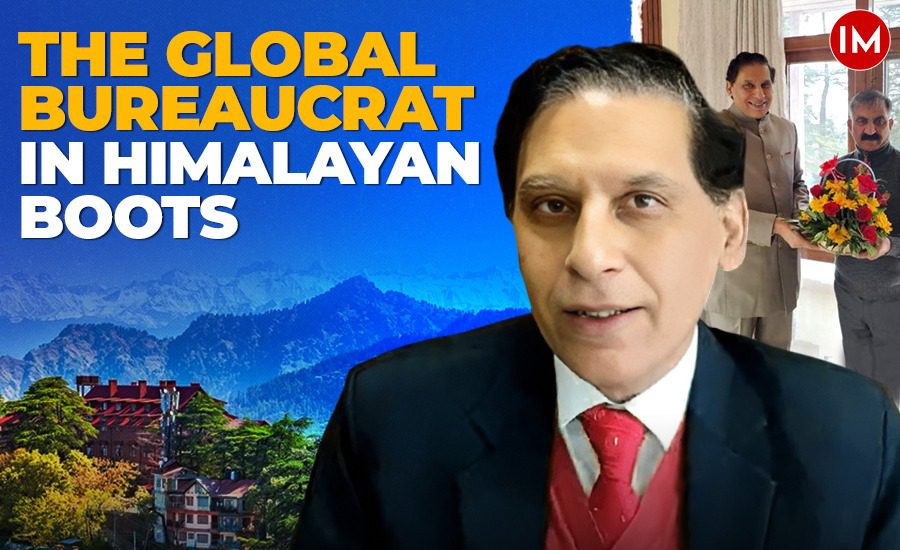
In the heart of Himachal Pradesh, where cedar forests line winding roads and snow-laced peaks dominate the skyline, a seasoned administrator quietly orchestrates the rhythm of governance. Stationed in Shimla’s secretariat, Mr. Prabodh Saxena, Chief Secretary of Himachal Pradesh, brings with him more than three decades of administrative insight, global education, and a sharp legal mind.
His is a journey that began in courtrooms and classrooms and has since spanned continents, ministries, and missions. An IAS officer of the 1990 batch, Saxena, took charge as the Chief Secretary of Himachal Pradesh on December 31, 2022. But the story of how he reached the state’s top bureaucratic post is one layered with depth, vision, and an ongoing conversation between law, policy, and people.
LAW, LEARNING, AND A LARGER PURPOSE
Born into a culture that valued thought and service, Prabodh Saxena’s first brush with systems of justice came through the study of law at Delhi University. While most law graduates chose litigation or corporate corridors, Saxena saw governance as his true calling.
This early legal education proved more than academic; it gave him a framework to dissect systems, understand societal fault lines, and appreciate the nuances of policy. But Saxena was not one to be confined by domestic boundaries. He pursued a Master’s degree in Law at the London School of Economics and Political Science, an experience that added a global dimension to his understanding of administrative structures and public policy.
What emerged from these academic hallways was not just a lawyer or a scholar, but someone preparing to serve, lead, and engage.
THE MOUNTAINS BECKON
In 1990, Saxena cracked the UPSC Civil Services Examination and entered the Indian Administrative Service, assigned to the Himachal Pradesh cadre. For someone trained in international law and policy, the landscapes of Himachal offered a completely different kind of classroom, one that demanded empathy, problem-solving, and real-time action.
From the start, Saxena treated every posting, be it in a remote district or the capital, as a chance to listen, learn, and lead. His law background allowed him to simplify the complex, untangle bureaucratic knots, and translate rules into action.
The early years in field postings saw him mediate disputes, streamline schemes, and understand the rhythms of rural Himachal. Each role, each village, and each file gave him a sharper lens to view the state, not just administratively, but socially and economically.
DIVERSE ROLES, COMMON PURPOSE
Over the years, Saxena’s journey through the bureaucratic maze was anything but linear. What set him apart was his ability to shift gears across domains like finance, planning, environment, and technology without losing focus or clarity.
As Principal Secretary (Finance), Saxena was instrumental in steering the state through complex fiscal phases. He had the unique ability to blend financial prudence with development needs, a balancing act that many found daunting. Budgets weren’t just numbers for him; they were instruments of impact. His time in finance saw structural discipline in spending and a forward-looking approach to revenue planning.
In his subsequent role as Secretary of Planning, Economics, and Statistics, Saxena championed data-backed governance. Under his leadership, statistics weren’t filed away; they were acted upon. Departments across sectors began using analytics and real-time data for more targeted decisions. Schools, hospitals, roads… all began to benefit from planning that was rooted in evidence, not assumptions.
Then came perhaps one of his most pivotal stints, as Secretary of Environment, Science, and Technology. In a state like Himachal, where ecological balance is both fragile and sacred, Saxena’s leadership was vital. He introduced policies that encouraged green technologies, emphasised climate sensitivity, and safeguarded biodiversity.
From promoting renewable energy to updating environmental regulations, Saxena turned sustainability from a buzzword into a working principle. His legal acumen came into play again, helping craft regulations that were actionable, not just aspirational.
HIMACHAL’S VOICE ON THE GLOBAL STAGE
Saxena’s influence didn’t stop at the Shivalik ranges. With an international education and diplomatic finesse, he represented India on several multilateral platforms. Engaging with global institutions, he brought to the table not just central government perspectives but also Himachal Pradesh’s unique development model.
His voice carried weight in conversations about legal reform, climate policy, and administrative efficiency. At a time when regional leadership often goes unnoticed in global circles, Saxena ensured that the state’s innovations and challenges were part of broader dialogues.
THE WRITER, THE SPEAKER, THE THINKER
Parallel to his administrative work runs another track, his intellectual contribution to the field of governance. With several publications in national and international journals, Saxena has consistently written on issues that matter, from legal reform and transparency to environmental governance.
He is a frequent speaker at institutions in India and abroad, where he shares experiences not through lofty theory but grounded narratives. His talks offer insights into the realities of running a government in difficult terrains and the tools needed to improve lives.
LEADING HIMACHAL INTO A NEW CHAPTER
On December 31, 2022, Saxena assumed office as the Chief Secretary of Himachal Pradesh, the state’s senior-most bureaucrat. In this position, he became the keystone of the administration, bridging political vision with bureaucratic execution.
From managing the complex tourism ecosystem to coordinating disaster response efforts in the wake of landslides and floods, Saxena has been the calm at the centre of the storm. His decisions are marked by clarity, not haste. His approach is deliberate, grounded, and informed.
With development comes challenge, and Saxena has navigated issues like urbanisation, environmental stress, and administrative modernisation with quiet strength. Even amid crises, his grasp of law and governance ensures the ship stays steady.
THE MENTOR IN THE MOUNTAINS
What makes Saxena’s career especially meaningful is his continued role as a mentor. From training young officers to inspiring students at academic forums, he has built bridges between generations. His speeches are known for their clarity, his writings for their depth, and his mentorship for its impact.
He’s also a rare example of a bureaucrat who hasn’t let busyness eclipse curiosity. Having travelled to more than 75 countries, Saxena brings a worldview that constantly refreshes his approach to administration. And yet, Shimla remains home, the centre of his lifelong public mission.
THE ONGOING STORY
Mr. Prabodh Saxena’s journey is far from over. With every policy he drafts, every meeting he leads, and every crisis he handles, he continues to write new chapters in Himachal’s administrative narrative.
This isn’t just the story of a man who rose through the ranks. It’s the story of someone who chose to walk the long road, who viewed governance not as a job but as a daily exercise in thought, fairness, and service.
In the quiet valleys and bustling towns of Himachal Pradesh, his legacy isn’t written in slogans; it’s reflected in systems that work better, policies that serve smarter, and a government that listens.
By combining a lawyer’s precision, a scholar’s perspective, and a civil servant’s instinct for the public pulse, IAS Prabodh Saxena has not just served the state; he has helped shape it.