“It rained. Water flooded the dried-up river… The dead blue fish came back to life.”
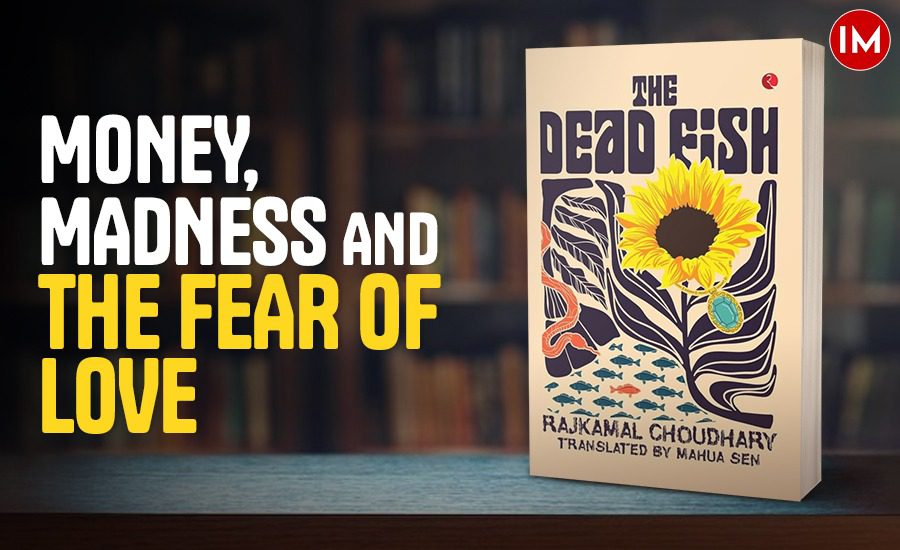
The journey of a man begins with his family. Ten-year-old Nirmal was thrown out of his house in the village, on the banks of the Padmavati, after his mother eloped with a lorry driver. Alone, he found his way to Karachi and through various odd jobs – selling newspapers, selling tea – grew into labour and enterprise. Then Bombay, New York, Calcutta; proletariat becoming bourgeoisie through shrewd loans, ruthless deals, and ever-accruing profit. It is a meteoric rise to success. “But why does even a man of this stature turn fragile, vulnerable and insane at some juncture in life?”
A boy who never experiences the fullness of love, through his mother or any other familial sources which are supposed to provide unconditional acceptance to the vulnerable young, realizes that the worth of a man, in the eyes of the world, is determined by his purchasing power. He becomes impassive externally because internal fear must be tightly controlled. All the while, inferiority runs unabated through his veins, uninterrupted by the dazzle of money and power.
Rajkamal Choudhary, as Arun Kamal informs us in the Foreword, was from the disillusioned “Hungry Generation” in the 1960s, when hope for a new country was fading in the face of brutal authority structures. The establishment had proved itself to be fundamentally corrupt; literature – and authors – were mutinous against it. In his own Author’s Note, Choudhary writes about two women from a friend’s family who “were taken to the hospital together on account of mental health issues”.
Although he goes on to say that there is no such reality in his novel, The Dead Fish is unsettlingly realistic. “‘Kalyani Mansion’ does not exist anywhere in Calcutta”, but when the narrative mentions that this fictitious thirty-storey skyscraper built by our protagonist Nirmal Padmavat had been inaugurated by Dr Bidhan Chandra Ray (actual contemporaneous chief minister of West Bengal at the time), artifice bleeds into art: “On behalf of the people of Calcutta, I extend my gratitude to the famous industrialist, Shri Nirmal Babu for constructing Kalyani Mansion…”
Also Read – The Sky Husband: Where the Spiritual and the Everyday Become One
The building had been named after Nirmal’s bewitching muse Kalyani, who had come to America to study medicine before becoming a bohemian model looking for new horizons in New York’s Shangri La: “Her eyes sparkled like a goldfish when she laughed.” Again, the narrative assures us that there is no way two fictitious people of such peculiarities could have ever actually met. And there are indeed other coincidences in the plot which are so improbable that they must have been drawn from imagination, but are characterized with disturbingly vivid psychological insight.
“People would say that Nirmal was obsessed with money, and they would consider him a patient of neurosis. Nirmal Padmavat, however, never bothered about his madness, his disease or people’s perception of him. He continued doing what he had already decided. He continued trying to decipher and decrypt the world around him. He transformed his mind into a bare, sharp sword, poised to cut through the layers of darkness, scattering shards of light at his feet.” Perception varies across personality, but Nirmal is considered cruel by most. To a man whose wife, Shirin, has left him for Nirmal: “Padmavat is not a human being but a frightful monster. He is not a human, rather he’s the great poet Goethe’s Mephisto, Shakespeare’s Othello, Emily Brontë’s Heathcliff. This man is the devil.”
Shirin Salzberg-Mehta-Padmavat is introduced in the novel as an eighteen-year-old singer at an upscale restaurant: “The boys of Calcutta / They know how to net a fish / They really know…” After her first husband, Shirin searches for water again with Nirmal: “She feels as if Nirmal is pushing her into a dark cave—the dark cave of death. There are poisonous animals in the cave. There are numerous snakes and she has been turned into a fish that has been pulled out of the sea. A blue fish. An unconscious fish. A fish thirsting for water. But the cave is dark…
There is no ray of light left anywhere.” And when, again, union between husband and wife is left unconsummated because of the husband’s unresolved shadows, the wife’s thwarted lust becomes physical anger: “Shirin opened her eyes, and extending her hand, tried to get a hold of Nirmal. She yearned to drink him in. But it was already too late. The piece of ice had now melted into water, and it did not take long for water to turn into steam and evaporate into thin air… Shirin leapt out like a fish after tearing the net and dove into Nirmal’s scattered, broken body. She began to beat Nirmal’s body with both her hands.” Shirin is the starving cat; Shirin is the dead fish.
Morality and sin are equal addictions in this strange novel by Rajkamal Choudhary. The hidden is revealed in maladaptive sexuality, sadism presents as generosity, conscience and consciousness spiral into disarray. The daughter of Kalyani (and the Doctor she had eventually married) is Priya — young, tender, curious. But the darkness of the world inhabited in that time and space spares nothing and nobody.
“Just a silhouette of two women. There were no arms, no hands, no fingers, no knees, no legs, just two fish. Blue fish. And the sea of darkness.” The lesbian relationship in this book is contextualized by the omniscient narrator through literary precedents in the works of Marquis de Sade, Alphonse Daudet, and Radclyffe Hall. In particular, the novel Wind Woman by Carol Hales (1953) becomes a point of similarity. But there is surprisingly no reference here (or earlier in the Author’s Preface written in 1965) to Indian authors like Ismat Chughtai, despite the very public controversy and court case she faced in 1944 for “obscenity” in ‘Lihaaf’.
Rajkamal Choudhary’s fragmented writing is discomfiting because it echoes reality. Another searing text by a Hindi playwright who emerged in the mid-1960s is Swadesh Deepak’s memoir Maine Mandu Nahin Dekha (translated by Jerry Pinto as I Have Not Seen Mandu; Speaking Tiger 2021). That too is a portrait of a man and his relationships which, once read, is difficult to forget. Amongst Deepak’s other brilliant short stories is ‘Paapi Pait’ — Sinful Stomach. But what is crime in a cruel world? When does desperation cross into depravity and to what degree can it be understood through compassion? How do hurt people heal without scarring further? Where does literature entangle in this vicious web as virtue?
Character is defined by circumstance. To close, the last paragraph of Jayanta Mahapatra’s haunting poem “Hunger” from 1976, evoked by the title of Choudhary’s book: “I heard him say: My daughter, she’s just turned fifteen… / Feel her. I’ll be back soon, your bus leaves at nine. / The sky fell on me, and a father’s exhausted wile. / Long and lean, her years were cold as rubber. / She opened her wormy legs wide. I felt the hunger there, / the other one, the fish slithering, turning inside.”
(Yauvanika Chopra is the Editor and researcher deeply engaged with Indian literature and languages in translation, she has worked with Speaking Tiger Books and served as Associate Director at the New India Foundation. She holds an MA in Contemporary Literature, Culture and Theory from King’s College London, where her research examined intertextual representations of Indian women.)
Also Read – Moy Moy’s Circle: A Moving Story of Love, Disability, and Quiet Change