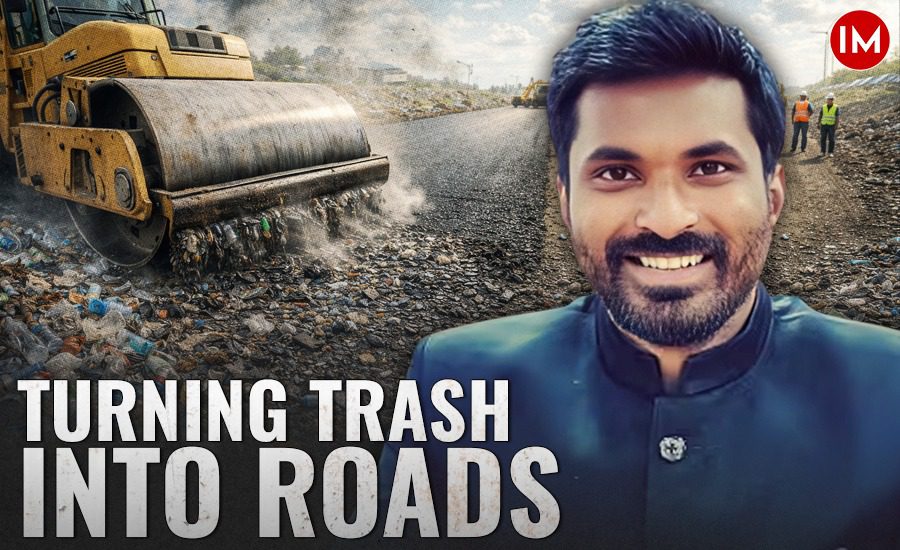
In the quiet stretches of Dakshin Dinajpur in north Bengal, an unusual hum of innovation has been changing the way people think about plastic. What was once seen as waste and nuisance has now become a resource — thanks to a simple yet powerful idea that combines technology, behavioural change, and community participation.
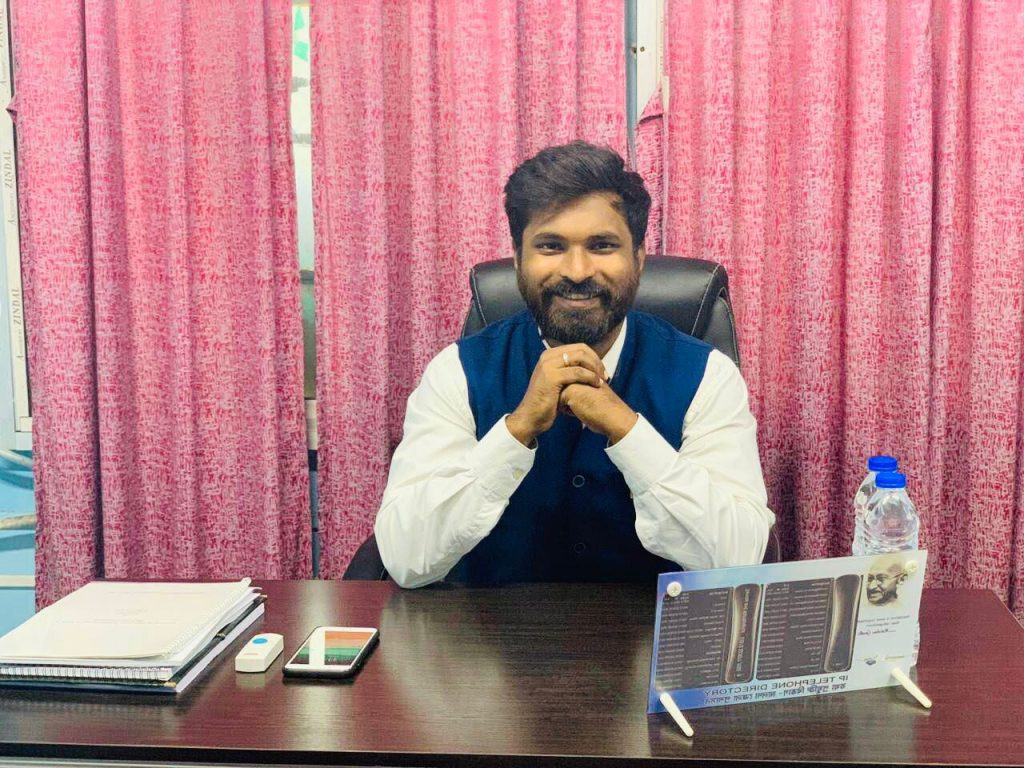
At the centre of this transformation stands Naveen Kumar Chandra — a young IAS officer with a penchant for finding practical, scalable solutions to everyday challenges. His “Waste to Wealth” initiative is a model of what good governance can achieve when public innovation meets local participation. Naveen was a recipient of the Nexus of Good Annual Award, 2025, for this effort.
The Problem Beneath the Surface
Plastic pollution has been one of the most persistent environmental problems in semi-urban India. Single-use bottles, wrappers, and discarded packaging material often clog drains, litter markets, and end up in open dumping grounds. In districts like Dakshin Dinajpur, where formal waste-processing infrastructure was minimal, the challenge was even more visible.
Surveys by the district administration in 2022 showed that nearly 65 per cent of plastic waste generated in urban areas was either burnt in open spaces or dumped alongside municipal waste. This not only created a sanitation hazard but also added to road-side litter and microplastic contamination of soil and water.
Instead of approaching the problem as a routine civic issue, the administration decided to treat it as an opportunity for circular economy innovation — converting plastic from a liability into an asset.
The Innovative Solution
The idea was simple but transformative. Smart plastic bottle collection machines were installed in public areas such as markets, schools, parks, and government offices. Citizens could deposit used plastic bottles and receive redeemable coupons — discounts or tokens that could be used in local shops, pharmacies, and eateries.
The collected bottles were shredded at district-level processing units, and the shredded plastic was supplied to the Public Works Department for road construction. Laboratory tests confirmed that mixing shredded plastic with bitumen not only reduced the use of virgin bitumen by 18 per cent but also enhanced road strength and durability.
This closed-loop process established a win-win model — cleaner surroundings, stronger roads, and direct economic value from waste.
Methodology and Implementation
The project followed a phased approach:
* The Study Phase: This phase was meant to study the problem and the possible solutions, pros and cons and counterfactuals of all solutions were studied, and a tailor-made solution was found.
* Execution: Initially, 7 such machines were installed at various locations with high footfall to collect such plastic bottles.
* Scaling Up: Based on the success of the initial execution, 10 more machines were installed across the district in key high-footfall zones.
* Processing and Utilisation: The administration partnered with a local recycler to handle shredding and storage, while ZP and district engineers integrated shredded plastic into road construction material.
* Community Engagement: Awareness campaigns were run through schools, local cable networks, and social media, encouraging residents to participate and highlighting environmental benefits.
Within a year, over 1.5 tonnes of plastic bottles have been collected and reused — the equivalent of preventing nearly 2 lakh bottles from entering landfills or open drains.
The Human Element: Incentivising Behavioural Change
One of the most remarkable aspects of this initiative is its ability to alter community behaviour. The coupon-based system transformed waste disposal into a rewarding act. People began collecting bottles not out of compulsion but out of habit — a habit supported by instant, visible rewards.
Local shopkeepers also benefited from increased footfall as residents came to redeem their coupons. In a subtle way, waste management became a local economic activity, creating new linkages between environmental responsibility and livelihood.
Tangible Outcomes
A third-party evaluation conducted after one year found:
* 1.5 tonnes of plastic waste recycled and reused.
* 16 kms of rural and semi-urban roads constructed/under construction using shredded plastic.
* Bitumen use was reduced by 18 per cent, leading to cost savings of nearly Rs 40 lakhs per km.
* Visible litter reduced by 30 per cent in urban centres.
* Over 10,000 residents participated, with 60 per cent of contributions coming from students and youth.
* 2,500 coupons redeemed at local stores, directly benefiting small businesses and saving for local consumers. This means a financial payout of nearly Rs 50,00,000.
Feedback from residents revealed 87 per cent satisfaction with the initiative, praising its convenience, transparency, and visible results.
A Model of Participatory Governance
The success of Dakshin Dinajpur’s “Waste to Wealth” initiative lies not just in its technology but in its governance model. It brings together administration, citizens, and private partners in a shared mission.
The project reflects key principles of good governance:
* Transparency, through open data on waste collected and rewards distributed.
* Accountability, as the initiative operates on measurable environmental outcomes.
* Inclusivity, ensuring all social groups, especially students and women, participate.
* Sustainability, by creating a self-financing model through recycling revenue.
This participatory approach has inspired nearby districts to explore similar systems for managing e-waste and single-use plastics.
Broader Impact and Replicability
The Dakshin Dinajpur model demonstrates that sustainable innovation does not always require high budgets or complex technology. Often, it needs context-sensitive ideas that resonate with local realities.
By linking waste management with economic incentive and social participation, the project has become a replicable template for small towns across India. Its success has drawn attention from the state’s Urban Development and Environment departments, and proposals are underway to integrate similar systems into municipal solid-waste plans in other districts.
At the heart of this initiative is the belief that governance should be both empathetic and inventive. In Dakshin Dinajpur, Naveen Kumar saw plastic waste not merely as a problem but as a resource waiting to be redefined. By empowering local institutions and citizens, he ensured that the system did not depend solely on government machinery but on community ownership — the real key to sustainability.
The “Waste to Wealth” project is more than an environmental intervention — it is a statement on the future of governance. It demonstrates that innovation can emerge from the grassroots; that local solutions can achieve global sustainability goals; and that leadership rooted in empathy can inspire real change.
In a time when the world struggles with plastic pollution and climate concerns, Dakshin Dinajpur’s example reminds us that good governance begins with good ideas — ideas that connect the everyday lives of people with the larger vision of sustainability.
Through this initiative, the district has not just cleaned its streets but has redefined waste itself — as wealth, as opportunity, and as hope.
The writer is a former IAS Officer)