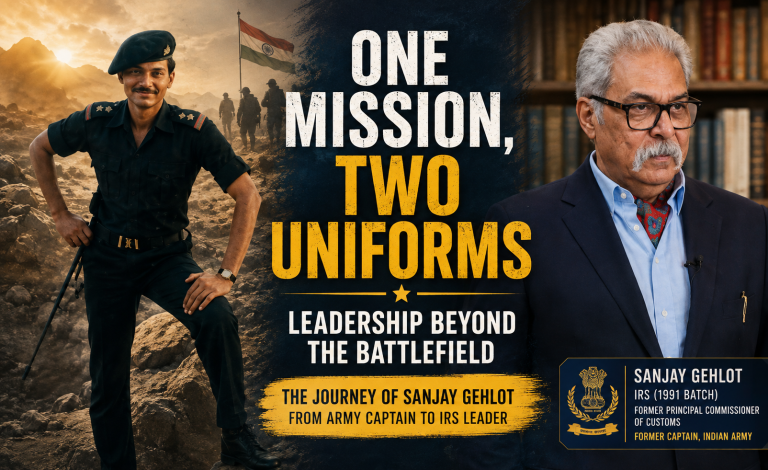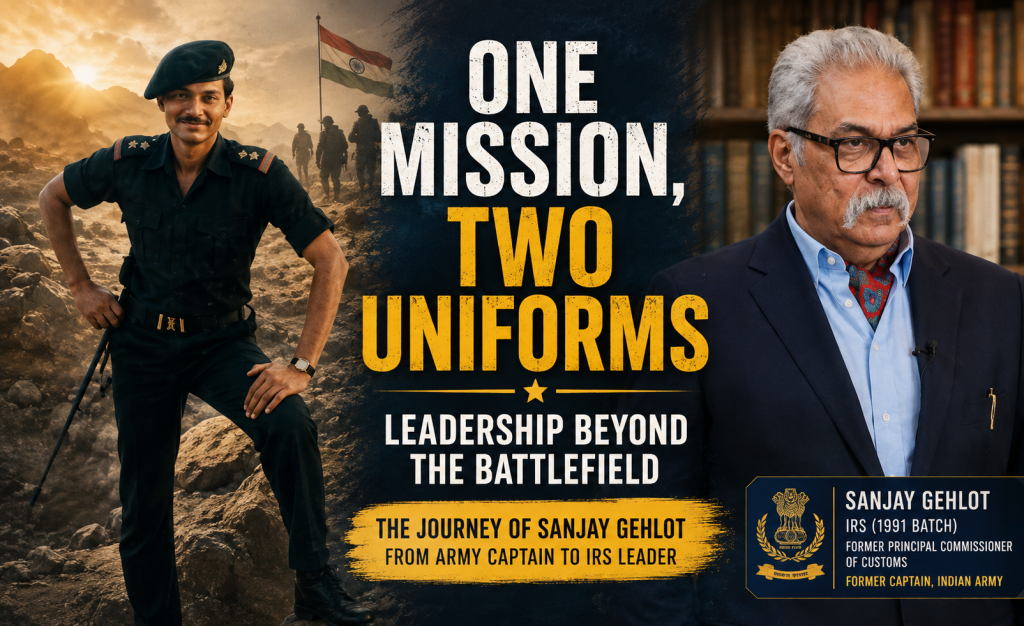
For many people, wearing the Army uniform is the highest form of service to the nation. Very few voluntarily leave that life to begin another equally demanding journey. Former Principal Commissioner of Customs Sanjay Gahlot (IRS, 1991 batch) is one of those rare officers.
Before joining the Indian Revenue Service, he served as a Captain in the Indian Army. The discipline of military life shaped him, but he believed he could contribute to the country in another way—through governance and public administration.
During nearly three decades in the civil services, he handled sensitive enforcement assignments, led important government organisations and mentored countless young officers. After voluntarily retiring, he chose yet another path—guiding UPSC aspirants and writing on public policy.
In an exclusive conversation with Indian Masterminds, the former Principal Commissioner of Customs and Former Captain in the Indian Army spoke about why he left the Army, the lessons that stayed with him, and what truly defines a good civil servant.
From the Battlefield to Public Administration
Most people dream of joining the Army. Sanjay Gahlot had already achieved that dream. Yet he decided to leave the uniform and join the Indian Revenue Service.
For him, it was not about changing careers. It was about expanding the scope of service.
“The Army taught me discipline, courage, teamwork and decisive leadership under pressure. Joining the IRS offered a wider opportunity to contribute to nation-building through governance and public administration,” says Mr. Gahlot.
He believes the values learned in the military remained with him throughout his civil service career.
“Military values became my guiding principles. They helped me lead with integrity, fairness and accountability.”
Lessons That Never Left Him
According to Gehlot, the Army does much more than teach tactics and discipline. It shapes character.
Whether handling customs enforcement or leading government organisations, he relied on the same principles he had learned as a young Army officer—planning carefully, taking responsibility and leading from the front.
He says these qualities became especially useful whenever multiple agencies had to work together.
“Planning, teamwork, punctuality and leading from the front proved equally relevant in civil administration. Military-style coordination ensured clarity of responsibility, faster execution and better morale.”
For him, leadership is not about giving orders. It is about earning trust.
The Most Challenging Assignments
Every posting brought new responsibilities.
However, Gehlot says two assignments tested him the most—handling sensitive customs enforcement work and later leading the Government Opium and Alkaloid Factories.
These assignments required balancing legal requirements, administrative efficiency and public interest at the same time.
“The experience reinforced that effective leadership requires integrity, adaptability, empathy and the ability to inspire confidence in difficult circumstances.”
He believes every difficult assignment teaches an officer something new.
Choosing Law Over Convenience
One question often faced by senior officers is whether to take the easy path or the right one.
Gehlot recalls that some enforcement decisions carried enormous pressure because influential interests were involved.
Still, he never allowed pressure to influence his judgement.
“I chose evidence over convenience and law over expediency. Though difficult at the time, those decisions ultimately stood judicial scrutiny.”
For him, integrity is rarely easy, but it always proves worthwhile.
When Citizens Changed His Thinking
After years in government, one incident changed how he looked at public service.
It was not a major investigation or an important policy decision.
Instead, it was meeting ordinary citizens whose lives depended on timely administrative action.
That experience reminded him that every government file represents real people.
“Public service is ultimately about people, not files. Every decision carries human consequences.”
He says empathy and transparency are just as important as efficiency.
Why He Chose Voluntary Retirement
Many officers continue working until their official retirement date. Gehlot chose a different route. After serving for nearly three decades, he decided to take voluntary retirement. The decision, he says, was entirely personal.
“My greatest satisfaction came from serving honestly, mentoring younger officers and resolving complex issues fairly.” He wanted to devote more time to mentoring civil services aspirants, writing and contributing to public policy discussions.
“Voluntary retirement was a conscious choice to contribute beyond the boundaries of government service.”
Music: His Stress Reliever
Government service often comes with enormous pressure. For Gahlot, music became the perfect balance. He enjoys playing the guitar and flute whenever work becomes demanding.
“Music helped me regain perspective, reduce stress and return to work with renewed clarity.” He believes emotional balance is just as important as professional competence.
Many Roles, One Purpose
Over the years, Gahlot has been an Army officer, IRS officer, mentor, writer and musician. He believes each role strengthened the others. Civil services sharpened his analytical thinking. Mentoring improved his communication. Music gave him emotional balance. Together, these experiences helped him become a better administrator and a better person.
“These experiences combined discipline with empathy, technical competence with human understanding, and professionalism with personal fulfilment.”
Would He Choose Civil Services Again?
If given a chance to start over at the age of 25, would he still join the civil services?
His answer is clear.
Yes.
Though he says today’s young people have many more career options—including entrepreneurship, technology and public policy—he believes the civil services continue to offer unmatched opportunities to make a difference.
“Civil services still offer unmatched opportunities to influence society positively. But today’s world also provides many other meaningful avenues for public service.”
A Life Defined by Service
Sanjay Gahlot’s journey is not simply about changing uniforms. It is about carrying the same commitment from one field of service to another.
Whether in the Army or the Indian Revenue Service, he believes leadership begins with integrity, grows through discipline and succeeds only when people remain at the centre of every decision. His story shows that while careers may change, the purpose of serving the nation can remain exactly the same.