The Confederation of All India Traders has intensified its demand for a comprehensive National E-Commerce Policy, highlighting growing concerns over the imbalance between traditional retailers and large e-commerce companies as India’s digital commerce market heads toward a projected $250 billion valuation by 2030.
In a communication to Union Commerce Minister Piyush Goyal, CAIT Secretary General Praveen Khandelwal cited a joint report by Deloitte and Google, which underscores the rapid growth of India’s e-commerce sector. The report estimates that the market, currently valued at around $90 billion, is set to nearly triple by the end of the decade, driven by increasing internet penetration and rising consumer demand across urban and semi-urban regions.
While acknowledging the growth potential, CAIT warned that the aggressive expansion of e-commerce companies is creating an uneven playing field for small retailers, kirana stores, and offline businesses that form the backbone of India’s retail economy. The traders’ body argued that a significant shift in consumer spending toward online platforms is taking place, particularly in smaller cities, raising concerns about the long-term sustainability of traditional retail.
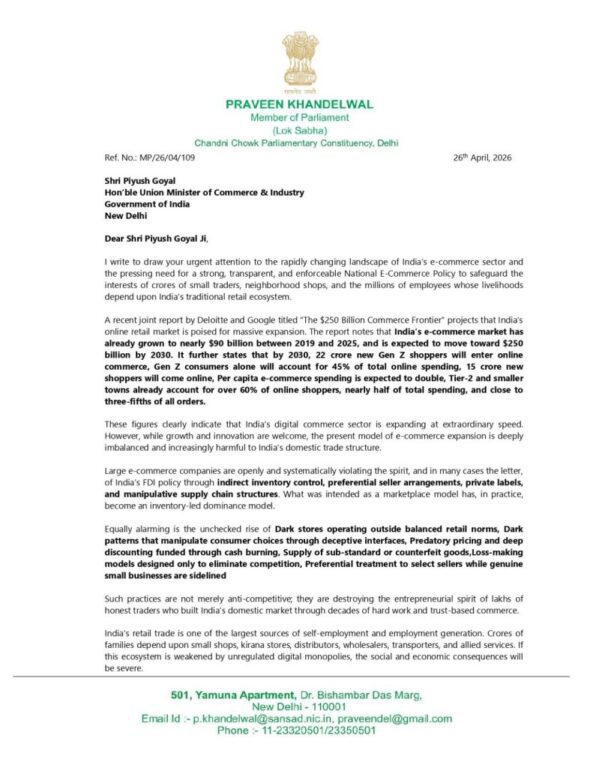
CAIT National President B C Bhartia alleged that several e-commerce companies are bypassing the intent of India’s foreign direct investment norms by operating through indirect inventory-based models, despite being allowed to function as neutral marketplaces. He pointed out that practices such as deep discounting, predatory pricing, preferential treatment of select sellers, and algorithm-driven product visibility are distorting competition and disadvantaging independent retailers.
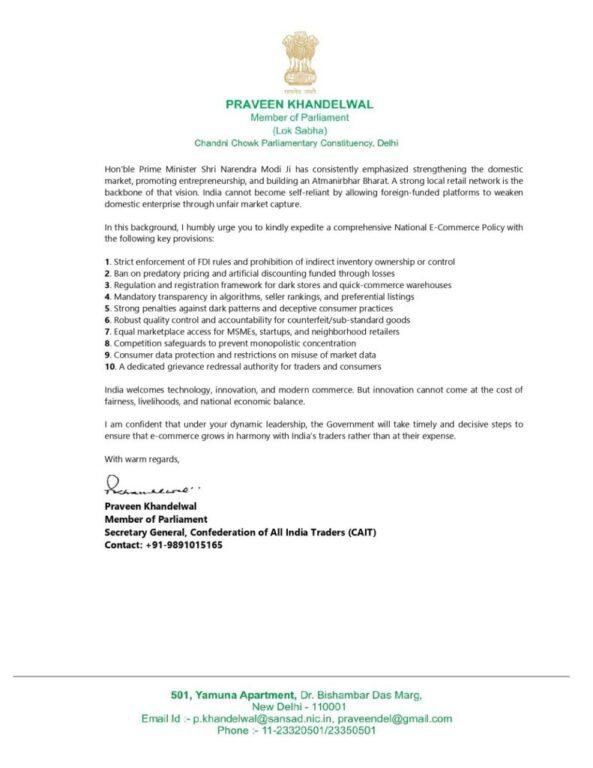
The organization further stated that the emergence of dark stores and private label strategies by large platforms is reshaping supply chains in ways that exclude traditional traders. According to CAIT, these developments are not only impacting small businesses but also threatening the livelihoods of millions dependent on the retail ecosystem, including wholesalers, distributors, and logistics providers.
Khandelwal emphasized that India’s retail sector remains one of the largest generators of employment and self-reliance, and any policy vacuum could accelerate its erosion. Referring to Prime Minister Narendra Modi’s emphasis on Atmanirbhar Bharat, he stated that strengthening domestic trade and ensuring fair competition must remain central to India’s economic strategy.
CAIT has urged the government to act swiftly and introduce a robust regulatory framework that ensures transparency in e-commerce operations, strict enforcement of FDI rules, and accountability for unfair trade practices. The body stressed that while technological advancement and digital commerce are essential for growth, they must not come at the cost of India’s traditional retail sector.
Reiterating its position, CAIT said the future of Indian commerce should be built on a balanced approach where e-commerce companies and offline retailers coexist and grow together, rather than one displacing the other.