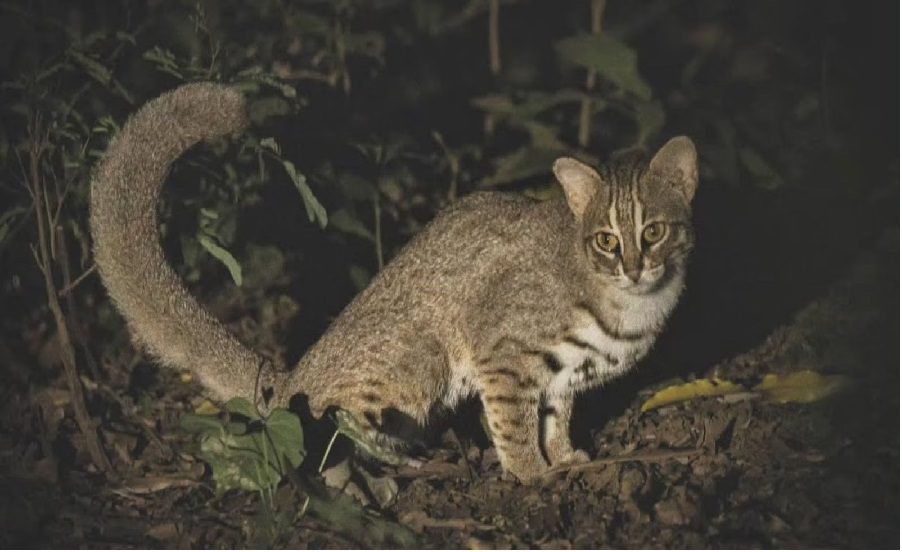
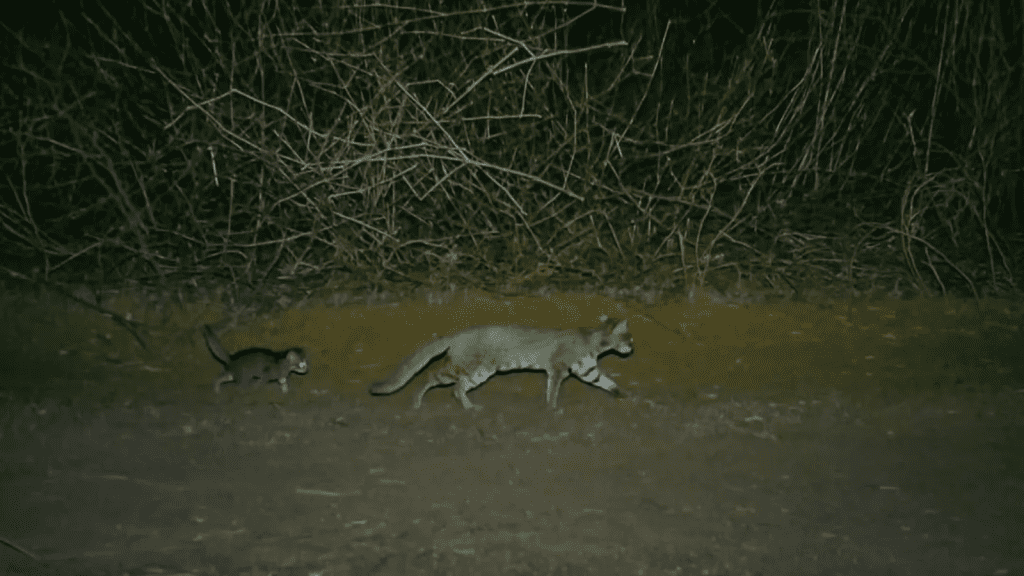
New Delhi: In a major wildlife discovery near Delhi, researchers have captured the first photographic evidence of a rusty-spotted cat breeding in the Aravalli landscape. According to The Indian Express report, the elusive feline – considered one of the world’s smallest wildcat species and listed as “Near Threatened” by the International Union for Conservation of Nature (IUCN) – was photographed alongside its kitten in Haryana’s Faridabad district, confirming the existence of a resident breeding population in the region.
Rare Mother-and-Kitten Sighting in Aravallis
The female rusty-spotted cat and her dependent kitten were photographed in July 2025 in Kot village of Faridabad district during field surveys conducted by researchers associated with the Department of Zoology at Indira Gandhi University, Meerpur.
Although the sighting lasted only 10 to 15 seconds, it provided crucial confirmation that the species is actively reproducing in the Aravalli scrublands on the outskirts of Delhi.
The findings were recently published in the peer-reviewed journal Zoo’s Print by researchers Amit Kumar, Tejveer Mavi, Yatin Verma, Ram Kumar Rawat, and Sohail Madan.
Read also: Cheetahs Score a ‘Half-Century’: Kuno Becomes Global Model for Wildlife Breeding Success
One of the World’s Smallest Wild Cats
The rusty-spotted cat (Prionailurus rubiginosus) is among the smallest wildcat species globally, measuring only about 35–48 cm in length, including its bushy tail.
The species is known for:
- Short reddish-grey fur
- Rust-coloured spots on the back and sides
- Secretive and elusive behaviour
- Low population density
The feline is native to India, Nepal, and Sri Lanka.
Protected but Under Threat
The rusty-spotted cat is classified as “Near Threatened” on the IUCN Red List and receives protection under Schedule I of the Wildlife (Protection) Act in India.
Researchers noted that nearly 75% of the species’ habitat is threatened due to:
- Urban expansion
- Agricultural activity
- Habitat fragmentation
- Land-use changes
Aravallis Emerging as Important Wildlife Habitat
Researchers said the discovery highlights the ecological significance of the Aravalli landscape, which continues to support sensitive wildlife despite increasing urbanisation pressures.
According to researcher Yatin Verma, the sighting is particularly important because it establishes breeding activity for the first time in the region.
“This is the first time anybody has recorded the breeding. It is proof that Aravallis is still home to very sensitive wildlife,” he said.
The study area consists of a scrub-agriculture-settlement mosaic with dry deciduous and thorn scrub vegetation such as Vachellia, Prosopis, and Ziziphus, which provide cover and prey for small carnivores.
Multiple Sightings Suggest Stable Population
Researchers said the species has now been observed across nearly 20–30 locations in the Aravallis, suggesting the possibility of a stable resident population.
According to Verma, three live sightings have been recorded so far:
- Bhondsi, Gurgaon (2023)
- Kot village, Faridabad (2025 mother-and-kitten sighting)
- Tikri area (recent sighting this week)
Before these observations, only a handful of camera-trap records had been documented in Haryana and Delhi-NCR.
Challenging Earlier Assumptions About the Species
The sightings also challenge the traditional belief that rusty-spotted cats avoid human presence completely.
Researchers observed that the animal appeared comfortable in modified landscapes and even near human settlements. During one earlier sighting in 2023, the cat was seen using a False Ashoka tree, a species commonly planted in urban areas.
Verma noted that in some live sightings, the cat remained in the vicinity for several hours while hunting.
Need for Conservation Beyond Protected Forests
The researchers stressed that the findings underline the importance of conserving fragmented green spaces outside officially protected forest zones.
The study noted that viable populations of rusty-spotted cats may survive beyond reserve boundaries, making it necessary to create conservation plans that include both protected and non-protected landscapes.
The Aravallis, often described as a natural barrier against desertification in north India, continue to serve as a critical biodiversity corridor despite mounting developmental pressures.
Preserve Green Spaces
The photographic evidence of a rusty-spotted cat breeding in the Aravallis marks a major milestone for wildlife conservation in the Delhi-NCR region. Beyond confirming the survival of one of the world’s smallest and most elusive wildcats, the discovery also reinforces the urgent need to preserve fragmented urban green spaces that continue to shelter rare and threatened species.
Read also: One-Day-Old Rhino Calf Video Goes Viral, IFS Officer Parveen Kaswan Shares Rare Wildlife Moment