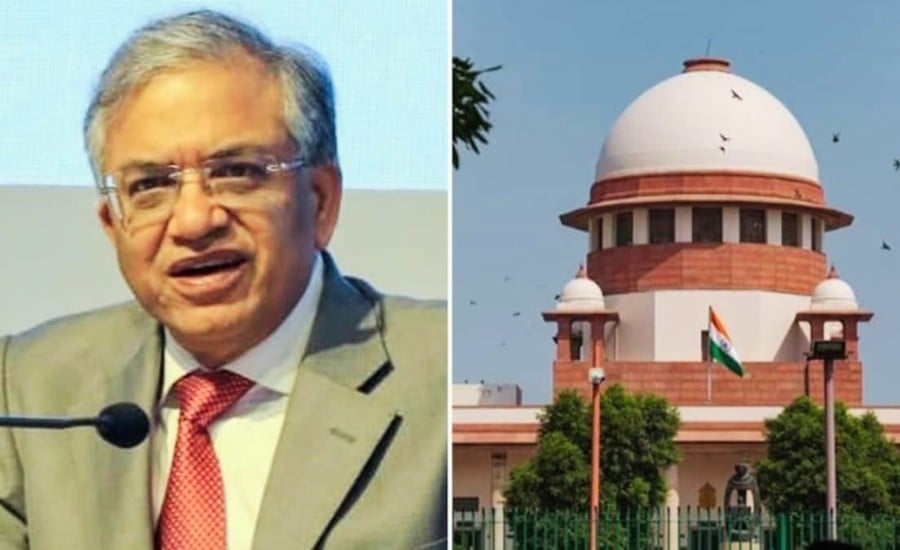
New Delhi: The Supreme Court on Monday clarified that it had not approved any modification to Form 6, the statutory form used for registration of new voters, during the ongoing Special Intensive Revision (SIR) of electoral rolls.
The clarification came while a bench headed by Chief Justice of India Surya Kant, along with Justices Joymalya Bagchi and V. Mohana, was hearing petitions challenging the functioning of Chief Election Commissioner Gyanesh Kumar and decisions taken by the Election Commission in connection with the SIR exercise.
The bench said it wanted to examine the official records to establish who authorised the changes to Form 6.
“When the records are produced, we would like to see who made the changes in Form 6,” the CJI said.
Additional Declaration Added to Form 6
The controversy concerns an additional declaration introduced alongside Form 6 during the SIR process. According to reports cited during the hearing, the declaration asks new voters to provide information concerning their own or their parents’ or grandparents’ presence in earlier electoral rolls.
Read Also: Why The Supreme Court Called India’s Criminal Justice System A ‘Wounded Republic’
The Election Commission has maintained that the additional declaration was an annexure rather than a modification of the statutory Form 6. The issue has also been raised in internal discussions within the poll panel.
During the hearing, senior advocate Menaka Guruswamy, appearing for one of the petitioners, referred to the additional requirements and said a modified Form 6 had been issued.
The CJI responded: “Please note that we have not approved any modified Form 6.”
Court Examines ECI Decision-Making Process
The petitions also question whether certain decisions concerning the SIR were taken by the CEC individually or through the Election Commission as a multi-member body.
The bench said it would examine whether the decisions were taken unanimously or, in the absence of consensus, by majority.
The CJI observed that if there was no consensus, the decision-making process would have to be examined in accordance with the applicable framework. The Court also indicated that if the records show that decisions were taken without the required process, it could consider their legal consequences.
The petitioners have alleged that several decisions and changes relating to the SIR were made without the concurrence of Election Commissioners Sukhbir Singh Sandhu and Vivek Joshi. These remain allegations before the Court. The Election Commission has maintained that its decisions and directions have legal validity and were issued in accordance with the applicable law and procedure.
No Interim Suspension of CEC Gyanesh Kumar
The petitioners had also sought interim action against CEC Gyanesh Kumar, a 1988-batch former IAS officer of the Kerala cadre, including suspension from office.
The Supreme Court did not pass an interim order suspending the CEC and instead sought responses and records before considering the issues raised in the petitions.
During the hearing, the Court also cautioned that it could not pass orders solely on the basis of media reports and would require the relevant official records and responses.
The matter will be considered further after the Election Commission and other respondents place their responses and records before the Court.
Read Also: Why A Supreme Court Plea Against CEC Gyanesh Kumar Is Making Headlines Across India