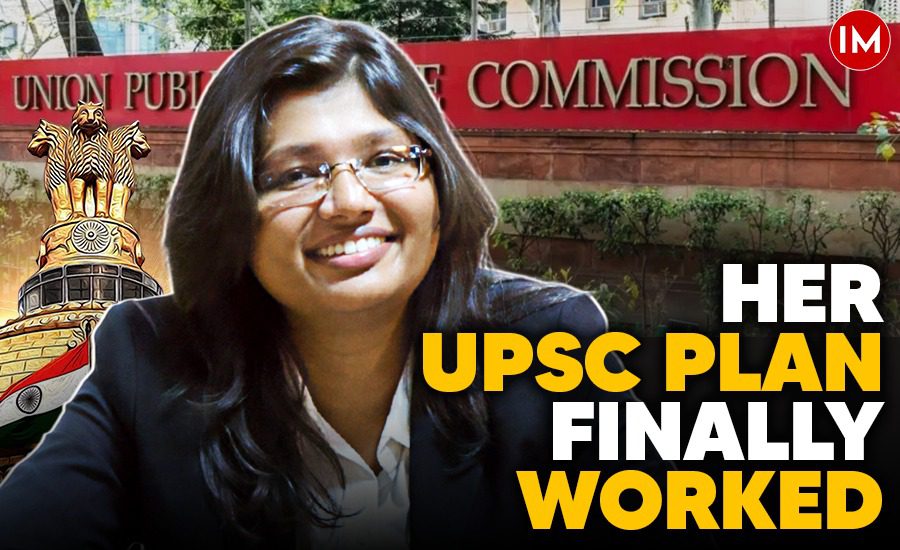
For years, Ritu Goyal was building the kind of career many dream of. A B. Tech graduate in Electrical Engineering from the Indian Institute of Technology, Delhi, she had already secured a place in the fast-moving world of global finance.
Born and raised in Indore, Ritu completed her schooling in her hometown before moving to Delhi for higher education. After graduating in 2017, she stepped into investment banking with Deutsche Bank in Mumbai. Later, she joined International Finance Corporation in Delhi, working on infrastructure investments and Public Private Partnership projects.
On paper, everything looked settled.
But somewhere between financial models and infrastructure deals, a bigger question began taking shape.
WATCHING POLICY SHAPE LIVES
At IFC, Ritu got a close look at how public policy directly influenced infrastructure and people’s lives. That exposure changed her.
“I closely saw how government policies shaped economic and social outcomes. That sparked my interest in governance and public service,” she shared in an exclusive conversation with Indian Masterminds.
It wasn’t just curiosity. It was the realization that her impact could go beyond balance sheets.
“I felt I did not want to remain confined to the finance domain. I wanted to work on diverse development challenges and create impact at scale.”
In August 2021, she made a bold call: she resigned. No backup plan. No guarantee. Just a decision to prepare for one of the toughest exams in the country.
THREE SETBACKS BEFORE THE BREAKTHROUGH
Ritu’s UPSC journey wasn’t a straight line. Her first attempt in 2022 ended at the prelims stage. Having started preparation only months earlier, she couldn’t complete the syllabus in time.
The second attempt in 2023 brought another prelims exit. This time, the lesson was sharper. Revision mattered. A lot.
“I realised preparation is not just about covering material. It’s about being able to recall it when it matters,” she stated.
In 2024, her third attempt finally took her beyond prelims, but mains became the wall she couldn’t cross. That failure hit differently.
She had focused heavily on prelims in earlier attempts and entered mains underprepared. Ethics, Essay, and large parts of her optional subject still needed work. Time was short. Answer-writing speed was weak. She couldn’t complete all the papers.
The result: no final list. And for the first time, she seriously thought of walking away.
THE PHASE OF SELF-DOUBT
Preparing from home in Indore, away from coaching hubs and large peer circles, meant isolation. While she studied, many of her friends were moving ahead in corporate careers: getting promotions, salary hikes, and financial stability.
That contrast was hard to ignore.
After failing mains, she even started interviewing for private-sector roles similar to her earlier work. The idea of returning felt practical and safe.
But after reflection, she decided on one final attempt. That decision changed everything.
THE STRATEGY SHIFT THAT CHANGED HER UPSC JOURNEY
For her final attempt in 2025, Ritu changed one thing that altered everything: she stopped preparing just to clear prelims. She prepared for mains from day one.
Her optional subject, Political Science and International Relations (PSIR), was a calculated choice. Having been away from Electrical Engineering for over four years, she felt PSIR was more practical and had strong overlap with General Studies, especially polity and international relations.
Her preparation remained largely self-driven.
From her home in Indore, she built her foundation through NCERTs and standard books. She made concise notes for repeated revision, used online resources, and consistently read The Hindu for current affairs.
Since PSIR was new to her, she relied on online lectures and coaching notes. But this time, she added something crucial. Tests. Lots of them.
For prelims, she solved mock papers regularly, focusing deeply on understanding solutions. For mains, she enrolled in test series for both General Studies and PSIR, writing multiple full-length papers.
She studied topper copies, improved her answer structure, sharpened presentation, and learned how to enrich answers with examples and quotes.
“The biggest change was answer writing and revision. Instead of collecting more material, I kept revising the same notes again and again,” she told Indian Masterminds.
That became her edge. And in 2025, it worked. She cleared all three stages and secured AIR223.
FINANCE, CITIES, AND POLICY
Her personality test reflected the journey she had lived.
The UPSC board focused heavily on her professional background at IFC and Deutsche Bank. Questions revolved around finance, infrastructure, and policy. They also asked about the cities she knew well, Indore and Mumbai, and the development challenges they face.
There were discussions on recent global events and public policy too.
For someone who had worked at the intersection of money and policy, it was familiar ground.
LOOKING AHEAD
With AIR 223, Ritu is likely to be allotted either IPS or IRS (Customs & Indirect Taxes). For her, the service matters less than the purpose.
“I look forward to serving in whichever role I am assigned and contributing meaningfully to public administration.”
And for aspirants still finding their way, her advice is simple, practical, and shaped by experience:
“Make concise notes. Revise them multiple times. Don’t keep collecting endless resources. Identify your weakest areas and work on them honestly.”
Because sometimes, success doesn’t arrive in the first attempt. Or the second. Or even the third. Sometimes, it comes when you decide to try one last time.
Also read: How IPS Vineet Kapoor’s ‘Srijan’ Is Transforming Slums Into Safer Spaces For Girls And Youth In Madhya Pradesh