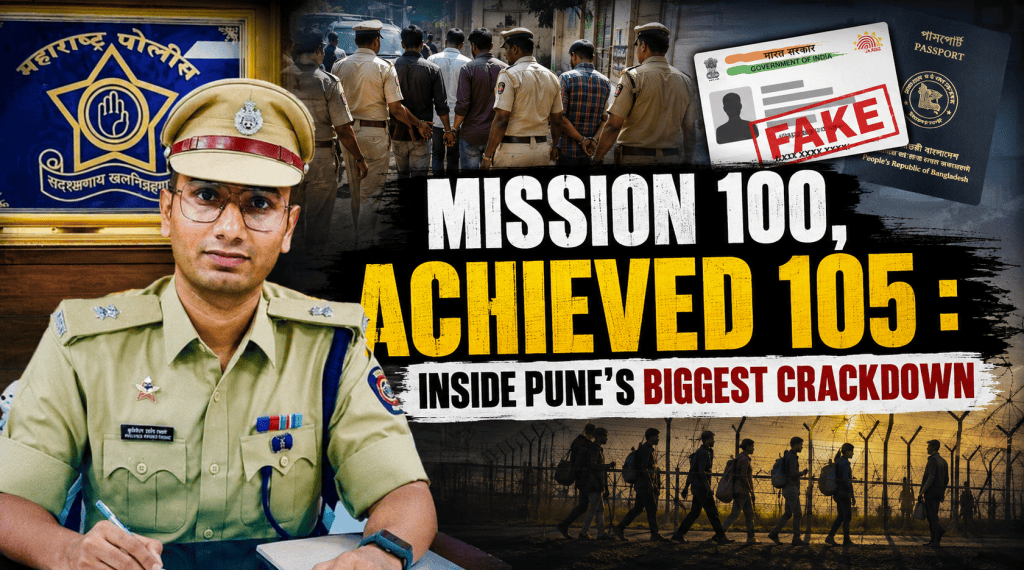
What began as a target of identifying 100 illegal Bangladeshi immigrants in a year turned into one of Pune Police’s biggest crackdowns against illegal immigration, fake identity documents and cross-border money transfers. Behind the operation is 2019-batch IPS officer Krushikesh Rawale, whose strategy shifted from visible policing to intelligence-led action. Even after detaining 105 illegal Bangladeshi nationals in just 11 months, he says the mission is far from over.
For most police officers, a target is simply a number. For Krushikesh Rawale, it became a mission.
When he took charge as Deputy Commissioner of Police (Zone I), Pune, Rawale, an Indian Police Service (IPS) officer of the 2019 batch from the Maharashtra cadre, set himself a goal—to identify and take action against 100 illegal Bangladeshi immigrants within one year.
He achieved it before time.
In just 11 months, Pune Police detained 105 illegal Bangladeshi nationals. Of these, 66 have already been deported, while the remaining are undergoing legal procedures before deportation.
But for Rawale, the numbers tell only part of the story.
The operation uncovered a much larger network involving forged identity documents, organised crime, illegal immigration and digital money transfers across borders.
Speaking to Indian Masterminds, Rawale said the operation continues even today.
“Our target was to identify 100 illegal Bangladeshi immigrants in one year. We crossed that mark by detaining 105 in just 11 months. But the operation is still going on, and we are confident that more illegal immigrants will be identified.”
Also Read – At 22, One of India’s Youngest IPS Officers Is Taking on Gangsters and Human Traffickers in Rajasthan
FROM VISIBLE POLICING TO INTELLIGENCE-LED ACTION
The operation did not begin with dramatic raids.
Initially, police relied on routine patrolling and a strong visible presence in sensitive areas. The results, however, were limited. Rawale realised that the network was too organised to be broken through conventional policing alone. That is when he changed the strategy.
Instead of increasing police deployment, his team focused on gathering intelligence. Informants were developed across localities, especially in areas where illegal immigrants were suspected to be living. Every piece of information was verified before action was taken.
Most raids were conducted at night, after careful planning.
The change in approach proved to be the turning point.
“We realised that heavy police presence alone would not work. So we shifted our focus to intelligence gathering. We cultivated local informants, verified every input and planned our raids accordingly. That completely changed the course of the operation.”
A NETWORK MUCH BIGGER THAN EXPECTED
As the investigation progressed, police discovered that the issue was not limited to illegal immigration.
Many of those detained possessed forged Indian identity documents, including fake Aadhaar cards, PAN cards, voter identity cards and even passports. These documents allowed them to rent houses, pass tenant verification checks and live as Indian citizens.
Police suspect that local agents, landlords and document providers worked together to help illegal immigrants remain undetected. The investigation also exposed another important link.
Many of the accused did not have Indian bank accounts. Instead, they used a mobile application to transfer money back to Bangladesh. Police are now tracing these digital transactions to identify possible hawala links and the larger financial network supporting illegal immigration.
The probe has widened from identifying illegal immigrants to dismantling the entire ecosystem that enables them to stay in India.
NATIONAL SECURITY AT THE CORE
Rawale says the operation gained urgency because of changing geopolitical developments in the region.
According to him, intelligence agencies had issued nationwide directives to identify illegal Bangladeshi immigrants following political developments in Bangladesh over the past two years.
Verification drives across Pune were intensified. For Rawale, illegal immigration is not merely an issue of documentation. It also has implications for national security. He believes every country has a responsibility to identify undocumented foreign nationals and ensure that immigration laws are enforced.
At the same time, he makes an important distinction. Not every illegal immigrant is a hardened criminal.
Some entered India in search of work and a better life. Others became part of organised crime networks involving prostitution, smuggling, human trafficking and document forgery. Each case, he says, has to be investigated individually.
BUILDING A SYSTEM, NOT JUST A CASE
One of the most enduring outcomes of the operation has been the creation of a structured policing model.
Rawale and his team developed a detailed Standard Operating Procedure (SOP) for identifying illegal immigrants, verifying documents and conducting investigations.
Police personnel were trained to recognise forged identity papers, carry out detailed tenant verification and interrogate suspects effectively.
The operation also strengthened coordination with central agencies, including the Foreigners Regional Registration Office (FRRO), Border Security Force (BSF) and the Intelligence Bureau (IB).
Once detained, every foreign national is verified through these agencies before deportation procedures begin.
This coordinated approach has made the operation more systematic and sustainable.
THE MISSION CONTINUES
Despite crossing his initial target, Rawale is not looking at the operation as a completed chapter.
Fresh intelligence continues to arrive. Informants remain active. Investigations into forged document rackets and financial networks are expanding.
The focus has now shifted from merely detaining illegal immigrants to dismantling the infrastructure that supports them—from fake document syndicates to cross-border financial channels.
“We are continuously taking action against them. Their networks are gradually weakening, and fear is being created among those involved. We are confident that we will completely dismantle the network.”
For IPS officer Krushikesh Rawale, the achievement is not the figure of 105 detentions.
It is the transformation of a routine policing exercise into an intelligence-driven operation that exposed an organised network operating beneath the surface of one of Pune’s busiest localities.
The target may have been met.
The mission, however, is still underway.
Also Read- From Illegal Mining Crackdown to Viral Traffic Line: The Story of IPS Officer Anu Beniwal