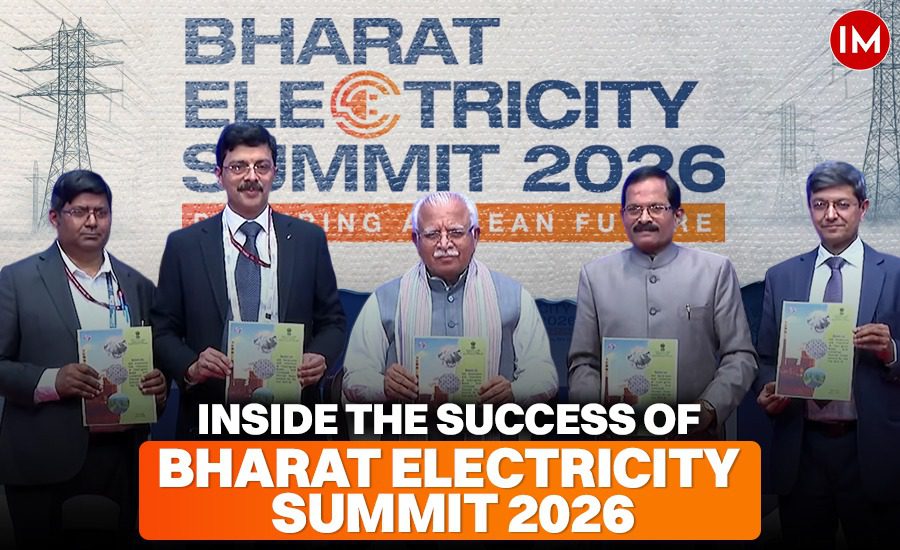
The Bharat Electricity Summit (BES) 2026, held from March 19-22 at Yashobhoomi in New Delhi, concluded on March 22 with resounding success, marking a significant milestone as the maiden edition of this global platform for the power sector.
Organized under the patronage of the Ministry of Power, the summit brought together policymakers, global experts, industry leaders, investors, innovators, and stakeholders to chart a roadmap for a resilient, technology-driven, and future-ready electricity ecosystem. It underscored India’s growing leadership in the global clean energy transition while addressing critical challenges in generation, transmission, distribution, storage, and digital integration.
The event witnessed unprecedented scale and participation. Over Bharat Electricity Summit 2026: A Strategic Leap Towards a Future-Ready Power Sector 35,000 exhibition attendees, delegates from 28 States and Union Territories, more than 200 exhibiting companies (including 80+ startups), 6,000+ delegates, 300+ speakers, and 100+ conference sessions highlighted its global significance. High-level bilateral engagements, business interactions, and strategic deliberations reinforced India’s role as a bridge between domestic ambitions and international cooperation, particularly with the Global South.
India’s Power Sector
India’s power sector has demonstrated remarkable transformation in recent years. Installed capacity has crossed 520 GW, with one of the fastest expansions globally. The transmission network now exceeds 5 lakh circuit kilometres. Renewable energy capacity has surged, with solar power rising from a mere 2.8 GW in 2014 to over 143 GW today. Non-fossil fuel capacity has surpassed 50% of the total installed base—achieving the 2030 target well ahead of schedule—positioning India as a frontrunner in the global energy transition.
Electricity demand is projected to grow by over 30% by 2030, fueled by emerging sectors such as AI-enabled data centres, electric mobility, and industrial expansion. Union Power Minister Shri Manohar Lal Khattar, in his valedictory address, described the summit as “extremely successful” with “impressive participation from different stakeholders.” Linking the sector to national aspirations, he stated: “India has a vision of Viksit Bharat by 2047 and for achieving this vision, electricity is a common resource that is needed by all economic stakeholders and citizens.” Hehighlighted the success of the Saubhagya Yojana in ensuring electricity reaches every corner of the country and emphasised sustainability through renewable expansion, invoking Prime Minister Narendra Modi’s vision: “One Sun, One World, One Grid” as a call for global cooperation “as one global family.”
Key Insights
Minister of State for Power and MNRE, Shri Shripad Naik, captured the essence of the deliberations: “India’s power sector is not merely expanding — it is advancing through a deeply coordinated federal architecture, where national vision and state-led execution are seamlessly aligned.” He outlined three pivotal insights: states as engines of innovation in renewable expansion and policy; tangible momentum in distribution reforms for reliable last-mile delivery; and an integrated, system- driven transition encompassing renewables, storage, transmission, and digital technologies.
Power Secretary Shri Pankaj Agarwal spotlighted industry momentum, noting discussions indicating an estimated ₹32,000 crore capex pipeline by manufacturers in the power sector. He stressed the need for “system- level evaluation of power costs to ensure affordability” and urged rapid scaling of energy storage for effective renewable integration.
Bharat Electricity Summit 2026 showcased India’s energy leadership, driving innovation, global collaboration, and a bold roadmap for a resilient power future
Strategic Takeaways
A high-level Ministerial meeting with States/UTs, chaired by the Union Minister, identified key priorities: strengthening DISCOM financial viability through structural and operational reforms; ensuring cost-reflective tariffs with targeted subsidies; accelerating nationwide smart metering; securing generation capacity tie- ups for future demand; and fast- tracking nuclear power for long- term energy security.
Strategic sessions delved into critical themes, including Centre- State coordination for faster project execution, green hydrogen as a global industrial fuel hub, AI-driven power systems for grid intelligence and cybersecurity, scaling nuclear baseload capacity, efficient power markets, financing frameworks to mobilise trillions, energy storage (with requirements expected to rise 5x by 2031-32), and “Make in India for the World” to bolster domestic manufacturing for global clean energy supply chains.
Infrastructure needs are substantial: over 1.37 lakh circuit km of new transmission lines by 2030 (investments around ₹9 lakh crore), significant pumped storage potential exceeding 200 GW, and growing adoption of Battery Energy Storage Systems (BESS) for peak management. The launch of the Indian Carbon Market Portal signals progress in climate finance, with trading set to begin soon.
Business Outcomes
States showcased ambitious plans: Gujarat targeting 190 GW renewable capacity by 2047; Andhra Pradesh developing an integrated clean energy hub with over ₹6 lakh crore investments; Maharashtra projecting demand of 280 TWh by 2030; Bihar advancing storage and grid infrastructure; and Delhi moving towards a high-renewable urban system.
Global engagements were a highlight, with bilateral meetings involving countries such as Malawi, Tajikistan, Mauritius, Kyrgyzstan, and Russia, alongside entities like Africa50. Focus areas included cross- border electricity trade, renewable collaboration, transmission development, and technology transfer. The India-Africa Strategic Meet emphasised partnerships in renewables, grid modernisation, and last-mile connectivity.
Business outcomes were tangible: over 1,200 buyer-seller meetings generated enquiries exceeding ₹517 crore (approximately USD 55 million).
Three key reports were released: “Rating Regulatory Performance of States and Union Territories 2025” by Power Foundation of India; “Ash Generation and Utilisation at coal/lignite-based Grid Connected thermal power stations for 2024-25” by Central Electricity Authority; and “Establishing a Sodium-ion Battery Ecosystem in India” by Council on Energy, Environment and Water.
Looking Ahead
The next edition of the Bharat Electricity Summit is scheduled for 2028 in Gandhinagar, Gujarat, building on this strong foundation.
The summit represented an important first step, with the focus now shifting to implementation. The outcomes will shape policy, deepen partnerships, and accelerate India’s transition towards a reliable, affordable, clean, and resilient power sector that supports Viksit Bharat @2047 while contributing to global energy security and sustainability, particularly for the Global South.