How does one tell a good story? The first requirement is to listen well.
“Once upon a time there was a boy named Kato. He was born a mute and ran from all his fears…” Kato loved hearing stories from his mother about Alhou the Creator who made Man and the Spirit which would protect Man. Then Kato’s little village life was turned upside down when he was visited by that Spirit in the form of gentle forest giant Kene, who took him on adventures to tall trees and wide rivers under the silver full moon and said that he should become a storyteller.
Once, Kato’s grandmother had given him an ebony-black shawl with a single crimson line running through it which represented his will, his anguagha: “It is the quality that makes your spirit strong or weak,” she explained. The rest of the shawl’s midnight black expanse represented Kato’s lot in life. ‘“Good, bad, happy, sad… we very rarely get to choose.” It is our will, as our anguagha, that takes us through the valleys and crests of existence. Kato’s anguagha has to be made as strong as that crimson line to cut through the darkness of all else that cannot be controlled.
Once, Kato asked Kene about the story of the muza muza spirits who are whispered to be abductors. Kene told him that there were different pathways in different realms, not always visible to humans, which were also like the threads of a shawl. “There were so many threads that went into a single shawl,” thought Kato. “They met, wove around, went under and over, yet through some strange magic they didn’t end up as an unrecognizable mess. Somehow, in a way that only the weaver could know, when his mother pleated the last loose bunch of threads, what emerged was a beautiful shawl.”
Always, to be thirteen years old is to be confronted with that sticky impetuousness which afflicts even older and ostensibly wiser adults: hot flashes of anger clouding rational thought, justified provocation teetering against stubborn self-preservation, creeping doubt about not being good enough to deserve the richest treasures of life. Kato is a heroic boy who wants to become a storyteller—but heroes have to befriend many dragons in tests of bravery and faith before they can lay claim to their destiny.
Always, it is true friendship which illuminates lonely paths. Between Kato and his childhood friend Apu – the brave without a voice and the brave whose voice is borrowed – there is a language of understanding which requires no words. Apu is a hero too; indeed everyone in the village is heroic (or at least not vicious in their cruelty). Those who enter later with corrupt intentions are perhaps also flawed heroes—but they may never become storytellers because they are blind to truth. And only true stories, told by the truthful, can go deep into the land to bring out life.
Always, a good story entails memory of one’s roots, and realization of how they intertwine with the roots of all other beings in depths we cannot fathom. For centuries after the creation of the universe, the Old Ones were its first storytellers. Kene heard the ocean in the rushing sound of a conch shell and wished to find it, and the pulse of his sister tree Lakhe beats in tune with the primordial heart of the earth. There are spirits, and lyrical humans who are attuned to their cosmic harmonies, like the tu-umi witch Ghonili. For Kato to discover his own voice, anchored by these ancient beings and his worldly family, is the classic baseline of Huthuka Sumi’s unforgettably vivid debut offering.
Our human worlds are inextricably linked with the mystical universe in rhythms which would be more discernible were we to inhabit bodies which were better connected to souls. It is the slender, fertile symbolic windows between the ‘real’ and ‘imaginary’ which are evoked in Giants by building a world into which the reader slips easily and finds themselves lingering even as the fantastic beauty of the mountains is heightened and shattered by the mechanical carnage of war. Pieces left behind will have to be made sense of, gathered and brought together in acts of foundational resolutions and towering bravery. The final requirement of a good story is transformation.
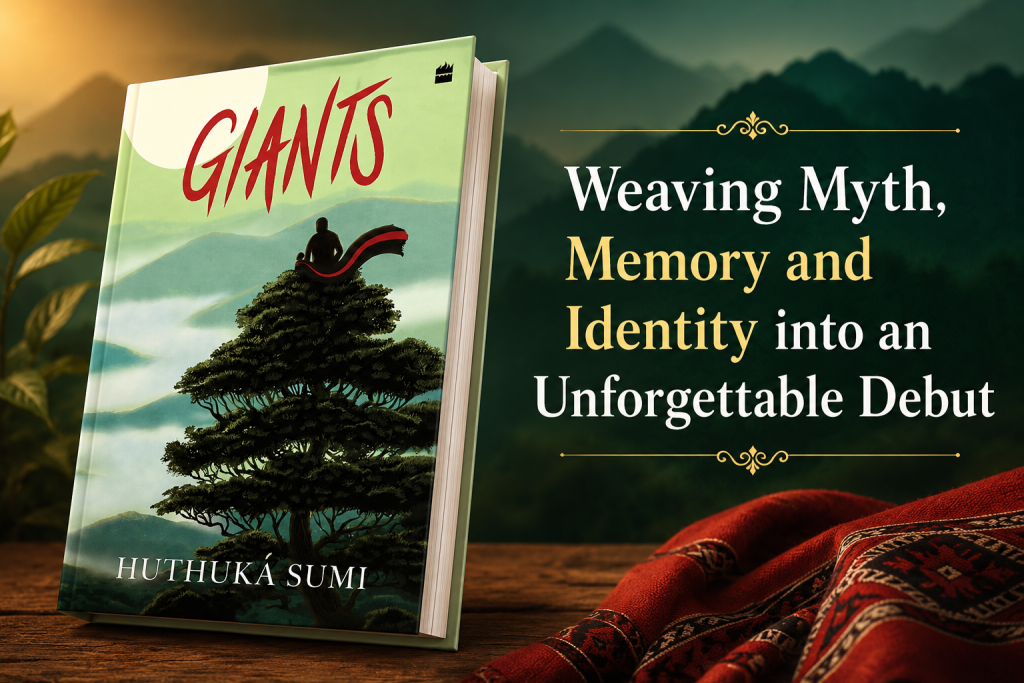
Every good story – and indeed all great art – is collaborative. Canato Jimo’s thoughtful cover illustration and book design elevate the book beautifully, and we must also take note of the late Mr. K Ghulakha P. Swu of Lazami village whom the author credits for his knowledge of Sumi Naga mythology, along with the late Reverend Aheto Sema. Giants is a labour of love, and the effort that has gone into its profound simplicity shines through every page. Sumis believe that a people without stories disappear—but this tale of Kato and Kene has deep roots, and is as alive as its rivers and mountains.
How does one convey truth?
“A storyteller is not just anyone. No, a storyteller was a truth teller — a courageous, truthful keeper of the land…” Listening to silence, seeing with clear vision and speaking with empathetic honesty are virtues of those who communicate in ways which resonate enough for us to occasionally glimpse truths slanting through their eternal patterns. In lightning moments of ecstasy, they bridge our illusions of difference, towards transcendence, so that we can ask forgiveness before returning to the start anew… before, again, that endless weaving of stories into spirals of crimson anguagha flickering within the vast space of destiny.
Also Read – How Trust, Teamwork and Persistence Helped Two Friends Crack UPSC IFS 2025