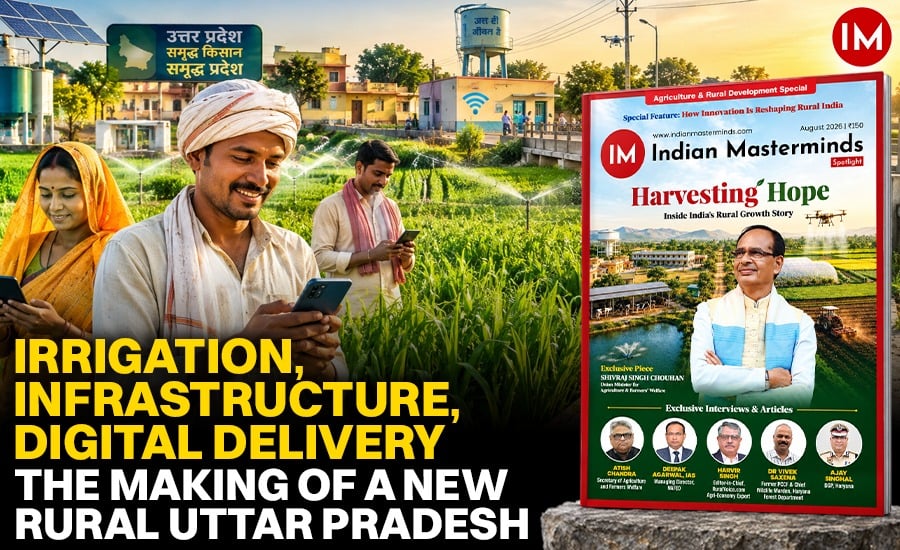
Drive through the rural stretches of Uttar Pradesh today, and the shift in atmosphere is tangible. For generations, the state’s agricultural story was defined by a frustrating paradox: incredible natural advantages; deep Gangetic soil, abundant rivers, and a vast labor force stymied by chronic policy inertia. Projects sat unfinished for decades, sugarcane farmers waited years for payouts, and millions of families managed barely above subsistence.
Over the last nine years, however, a fundamental pivot has taken place across Uttar Pradesh’s rural landscape.
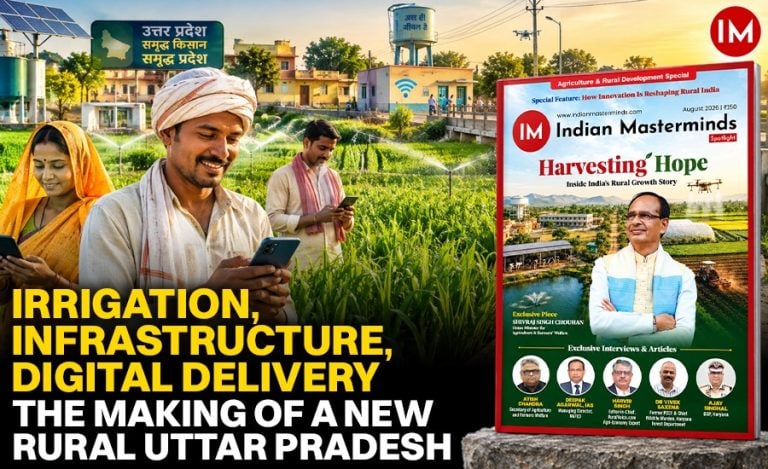
Under the Yogi Adityanath administration, policy execution moved from piecemeal welfare to systemic economic engineering. What was once seen as an underperforming rural belt has systematically repositioned itself as the principal driver of India’s agricultural output and food security. This movement didn’t happen by chance; it was driven by heavy capital investment in long-overdue infrastructure, direct digital governance, and a clear strategy to link small-scale farmers directly to macro-level supply chains.
Economy on Rural Foundation
At the core of this transformation lies a practical realization: Uttar Pradesh cannot reach its broader economic ambitions without a thriving rural foundation. When the government took office in 2017, it started with immediate financial relief Rs 36,000 crore farm loan waiver designed to pull small and marginal landholders back from the brink. But debt relief was only the baseline. Today, UP leads the country in total foodgrain production, cultivating more than 21.38 million hectares and contributing over 20% to India’s national food basket. From wheat and paddy to potatoes and dairy, the state has consolidated its position as the country’s primary agrarian anchor.
Nowhere is this shift clearer than in the sugarcane belt. Historically, cane farming in UP was defined by endless paperwork, opaque middleman networks, and years of delayed mill payments. The state tackled this by rolling out the “Smart Sugarcane Farmer” digital platform. By introducing transparent online ticketing, digital harvesting calendars, and direct-to-bank clearances, the system eliminated major administrative bottlenecks. To date, over Rs 3.22 lakh crore has been transferred directly into the bank accounts of sugarcane growers, a payout figure that exceeds the combined records of several previous administrations. With state-advised cane prices raised to Rs 400 per quintal for early varieties and 121 modern sugar mills operational, around 48 lakh families have found long-sought financial stability. At the same time, sugar mills were repurposed as modern bio-energy centers, turning UP into India’s top ethanol producer at 188 crore liters annually.
Water Management
Water management has provided another critical foundation for this revival. For over forty years, several massive irrigation proposals existed primarily on paper, leaving large swathes of Purvanchal and Bundelkhand entirely reliant on fickle monsoon cycles. The administration focused heavily on clearing these decades-old backlog projects. The most notable milestone was the completion of the long-delayed Saryu Nahar National Project in Balrampur. Conceived back in 1978, the project was fast-tracked and completed at a cost of Rs 9,802 crore. Featuring a 6,623-kilometer canal network that links five major rivers: the Ghaghara, Saryu, Rapti, Banganga, and Rohini. It unlocked irrigation potential across 14.04 lakh hectares in nine eastern districts, directly benefiting nearly 30 lakh farming households. Combined with the Arjun Sahayak Project, the Madhya Ganga Canal Phase-2, and thousands of solar pump installations under PM-KUSUM, the state has meaningfully reduced rainfall dependency for its growers.
Direct social protection and digital accountability have similarly redefined rural administration. Under the Pradhan Mantri Kisan Samman Nidhi (PM-KISAN) program, Uttar Pradesh is the national leader in implementation, having disbursed over Rs 38,000 crore directly into the accounts of more than 2.58 crore registered farmers. By routing funds through direct bank transfers linked with verified records, the system guarantees that crucial working capital reaches smallholders right when seed and fertilizer purchasing cycles begin.
Improved Living Conditions
Yet, raw agricultural yield is only half of the broader rural equation. True economic stability requires functional living conditions and modern physical infrastructure. Over the past nine years, basic living standards across rural UP have seen significant upgrades. Under the Pradhan Mantri Awas Yojana (Gramin), the state achieved a completion rate above 98.7%, constructing over 36.37 lakh pucca homes for lower-income rural households, with an additional 6.18 lakh homes sanctioned to cover remaining gaps. These units are paired with basic sanitation via the Swachh Bharat Mission, piped water connections through the Jal Jeevan Mission, and power grid access via the Saubhagya scheme, which brought electricity to over 1.5 crore previously off-grid households.
To ensure this growing productivity translates into market value, physical logistics have been upgraded simultaneously. Expanded rural feeder roads under PMGSY, combined with major arterial highways; including the Purvanchal, Bundelkhand, and Ganga Expressways have dramatically cut transit times. Fresh produce that previously suffered heavy post-harvest losses due to poor logistics can now move efficiently to major commercial hubs like Lucknow, Delhi, and Varanasi. Complementing this mobility is the One District One Product (ODOP) initiative alongside targeted agro-processing incentives. By providing funding, modern tools, and market visibility for localized rural crafts and food processing clusters, the state is steadily building off-farm economic opportunities right within rural districts.
Taken together, from historic crop yields and streamlined sugarcane payouts to multi-river irrigation systems, modern rural housing, and high-speed transit networks; the landscape of rural Uttar Pradesh reflects a clear administrative shift. It demonstrates that when targeted capital allocation, digital delivery systems, and focused policy execution align, the rural heartland doesn’t just subsist, it becomes the steady engine driving an entire state’s economic trajectory forward.