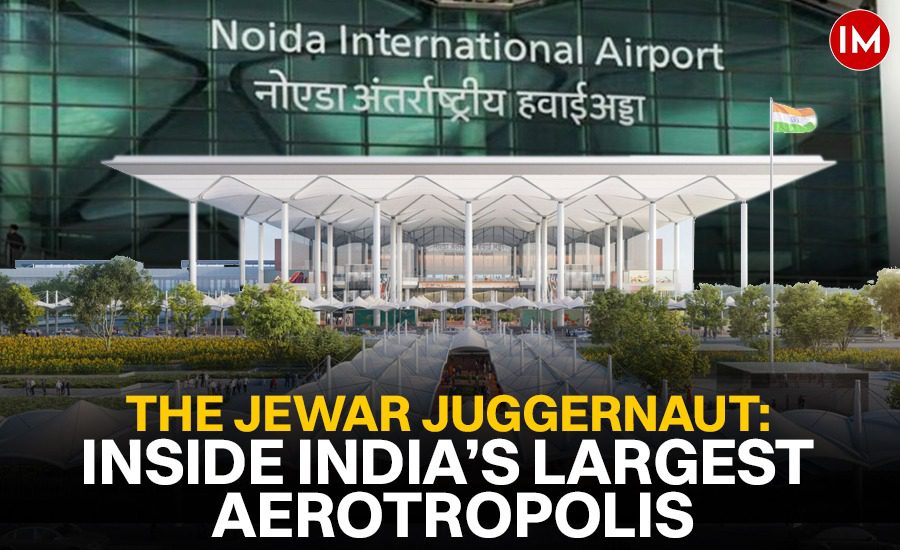
The global economic map is currently being redrawn, and its new coordinates point directly to a once-quiet corner of Western Uttar Pradesh. Inauguration of the Noida International Airport (NIA) at Jewar has officially transitioned from a blueprint of ambition to a structural engine of growth. Over the last decade, Uttar Pradesh has shed its “landlocked” identity to become the “Expressway Capital of India,” but Jewar is the crowning achievement. It is not merely an airport; it is a multi-modal economic nerve center an “Aerotropolis” that is fundamentally altering the state’s global image, landscape, and fiscal DNA.
Beyond the Runway
Developed in partnership with Zurich Airport International AG, the NIA is a masterclass in modern urban planning. With Delhi’s Indira Gandhi International Airport hitting its saturation point of 110 million passengers, Jewar was conceived not as a secondary overflow facility, but as a primary global gateway.
Economic modelling confirms that this airport-led ecosystem will contribute a staggering 2% to 3% of the regional GDP within its first five years of operation. Phase 1, a ₹11,200 crore powerhouse, already targeted 12 million passengers annually, with a roadmap to scale to 70 million by 2036. This isn’t just about travel; it’s about livelihoods.
The project has already catalysed 50,000 direct jobs in aviation and high-tech Maintenance, Repair, and Overhaul (MRO) services. These MRO facilities are particularly critical; previously, Indian airlines spent billions of dollars sending aircraft to Singapore or the Middle East for servicing.
The Logistics Revolution
Perhaps the most significant victory of the Jewar International Airport is the Logistics Revolution. Exporting bulky or time-sensitive goods required a long, expensive overland journey to ports in Gujarat or Maharashtra. Jewar has effectively solved this by becoming a “dry port in the sky.” With an initial cargo capacity of 2.5 lakh metric tonnes scaling eventually to 20 lakh metric tonnes (with a ultimate potential of 80 lakh), the airport is a gateway for the world. The strategic brilliance lies in its integration. By linking directly with the Eastern Dedicated Freight Corridor (EDFC) at Dadri, Jewar allows goods from factory floors across UP to reach global markets with a 15% to 20% reduction in logistics costs.
Global Image Revamp
This logistical edge has fundamentally shifted UP’s global image from a traditional agrarian heartland to a Benchmark for industrial investment. The Yamuna Expressway Industrial Development Authority (YEIDA) has transformed 5,100 hectares into a high-tech corridor that has caught the eye of the “Fortune 500.”
The most glittering jewel in this industrial crown is the Semiconductor Hub. Attracted by the airport’s proximity and the state’s aggressive “Electronics Manufacturing Policy,” the HCL-Foxconn joint venture established a ₹3,706 crore semiconductor plant in Sector 28.
The International Film City: Spread over 1,000 acres, this project is designed to rival Mumbai’s Bollywood, providing a 360-degree ecosystem for content creation, post-production, and VFX.
Medical Device Park: A dedicated cluster for the manufacturing of high-end medical equipment, reducing India’s import dependency. Apparel and Toy Parks: Utilizing the cargo capacity of Jewar to feed global retail chains.
Jewar International airport has enhanced India’s standing in sustainable development. As the nation’s first net-zero emission airport, it blends “Ghat-inspired” architectural aesthetics with carbon-neutral operations. The use of solar power, rainwater harvesting, and a “circular economy” approach to waste makes it a global case study in green infrastructure.
A Real Estate Gold Rush
This industrial surge has triggered a landscape transformation and a real estate gold rush that the region has never seen. The skyline along the 165-km Yamuna Expressway is no longer dominated by silos, but by cranes and glass-fronted corporate offices.
The data is nothing short of staggering. Between 2020 and 2026, residential plot prices in the YEIDA sectors surged by 536%. Apartment values, once stagnant, rose by 158% as the speculative phase of investment gave way to “occupancy-driven” demand. What was once open farmland is now a “Grade-A” urban sprawl.
This development is governed by a Smart City framework. Unlike the organic growth of older NCR hubs, the Jewar-Yamuna region is being built with a plug-and-play infrastructure model. Wide boulevards, dedicated cycling tracks, underground utility ducts, and vast green belts ensure that the quality of life matches the economic opportunity.
Connectivity Redefined
The airport is the first in India to be connected by such a diverse array of transit options like The Pod Taxi System, Rapid Rail (RRTS) & Metro which would ensures that a passenger can travel from the heart of Delhi to the Jewar boarding gate in just 21 minutes besides Road Network including a 31.42 km greenfield link now connects the airport directly to the Delhi-Mumbai Expressway at Ballabhgarh.
Powering the State Treasury
For the state government, Jewar is the “golden goose” of non-tax revenue. Through land premiums, stamp duties, and a revenue-sharing model with the Zurich Airport group, the state’s coffers are seeing an unprecedented influx of capital. This revenue is being re-invested into the Purvanchal and Bundelkhand regions, ensuring that the prosperity generated in the west fuels the development of the east.
As the first commercial flights ascend from the runways of Jewar this year, they carry more than just passengers and cargo; they carry the aspirations of 240 million people. The New UP is no longer a political slogan or a distant dream, it is a tangible, data-backed reality. The Jewar Airport has started its engine, and the subcontinental giant has finally found its wings.