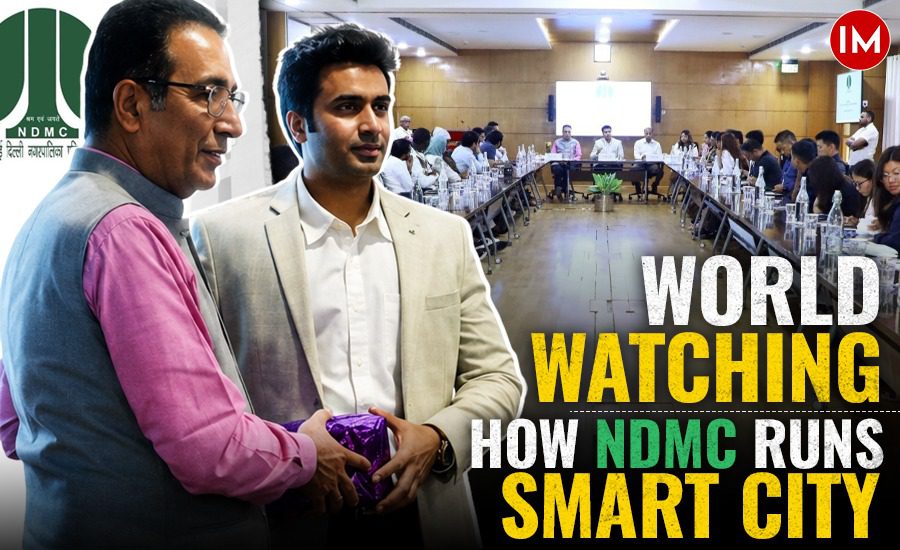
NDMC’s smart governance model is drawing global attention, with delegations from six countries studying its urban management practices. A 40-member team visited New Delhi to explore its technology-driven and sustainable civic systems. The interaction was led by NDMC Secretary Rahul Singh, who highlighted best practices of urban governance to the visiting officers.
Rahul Singh (2013 batch IAS officer) in exclusive conversation with Indian Masterminds said, countries are keen to learn from India’s urban governance, with the Anupam Colony Project emerging as a key attraction for its strong ground-level execution.
Six nations turn to NDMC model for urban governance lessons
NDMC’s smart governance framework is attracting increasing international attention, with delegations from countries like Bhutan, Sri Lanka, Tajikistan, Nigeria, and Niger studying its urban management systems. A 40-member delegation of senior civil servants recently visited New Delhi to understand the Council’s technology-driven and sustainability-focused civic operations.
The visit, organised in collaboration with the National Centre for Good Governance (NCGG), focused on ‘Best Practices in Civic Governance,’ where NDMC showcased its integrated urban administration model combining digital systems, field execution, and structured governance protocols.
In an interaction with Indian Masterminds, Secy. Rahul Singh noted that the engagement as a shift in global learning trends, stating that countries are increasingly seeking best practices in urban governance from India, particularly those that are scalable and adaptable to local conditions.
Integrated urban governance anchored in technology
NDMC’s governance is built around the Integrated Command and Control Centre (ICCC), which enables real-time monitoring of civic operations across the city. This system has significantly enhanced responsiveness, coordination, and efficiency in municipal functioning.
The Council’s push toward e-governance and m-governance has further transformed citizen services. With more than 49 services available online and the NDMC 311 mobile application facilitating grievance redressal and service tracking, the system has strengthened transparency and accountability in service delivery.
The Secretary also highlighted NDMC’s structured financial management framework, which ensures fiscal discipline while supporting sustained investments in urban infrastructure and innovation.
‘Anupam Colony Project’ emerges as key international attraction
Among the various initiatives presented, the Anupam Colony Project drew significant attention from visiting delegates. The locality-level solid waste management model demonstrates how decentralised planning and strong field execution can deliver measurable improvements in urban cleanliness and efficiency.
Rahul Singh described it as the most closely observed initiative during the visit, stating, ‘Anupam Colonies is the centre of attraction.’ He further emphasised that its strength lies in its practical design and execution on the ground, making it highly suitable for replication across different urban contexts.
He added that the initiative is ‘ground-rooted and well implemented,’ underscoring its potential as a transferable model for cities facing similar challenges.
Technology-driven waste management and accountability systems
Smart Waste Management and Real-Time Monitoring NDMC’s waste management system has drawn significant global attention for its integration of technology with field operations. The NDMC Secy. highlighted how the Council has deployed a comprehensive urban governance model for garbage management, backed by real-time monitoring systems.
‘We have deployed Integrated Command and Control Centres and continuous tracking of garbage collector trucks through GPS technology,’ he explained. The system goes beyond basic collection, incorporating route mapping, accountability mechanisms, and workforce monitoring. ‘Roads are marked, about 500 metres, where bins are placed systematically. Daily biometric attendance of garbage collectors is taken so that operations can be effectively monitored,’ he added. This level of precision and accountability ensures efficiency, transparency, and consistency in service delivery, making it a strong candidate for replication in other urban contexts.
Cleanliness, sustainability and urban environment management
NDMC’s sanitation and environmental initiatives form a core component of its governance model. Mechanised sanitation systems, including the deployment of “Gobbler” machines, have improved efficiency in waste collection and street cleaning operations.
Night-time Mechanised Road Sweeping (MRS) operations have further contributed to reducing dust pollution and improving air quality across key urban corridors.
The Council’s environmental strategy includes source-level waste segregation, the Reduce-Reuse-Recycle (RRR) framework, scientific e-waste disposal systems, and air pollution control measures such as mist sprayers. These initiatives collectively aim to enhance urban liveability while maintaining ecological balance.
SOP-driven governance and cross-sector interest
Another key factor behind NDMC’s success is its emphasis on clearly defined Standard Operating Procedures (SOPs). Secy. Rahul Singh stressed that structured processes ensure consistency and scalability across all initiatives. “We have very clearly defined SOPs for all the initiatives,” he said, highlighting how this institutional clarity strengthens implementation and facilitates replication.
While solid waste management remained the primary focus for visiting officials, their interest extended to a wide range of urban systems. He noted that delegates were keen to understand NDMC’s work in road management, footpath development, metro infrastructure integration, water treatment, subway design, and innovative drainage solutions that do not disturb existing systems.
Inter-departmental coordination strengthening governance
NDMC’s integrated approach is further reinforced through coordinated functioning across departments, including Finance, Civil, Health, Horticulture, and Training. Officials presented ongoing innovations in sanitation management, green cover expansion, and pollution control strategies.
Health Officer Dr. Shakuntala Srivastava while interacting with the delegation, highlighted initiatives related to vector control, scientific waste disposal, and broader environmental health measures, reflecting NDMC’s emphasis on preventive public health systems.
This multi-departmental coordination has enabled NDMC to function as a unified governance ecosystem rather than a collection of isolated administrative units.
Delegates Applaud NDMC’s Governance Framework
The visiting delegation engaged in detailed discussions with NDMC officials, exploring how these initiatives could be adapted in their respective countries. They appreciated the Council’s ability to deliver high-quality civic services through technology-driven governance, while maintaining a strong focus on sustainability and citizen welfare.
The delegation also noted that NDMC’s model is particularly suited for developing nations dealing with rapid urbanisation and limited financial resources. Its emphasis on affordability, adaptability, and practical execution sets it apart from capital-intensive global models.
By combining smart infrastructure with efficient administrative systems, NDMC offers a blueprint that can be customised across diverse socio-economic contexts, making it an attractive option for countries seeking sustainable urban transformation.
India’s expanding soft power in urban governance
The international interest in NDMC’s initiatives signals India’s emergence as a knowledge partner in sustainable urbanisation. By exporting governance models rather than just infrastructure, India is reshaping global urban development narratives, especially among Global South nations. Such collaborations not only strengthen diplomatic ties but also position India as a leader in practical, scalable, and inclusive city management solutions. These partnerships could eventually lead to the institutionalisation of NDMC’s practices as globally adaptable governance frameworks.
With strong leadership, structured processes, and proven execution on the ground, NDMC’s model is no longer just a local success story, it is fast becoming a global benchmark for smart, sustainable, and citizen-centric urban governance.
Also Read – From Barracks to Books: How Rajnandgaon Police Is Building Futures Through ‘Pahal’