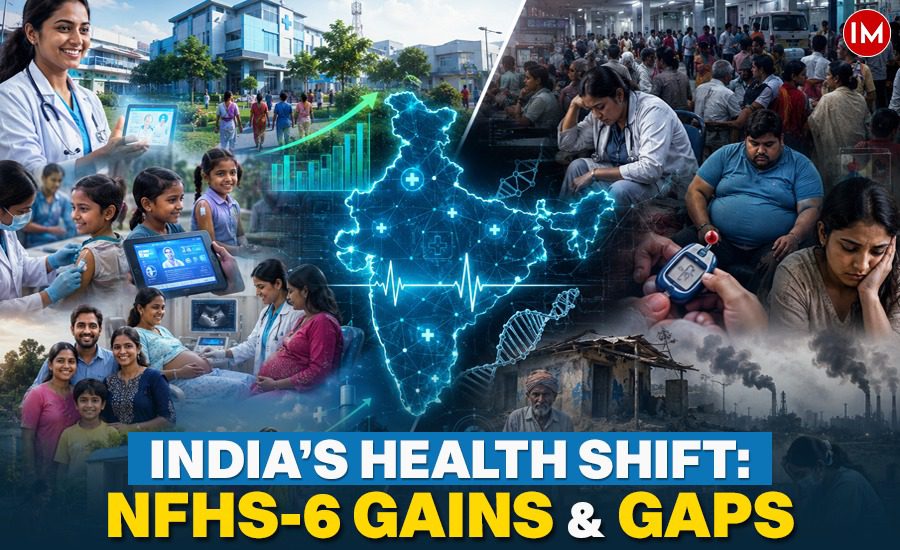
India’s development trajectory in health and human capital has entered a decisive phase, the latest findings from the National Family Health Survey (NFHS-6) show a country that has made substantial progress in expanding healthcare access, improving maternal and child indicators, and strengthening social welfare delivery, yet continues to struggle with inequalities, behavioural gaps, and a rising burden of lifestyle diseases.
Conducted in 2023-24 across nearly 6.79 lakh households in 715 districts by the Ministry of Health and Family Welfare in collaboration with the International Institute for Population Sciences (IIPS), the survey provides one of the most comprehensive datasets on population, health, and nutrition, enabling district-level policy planning while also exposing the complexities of India’s ongoing health transition.
Maternal and Child Healthcare: Expansion of Services with Measurable Gains
NFHS-6 highlights strengthening of maternal and child healthcare services, exhibiting sustained policy focus and improved service delivery systems across the country. Antenatal care coverage has reached near universal levels, with 95.9% of pregnant women receiving ANC, while early registration during the first trimester improved from 70.0% to 76.2%, indicating better awareness and early engagement with health systems.
The proportion of mothers receiving at least four ANC visits increased from 58.5% to 65.2%, demonstrating improved continuity of care, which is critical for reducing maternal and neonatal risks. Institutional deliveries rose from 88.6% to 90.6%, bringing India closer to universal institutional childbirth, while births attended by skilled personnel increased from 89.4% to 91.3%, ensuring safer delivery outcomes. Postnatal care within two days of delivery also improved significantly from 79.1% to 85.3%, hence better monitoring of newborn health during the most vulnerable period.
However, while access indicators show strong progress, concerns remain about regional disparities in quality of care and the need to ensure that improved coverage results into consistently better maternal and neonatal outcomes. Discussing on this transition, 2014 batch IAS officer Dr. M. S. Lakshmi Priya, former State Mission Director, National Health Mission, notes that India is indeed moving from access expansion to outcome challenges, but ‘States are at different stages and speeds in this transition, depending on their capacity to adopt and implement new initiatives,’ highlighting the uneven nature of progress across a country of 140 crore people. She also counters concerns about over-reliance on incentive-based schemes, emphasising that ‘both demand and supply sides have been strengthened simultaneously,’ suggesting that improvements are not merely scheme-driven but supported by systemic expansion.
Nutrition and Supplementation: Progress with Persistent Challenges
Maternal nutrition indicators under NFHS-6 show encouraging improvement, yet also showcase the depth of nutritional challenges that persist. The proportion of mothers consuming iron-folic acid supplements for 100 days or more during pregnancy rose from 44.1% to 54.9%, while those consuming supplements for 180 days or more increased from 26.0% to 37.8%, indicating better adherence and programme outreach. These gains are significant in addressing anaemia and improving birth outcomes, especially in vulnerable populations.
However, the fact that nearly half of pregnant women still do not complete the recommended supplementation cycle highlights persistent gaps in behavioural compliance, supply chain consistency, and counselling effectiveness. While programmes have successfully expanded coverage, the challenge now lies in ensuring sustained adherence and supplementation into measurable health improvements. Moreover, underlying determinants such as dietary diversity, socio-economic conditions, and women’s autonomy continue to influence nutritional outcomes, suggesting that supplementation alone cannot resolve the broader nutrition deficit without integrated, multi-sectoral interventions.
Addressing this gap, Dr. M.S. Lakshmi Priya points out that while some resistance among women persists, ‘with growing awareness and understanding of benefits, these tendencies are gradually changing.’ She highlights the importance of community-driven approaches, suggesting models like the “buddy mother” initiative to improve participation and adherence, indicating that behavioural change must complement system efficiency.
Family Planning: Stabilising Fertility with Expanding Contraceptive Access
India’s demographic transition continues to consolidate, with the Total Fertility Rate remaining stable at 2.0, indicating that the country has reached below replacement-level fertility of 2.1. The Contraceptive Prevalence Rate has increased from 66.7% to 69.1%, reflecting improved access to family planning services and greater acceptance among couples. These gains are indicative of the sustained impact of initiatives such as Mission Parivar Vikas and broader reproductive health programmes.
However, while aggregate numbers suggest progress, concerns remain, particularly regarding method mix and gender dynamics. The burden of contraception continues to fall disproportionately on women, with female sterilisation dominating the contraceptive framework, while male participation remains limited. This raises questions about reproductive agency, informed choice, and the need for diversifying contraceptive options. Furthermore, the stability in fertility rates masks regional disparities and socio-economic variations, indicating that while national averages have improved, the transition is uneven across different population groups.
Offering a ground perspective, Dr. Lakshmi Priya stresses that ‘awareness and women’s literacy are key to improving reproductive choice,’ while also acknowledging that male participation remains low due to social challenges. These days, government interventions emphasis that reproductive health must not remain the sole responsibility of women, calling for greater dialogue and shared responsibility between partners.
Immunisation and Child Health: Strong Gains Show System Efficiency
NFHS-6 presents one of its strongest success stories in the area of immunisation and child health, showing the robustness of India’s public health delivery systems. Full immunisation coverage among children aged 12-23 months increased from 83.8% to 87.1%, indicating steady progress towards universal immunisation. Notably, 95.6% of children received vaccinations through public health facilities, highlighting strong community trust in the public healthcare system. The coverage of key vaccines has improved significantly, with rotavirus vaccination rising sharply from 36.4% to 85.4%, and the second dose of measles-containing vaccine increasing from 58.6% to 71.8%.
Additionally, the prevalence of acute respiratory infection symptoms among children declined from 2.8% to 1.9%, while severe diarrhoea cases reduced to 0.5%, reflecting better preventive care and treatment access. These improvements are supported by strengthened cold chain infrastructure, digital tracking systems such as U-WIN, and the efforts of frontline health workers under the Universal Immunization Programme. However, sustaining these gains will require continuous investment in last-mile delivery, addressing vaccine hesitancy in pockets, and ensuring that improvements in coverage are matched by quality and timeliness of immunisation.
Child Nutrition: Declining Stunting but Challenge Remains
Child nutrition indicators show meaningful progress, yet the scale of the challenge remains substantial. Stunting among children under five declined from 35.5% to 29.3%, marking an improvement in long-term nutritional outcomes and the impact of programmes such as POSHAN Abhiyaan and POSHAN 2.0. Severe wasting reduced from 7.7% to 5.2%, while underweight prevalence showed only a marginal decline from 32.1% to 31.8%, indicating that acute malnutrition is improving faster than chronic undernutrition.
Breastfeeding practices have also improved, with 95.6% of children under six months being breastfed, and early initiation within one hour of birth increasing from 41.8% to 50.1%. Complementary feeding practices have strengthened, with children aged 6-8 months receiving solid or semi-solid food along with breastmilk rising from 45.9% to 59.5%.
Despite these gains, nearly one-third of children remain stunted, highlighting persistent issues related to dietary diversity, maternal health, sanitation, and socio-economic inequalities. The data suggests that while programme convergence has improved outcomes, deeper behavioural and structural factors continue to limit the pace of progress, necessitating a shift from food security to nutrition security.
Health Insurance Expansion: Moving Towards Financial Protection
NFHS-6 records an expansion in health insurance coverage, with household-level coverage increasing from 41.0% to 60.2%, marking a step towards universal health coverage. This growth shows the impact of government-led initiatives such as Ayushman Bharat- Pradhan Mantri Jan Arogya Yojana, which has expanded access to affordable healthcare, particularly for economically vulnerable populations. Increased financial protection is crucial in reducing out-of-pocket expenditure, which has historically been a major barrier to healthcare access in India.
However, the expansion of coverage also raises important questions about the quality and accessibility of services within the insured network, as well as the continued reliance on private healthcare providers in many regions. While insurance penetration has improved, ensuring equitable access and maintaining quality standards remain critical policy challenges.
Women’s Empowerment and Digital Inclusion: Transformative Gains with Uneven Reach
NFHS-6 highlights notable progress in women’s empowerment, particularly in the areas of digital inclusion and financial access. Women who have ever used the internet nearly doubled from 33.3% to 64.3%, showing rapid digital penetration and improved connectivity. Financial inclusion has also strengthened, with women having and operating their own bank accounts increasing from 78.6% to 89.0%, and those owning and using mobile phones rising from 53.9% to 63.6%. These gains indicate greater autonomy, access to information, and participation in economic activities.
Additionally, the use of hygienic menstrual protection methods among women aged 15-24 increased from 77.6% to 79.2%, supported by targeted schemes promoting menstrual hygiene awareness and accessibility. However, these improvements coexist with persistent gender disparities in decision-making, labour force participation, and health outcomes. Digital and financial inclusion, while necessary, are not sufficient indicators of empowerment unless accompanied by greater agency and control over personal and household decisions.
Emerging Health Risks: The Rise of Non-Communicable Diseases
While NFHS-6 gives strong progress in traditional health indicators, it simultaneously highlights the growing burden of non-communicable diseases and lifestyle-related risks. The survey points to a dual burden of disease, where undernutrition persists alongside rising levels of overweight, obesity, hypertension, and diabetes. This epidemiological transition is driven by urbanisation, changing dietary patterns, sedentary lifestyles, and increased stress levels.
The shift from infectious diseases to chronic conditions presents new challenges for the healthcare system, which must adapt from episodic care to long-term disease management and prevention. The rising prevalence of these conditions also has significant economic implications, affecting workforce productivity and increasing healthcare costs. Addressing this emerging crisis will require a strong emphasis on preventive healthcare, behavioural change interventions, and integrated policy approaches that link health with nutrition, lifestyle, and environmental factors.
Infrastructure vs Human Capital: A Development Model Under Scrutiny
India’s development strategy has heavily emphasised infrastructure-led growth, with major investments in highways, industrial corridors, and urban expansion. While such investments enhance connectivity and economic efficiency, their impact on human development remains uneven. NFHS-6 suggests that improvements in infrastructure have not always translated into better nutrition, health, or education outcomes.
Without parallel investments in human capital, the benefits of infrastructure tend to accrue disproportionately to those already positioned to leverage new opportunities. This creates a dual economy: one that is globally competitive and capital-intensive, and another that remains vulnerable and underdeveloped. The challenge, therefore, is not to abandon infrastructure development, but to balance it with investments in human capabilities, ensuring that growth translates into tangible improvements in everyday life rather than remaining confined to aggregate economic indicators.
Conclusion: Transition from Access to Outcomes
NFHS-6 ultimately presents a picture of a nation in transition: one that has largely succeeded in expanding access to healthcare services and improving key indicators of maternal and child health, yet now faces the more complex challenge of improving outcomes and ensuring equity.
The survey shows that the next phase of India’s development will depend not just on expanding coverage, but on enhancing quality, addressing behavioural and social determinants, and ensuring that gains are inclusive and sustainable. As India moves towards achieving its Sustainable Development Goals, the focus must shift from quantitative expansion to qualitative interventions, ensuring that health systems not only reach people but also deliver meaningful improvements in their well-being.
Read Also: Checking Indian Schooling System:Scale, Growth and the Crisis Beneath