There was a time when summers in Vijayapura felt endless. The land cracked under scorching temperatures touching 43 degrees Celsius, dust storms swept across barren stretches, and villages waited anxiously for uncertain monsoons. Despite having dams and rivers nearby, drought returned almost every four years. Trees were rare. Shade was rarer.
By 2016, the district’s notified forest area stood at a shocking 0.17 percent — among the lowest in Karnataka. For many, Vijayapura had become synonymous with dry winds, failed rains, and disappearing groundwater.
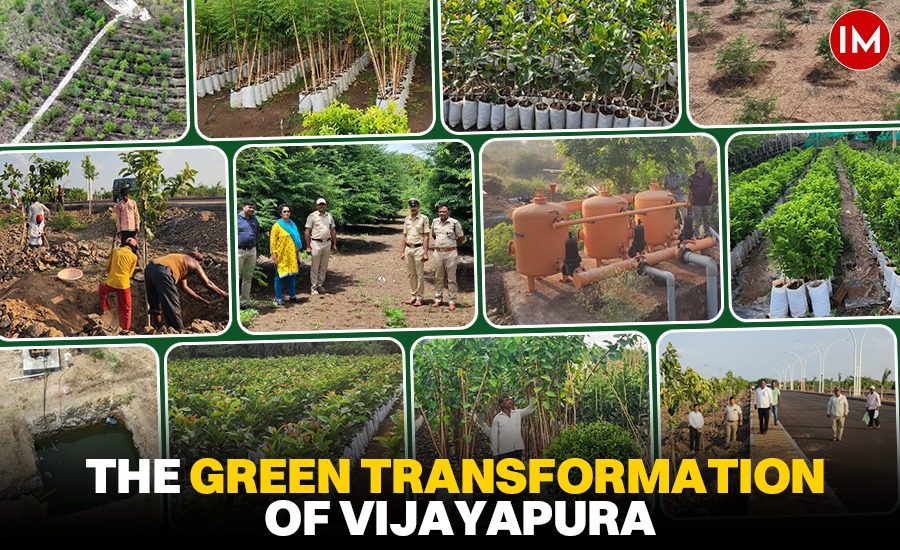
But a decade later, the same district is being spoken about as one of India’s most remarkable examples of ecological restoration. Roadsides are lined with trees, barren lands have turned green, migratory birds are returning to water bodies, and wildlife once lost to the region is slowly reappearing. At the heart of this transformation lies an ambitious mission that planted and distributed over 1.48 crore trees across the district.
Also Read- Securing Inviolate Area For The Wild – A Mirage, Or A Thwarted Dream?
A DISTRICT LOSING ITS GREEN COVER
Located in the rain-shadow region of the Deccan Plateau, Vijayapura receives barely 450–600 mm of rainfall annually, spread over just 20 to 30 rainy days. Decades of deforestation, groundwater depletion, and harsh climatic conditions had stripped the district of vegetation.
According to forest officials, the challenge was unique because the district had very little notified forest land. Expanding traditional forest areas was nearly impossible under existing policies.
During a conversation with Indian Masterminds, RFO Santosh A Ajjur explains the scale of the crisis: “The notified forest area in Vijayapura is only 0.17 percent, which is roughly 1,700 hectares. So we realized that if we wanted to increase greenery, we had to move beyond forest lands and focus on trees outside forests.”
That realization became the turning point.
THE IDEA: TREES OUTSIDE FORESTS
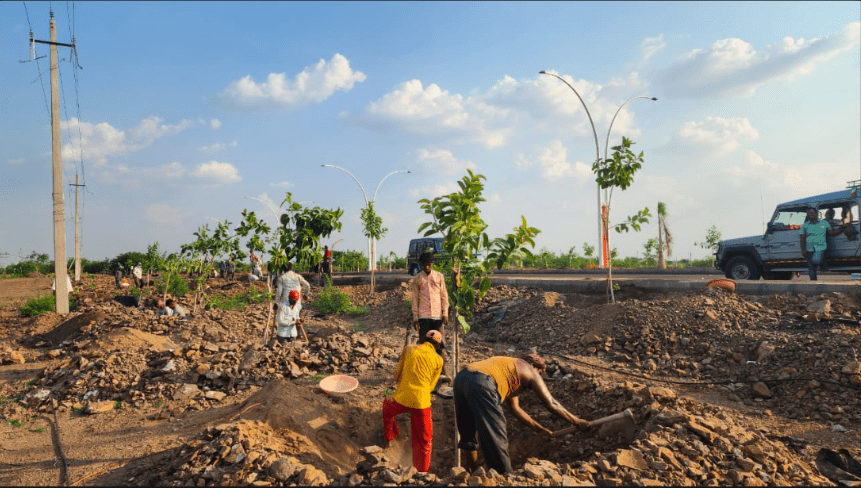
Instead of limiting afforestation to forest land, officials adopted a broader strategy — planting trees wherever land was available. Roadsides, schools, institutional campuses, grazing lands, degraded revenue land, canal stretches, and village commons became plantation zones.
The initiative gained momentum in 2016 under the leadership of Karnataka minister M. B. Patil, when the “Koti Vriksha Abhiyan” (KVA) was launched with the goal of planting one crore trees in five years.
The campaign united the forest department, district administration, farmers, NGOs, schools, and ordinary citizens. Plantation drives became community events. Trees were planted during weddings, birthdays, and public celebrations. Programmes like “Vrukshathon” and “Vrukshabandhan” helped turn afforestation into a people’s movement.
DCF Mallinath Kusnal told Indian Masterminds that the mission succeeded because it became larger than a government programme. “This was never about one department planting trees. The idea was to create ownership among people. Once citizens began seeing trees as part of their future, the movement gained its real strength.”
WATER FIRST, THEN FORESTS
Officials quickly realized that planting trees in an arid district would fail without solving the water problem first.
The Almatti Dam, lift irrigation projects, and canal networks transformed the region’s water availability. Irrigation expansion improved groundwater recharge and created conditions where plantations could survive.
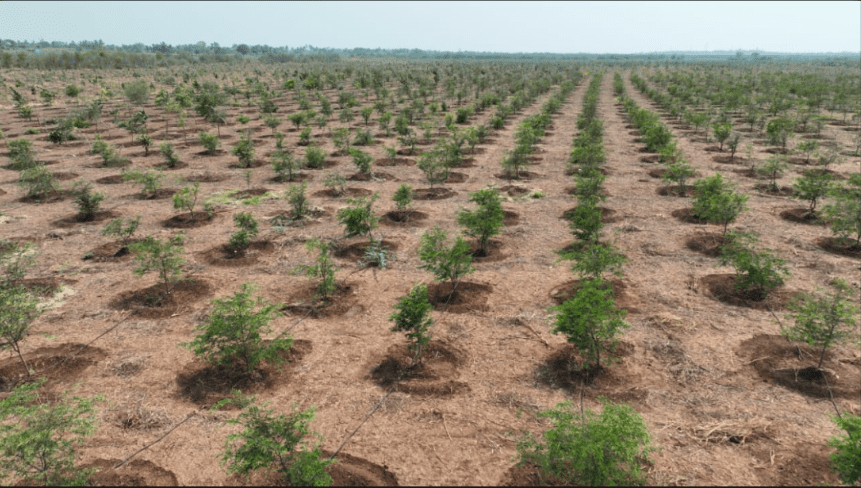
“Before water came, large-scale plantation was impossible,” says Santosh Ajjur. “The irrigation projects changed everything. Water from dams, canals, and lift irrigation improved groundwater levels, and because of that, survival rates of plantations improved significantly.”
Afforestation methods were also redesigned for harsh climatic conditions. Saplings were planted in large moisture-retaining soil bags weighing up to 80 kilograms. Solar-powered drip irrigation systems were introduced in difficult dryland blocks to ensure survival during extreme summers.
Instead of focusing only on plantation numbers, the administration focused on survival rates.
BUILDING A CLIMATE-RESILIENT ECOSYSTEM
Over the years, nearly 184 indigenous and economically valuable species were planted, including neem, jamun, tamarind, mango, sandalwood, teak, ficus, mahogany, and Terminalia varieties.
Fourteen nurseries were established to raise quality saplings suited to local ecology. Officials also understood that farmers would participate more actively if trees generated economic benefits. As a result, fruit-bearing and commercially valuable species were promoted alongside native varieties.
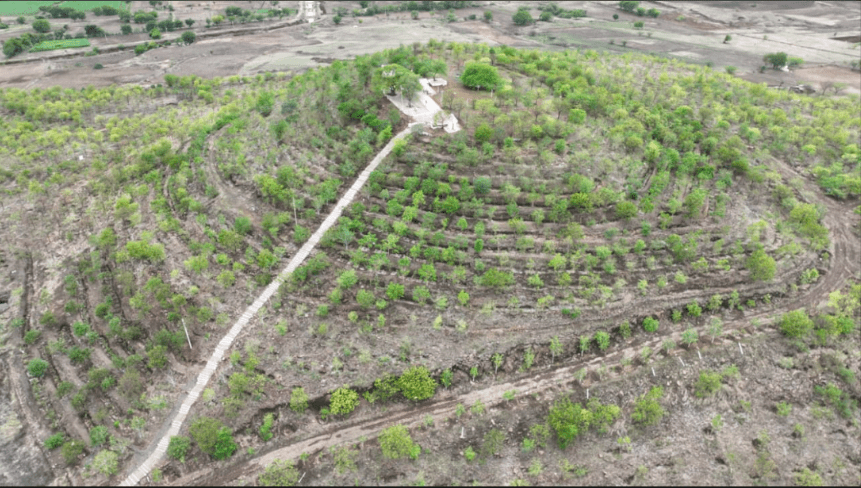
The results have been dramatic.
Between 2016 and 2025:
- 34.67 lakh saplings were directly planted.
- 113.53 lakh saplings were distributed to citizens.
- Green cover increased from 0.17 percent to nearly 2 percent, according to Forest Survey of India estimates.
But the real impact is visible beyond statistics.
WHEN WILDLIFE RETURNED
As green cover expanded, biodiversity slowly returned to landscapes that had remained barren for decades. Blackbucks, jackals, foxes, porcupines, jungle cats, and even wolves have started appearing again in regenerating areas.
The Almatti backwaters are now attracting migratory birds such as Greater Flamingos, Painted Storks, River Terns, and Bar-headed Geese.
Areas like Bhootnal, once rocky wastelands, are increasingly being viewed as potential bird sanctuaries due to rapid habitat restoration.
Mallinath Kusnal believes the ecological revival is one of the initiative’s biggest achievements. “Afforestation is not just about planting trees. When vegetation returns, everything returns — birds, pollinators, wildlife, soil health, groundwater recharge, and eventually hope among people.”
A LONG ROAD STILL AHEAD
Despite visible improvements, officials insist the transformation is still incomplete. Scientific studies conclusively linking the plantation drive to increased rainfall are yet to be conducted, though locals say they can already feel climatic changes.
Santosh Ajjur, who has spent most of his life in Vijayapura, says the difference is visible to residents. “Earlier, we hardly received rainfall. Recently, one season recorded almost 800 mm rainfall. We cannot scientifically claim this happened only because of plantations, but people here can feel the environmental change.”
Today, three forestry wings are actively working across nine ranges in Vijayapura to maintain and expand the green movement.
The district that once struggled under drought and barren landscapes is now emerging as a model for climate resilience in semi-arid India.
And perhaps Vijayapura’s greatest lesson is this: ecological restoration does not begin with forests alone. Sometimes, it begins with a community deciding that even the driest land deserves another chance to breathe.
Also Read – How Project Jaladhara Made Annamayya District Rank 2nd in Groundwater in Andhra Pradesh