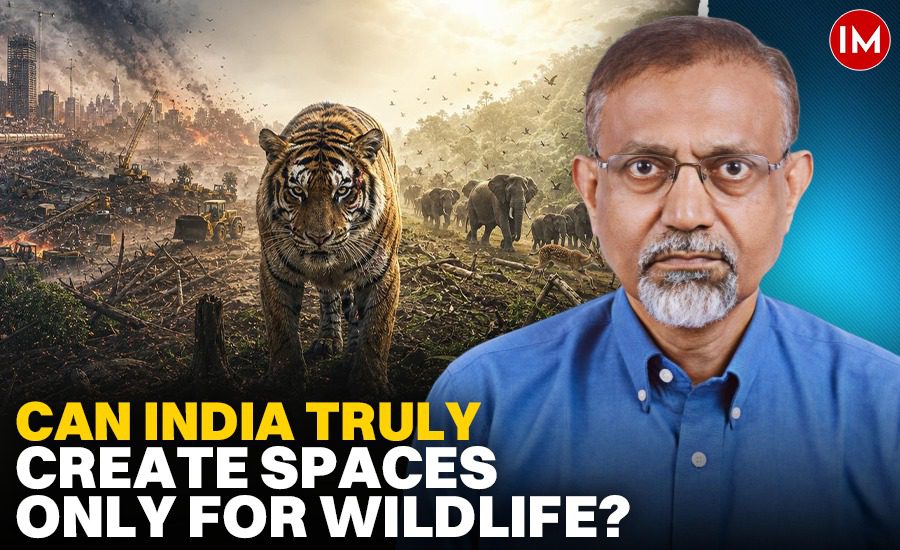
Wars may redraw borders, but conservation quietly redraws the relationship between humans and nature. Deep inside India’s forests, a similar contest is unfolding—not with weapons, but with ideas. At the heart of it lies a difficult question: Can we truly create inviolate spaces for wildlife in a country as densely populated and socially complex as India? Or is this ideal slowly turning into a mirage?
The idea of an “inviolate area” is simple in theory. It refers to a protected space completely free from human habitation and interference, where wildlife can thrive without fear or disruption. Such areas allow ecosystems to function naturally. Flora regenerates. Fauna multiplies. Biodiversity reaches its full potential. In essence, these are the last sanctuaries where nature remains untouched.
But reality is far more layered. India’s conservation journey has never been just about forests and animals. It has always been about people too—especially those who have lived in and around these forests for generations.
THE EVOLUTION OF CONSERVATION AND THE INVIOLATE IDEAL
India’s respect for nature is ancient. Trees and animals have long been objects of reverence. Yet, formal conservation began only in the colonial era with laws like the Indian Forest Act of 1865, later revised in 1878 and 1927. These laws primarily aimed at regulating forests but inadvertently provided some protection to wildlife by restricting activities like hunting and trapping.
By the early 20th century, large-scale habitat loss due to agriculture and settlements had already pushed several species toward extinction. This triggered a shift in thinking. The idea of setting aside exclusive areas for wildlife began to take shape. National parks and sanctuaries emerged in regions like Corbett, Kaziranga, Bandipur, and Gir.
A major turning point came in 1972 with the enactment of the Wildlife (Protection) Act. This was India’s first comprehensive legislation aimed specifically at wildlife conservation. It laid the foundation for a nationwide network of protected areas and strictly regulated hunting and trade in wildlife.
Soon after, Project Tiger was launched in 1973. It marked a decisive shift—from passive protection to active conservation. Over time, India built an extensive protected area network, now covering over 5% of its geographical area, including national parks, sanctuaries, conservation reserves, and tiger reserves.
Yet, one fundamental challenge remained: most of these areas were not truly inviolate.
India’s high population density meant that many protected areas included human settlements—both tribal and non-tribal. Initially, this coexistence was seen as sustainable. Tribal communities, living in small, scattered groups, were believed to have minimal impact on ecosystems.
But as time passed, this assumption began to unravel.
THE HUMAN-WILDLIFE DILEMMA
As conservation efforts intensified, the limitations of coexistence became more visible. Wildlife needs space—quiet, undisturbed, and expansive. Human settlements, even when small, introduce pressures: agriculture, resource extraction, infrastructure development, and growing aspirations.
To address this, the government introduced voluntary relocation programs. Schemes like the Beneficiary Oriented Programme for Tribal Development (BOPTD) aimed to rehabilitate forest-dwelling communities outside protected areas. The goal was twofold: improve the quality of life for people and reduce pressure on wildlife habitats.
In states like Karnataka, this approach has shown tangible results. In reserves such as Bhadra and Bandipur, relocated areas have witnessed ecological recovery. Former agricultural fields have turned into grasslands. Herbivore populations have increased. Tiger numbers have shown positive trends.
Equally important, many relocated families have experienced better access to education, healthcare, and livelihoods. In several cases, relocation has created a win-win situation—benefiting both people and wildlife.
However, the process is far from smooth.
The Forest Rights Act (FRA) of 2006 added a new dimension. It recognized the rights of forest-dwelling communities over land and resources. While this was a significant step toward social justice, it complicated conservation efforts.
Once rights are recognized, the state is obligated to provide civic amenities—roads, electricity, water, schools. These developments, though essential for human welfare, disrupt the ecological balance of protected areas.
The challenge becomes sharper in regions with large tribal populations, such as Nagarahole. Here, thousands of families live within forest boundaries. Some have relocated, but others are hesitant. In certain cases, even relocated families express a desire to return, influenced by perceived benefits under the FRA.
This creates a policy dilemma:
- Can conservation succeed without relocation?
- Can relocation succeed without full community consent?
The current model of voluntary relocation, while ethically sound, often slows down the process. Even a few unwilling families can halt large-scale efforts to create inviolate spaces.
BETWEEN POLICY AND REALITY
At the core of this debate lies a deeper question: What does tribal welfare truly mean?
Is it about preserving a way of life within forests, or enabling access to modern opportunities?
Historically, forest-dwelling communities lived with minimal needs. Their lifestyles were simple. Their ecological footprint was low. But today, aspirations have changed. Education, healthcare, connectivity, and income opportunities are no longer optional—they are essential.
Providing these within protected areas is nearly impossible without compromising ecological integrity.
This makes coexistence increasingly untenable.
Experts argue that insisting on keeping communities within forests may actually perpetuate deprivation. Instead, well-planned relocation—done with consent and dignity—can open pathways to better livelihoods while preserving critical habitats.
Importantly, relocation does not mean cultural erasure. It can be designed to respect traditions while enabling economic and social mobility.
At the same time, there are valid concerns. Activists and organizations often highlight risks of displacement, loss of identity, and inadequate rehabilitation. These concerns cannot be dismissed. Poorly executed relocation can indeed cause harm.
This is why the issue is not just about whether to relocate, but how to relocate.
A NECESSARY BALANCE
India’s protected areas represent the last fragments of wilderness. They are not just habitats for wildlife—they are ecological lifelines. Losing them would mean irreversible damage.
At the same time, millions of people depend on forests for survival.
Balancing these two realities is the central challenge of conservation.
Moving forward, a few key principles emerge:
- Clarity in Policy: Conservation goals and community rights must be aligned, not left in conflict.
- Informed Choice: Communities should be fully aware of the limitations of living inside protected areas.
- Better Rehabilitation Models: Relocation must offer real improvements—housing, jobs, education, and dignity.
- Alternative Livelihoods: Not all communities need to depend on agriculture; diverse employment options must be explored.
- Time-Sensitive Action: Delays in decision-making can irreversibly harm wildlife populations.
The idea of inviolate spaces is not outdated. It is more relevant than ever. But achieving it requires realism, empathy, and strong governance.
A CHOICE THAT CAN NO LONGER BE DELAYED
India stands at a crossroads.
On one side lies the vision of pristine forests, thriving wildlife, and ecological security. On the other lies the responsibility toward communities that have lived in these landscapes for generations.
The two are not mutually exclusive—but they require careful navigation.
The truth is stark: a bustling human settlement and a truly inviolate forest cannot coexist indefinitely.
A choice will have to be made—not abruptly, not forcefully, but thoughtfully.
If done right, relocation can become a bridge, not a barrier. A bridge between conservation and development. Between wilderness and well-being.
Because in the end, protecting wildlife is not just about saving animals. It is about preserving the delicate balance that sustains life itself.
And that balance demands courage—not just to protect forests, but to rethink how we live with them.