Lucknow: Over the past three months, the Yogi Adityanath government has unveiled a series of welfare measures aimed at teachers, Shiksha Mitras (para-teachers), instructors and non-teaching staff in Uttar Pradesh. The announcements include a cashless medical scheme, accident insurance of up to ₹1 crore, a substantial hike in instructors’ honorarium, plans for a separate Teacher Eligibility Test (TET) for in-service teachers and recruitment for over 10,000 teaching posts.
Politically, these initiatives are being viewed as a significant outreach to one of the state’s most influential communities. While the measures offer direct financial and social security benefits, several long-standing issues—including the demand for restoration of the Old Pension Scheme (OPS) and regularisation of Shiksha Mitras—continue to remain unresolved.
A Teacher Community with Significant Electoral Influence
The importance of teachers in Uttar Pradesh extends beyond classrooms. Collectively, government, aided and recognised private educational institutions constitute one of the state’s largest organised communities.
According to available estimates:
- Around 5–6 lakh regular teachers work under the Basic Education Council.
- Approximately 1.5 lakh Shiksha Mitras serve in primary schools.
- Nearly 25,000 part-time instructors are engaged in government schools.
- Government and aided secondary schools employ another 2–2.5 lakh teachers and staff.
When retired teachers and family members are included, this community is estimated to influence 30–40 lakh votersacross Uttar Pradesh.
Teachers also play a key role in election duties, voter list revision and other grassroots administrative functions. In rural areas, they continue to enjoy considerable social credibility, making them an important constituency for every political party.
Read also: CM Yogi Adityanath to Unveil ₹2,500 Crore Development Projects Across Shamli, Bijnor and Ghaziabad
Cashless Medical Scheme for 15 Lakh Beneficiaries
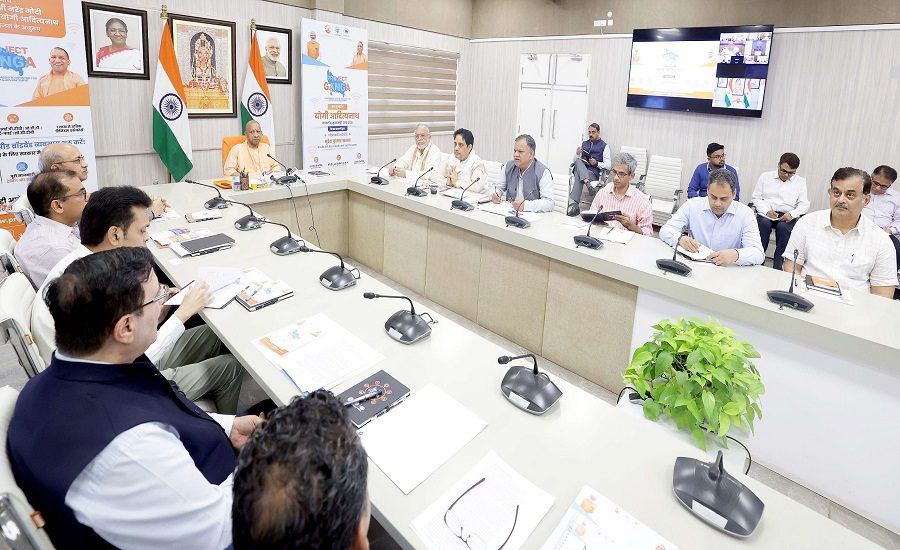
The government’s biggest announcement came in July 2026, when Chief Minister Yogi Adityanath launched the Chief Minister’s Teachers’ Cashless Medical Scheme from Varanasi.
The scheme provides cashless healthcare worth up to ₹5 lakh annually per family, with the state government bearing the entire insurance premium.
More than 15 lakh beneficiaries are expected to benefit, including:
- Regular teachers
- Shiksha Mitras
- Part-time instructors
- Mid-day meal cooks
- Non-teaching staff
- Eligible employees of Kasturba Gandhi Balika Vidyalayas
The initiative is aimed at strengthening social security for the education workforce.
Accident Insurance of Up to ₹1 Crore
Alongside the health scheme, the Uttar Pradesh government signed a Memorandum of Understanding (MoU) with the State Bank of India (SBI) to extend accident insurance benefits.
Under the arrangement:
- Regular teachers will receive personal accident insurance of up to ₹1 crore.
- Contractual teachers, instructors and Shiksha Mitras earning more than ₹10,000 per month will receive insurance coverage ranging between ₹30 lakh and ₹80 lakh.
- Similar compensation will also be available in cases of permanent disability.
The initiative significantly expands the social security net available to the state’s education workforce.
Honorarium of Instructors Almost Doubled
In another major decision, the government substantially increased the honorarium of part-time instructors.
Following observations made by the Supreme Court in February 2026 regarding the low honorarium paid to instructors, the state government decided in May 2026 to increase the monthly honorarium from ₹9,000 to ₹17,000.
The revised payment has been made effective from April 1, 2026, offering substantial financial relief to thousands of instructors across the state.
Separate TET for In-Service Teachers
The government has also announced plans to conduct a special Teacher Eligibility Test (TET) exclusively for teachers already serving in schools.
The move follows the Supreme Court’s direction making TET qualification mandatory for teachers handling classes up to Class VIII.
Officials say the objective is to ensure that in-service teachers are not forced to compete directly with fresh candidates and are provided a separate opportunity to establish their eligibility.
The government also granted special leave to serving teachers appearing in the July 2026 UPTET examination.
Recruitment Planned for Over 10,000 Teaching Posts
To address teacher shortages in urban primary and upper primary schools, the government has initiated recruitment for more than 10,000 teaching posts.
Instructions have already been issued to the newly constituted Uttar Pradesh Education Service Selection Commission (UPESSC) to begin the recruitment process.
The vacancies are expected to strengthen staffing in government schools where shortages have persisted for years.
Challenges That Continue to Trouble the Government
Despite the recent welfare announcements, several long-standing issues remain unresolved and continue to generate dissatisfaction among sections of the teaching community.
Old Pension Scheme (OPS) Demand
The restoration of the Old Pension Scheme (OPS) remains the biggest demand of teachers’ organisations.
While the state government maintains that reinstating OPS would impose a significant financial burden on the exchequer, opposition parties continue to raise the issue ahead of elections.
Regularisation of Shiksha Mitras
The future of nearly 1.37 lakh Shiksha Mitras continues to remain uncertain.
The issue dates back to 2017, when the Supreme Court cancelled their absorption as Assistant Teachers.
Although the government has enhanced honorariums and extended additional welfare benefits, demands for regularisation and equal pay for equal work remain unresolved and continue to trigger protests.
Transfer Policy and Digital Attendance
Teachers have also voiced concerns regarding the recently implemented three-tier transfer and adjustment policy.
Another contentious issue is mandatory digital attendance, which teachers argue is difficult to comply with in remote rural areas due to poor internet connectivity and infrastructure constraints.
Will the Welfare Measures Translate into Political Support?
The recent announcements—including free cashless healthcare, accident insurance, higher honorarium for instructors, recruitment plans and separate TET for in-service teachers—represent one of the most comprehensive welfare packages extended to Uttar Pradesh’s education sector in recent years.
These initiatives directly benefit a large section of teachers and education workers while addressing several immediate concerns.
However, politically sensitive issues such as the restoration of the Old Pension Scheme, regularisation of Shiksha Mitras and implementation challenges related to transfers and digital attendance continue to remain unresolved.
Whether the government’s recent outreach succeeds in addressing the long-standing concerns of Uttar Pradesh’s influential teaching community—and translates into sustained political goodwill—will become clearer in the months ahead.