India’s maritime sector is entering a defining phase of transformation.
From expanding port capacity and modernising logistics networks to developing inland waterways and green shipping solutions, the country is laying the foundation for a globally competitive maritime ecosystem.
At the centre of this ambitious transition is the Ministry of Ports, Shipping and Waterways, which is steering projects aimed at reducing logistics costs, boosting trade efficiency, and positioning India as a leading maritime power by 2047.
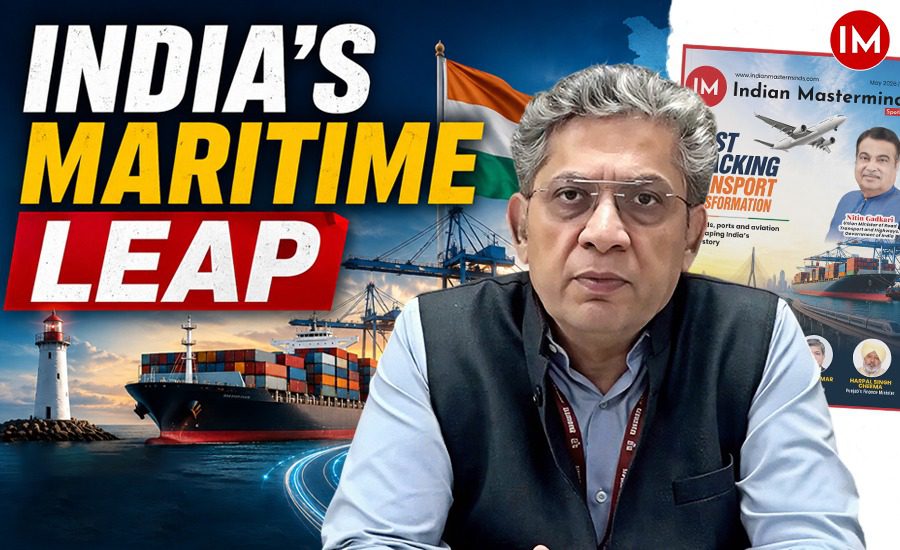
In an exclusive conversation with Indian Masterminds Spotlight, Secretary, Ministry of Ports, Shipping and Waterways, Mr. Vijay Kumar, speaks about Maritime Amrit Kaal Vision 2047, port modernisation, transshipment hubs, green hydrogen vessels, inland waterways, and India’s roadmap towards becoming a global maritime and logistics powerhouse.
Q1. India’s Maritime Amrit Kaal Vision 2047 aims to expand port capacity to over 10,000 MMTPA—what are the key milestones for the next decade?
India’s Maritime Amrit Kaal Vision 2047 sets an ambitious long-term vision, and the next decade is critical for building that foundation. Our immediate milestone is to scale port capacity to around 3,500 MMTPA by 2030, supported by targeted infrastructure augmentation and mechanisation across major ports. Alongside capacity, we are focusing on operational excellence—bringing down container vessel turnaround time to nearly 20 hours through digitisation, process optimisation, and better hinterland connectivity. We are also deepening private sector participation, with a target of more than 85% cargo handling at major ports through PPP models, which will drive efficiency and investment.
On the global front, we aim to position at least five Indian ports among the world’s top 30, reflecting both scale and service quality. Sustainability is equally central—major ports are working towards achieving over 60% of their energy needs from renewable sources. Together, these milestones will ensure that India’s port ecosystem is globally competitive, resilient, and future-ready.
Also Read – A Poet in the Corridors of Power: How Tushar Dhawal Singh Kept Poetry Alive Inside Bureaucracy
Q2. With the passage of the Indian Ports Act, 2025, how will governance between the Centre and states change in port management?
The Indian Ports Act, 2025, marks a major reform in modernising India’s port governance architecture by addressing long-standing fragmentation and aligning regulatory frameworks with evolving needs of trade and modern logistics requirements.
The Act establishes a harmonised and enabling framework with clearly defined functional boundaries and strengthened coordination between the Centre and States. While major ports continue under the Centre and ports other than major ports under State Governments, the Act advances cooperative federalism by ensuring alignment in standards, safety protocols, and digital systems across ports nationwide.
It also enables streamlined procedures through single-window clearances and digital processes, significantly improving the investment climate. This approach ensures standardisation with flexibility, empowering states to innovate while maintaining national-level efficiency, consistency, and global competitiveness.
Recent legislative and policy reforms are driving greater autonomy, transparency, and efficiency in port operations, while aligning India’s maritime ecosystem with global best practices.
Q3. India has historically underutilised inland waterways—what concrete steps are being taken to shift freight from road to waterways?
With over 14,000 km of navigable waterways, India possesses significant untapped potential, which is now being actively unlocked through targeted investments and policy interventions.
A key policy priority is to shift bulk and long-haul cargo towards inland waterways and coastal shipping, thereby reducing logistics costs, easing congestion on highways, and lowering carbon emissions.
The Ministry is developing major National Waterways such as NW-1 (Ganga), NW-2 (Brahmaputra), and NW-16 (Barak), along with multimodal terminals and strong last-mile connectivity linking river ports to road and rail networks. River Information Systems (RIS) are enhancing safety, navigation, and operational efficiency, while integration with coastal shipping is optimising cargo movement.
The shift is already gaining momentum, with encouraging trends visible across key waterways, and is steadily contributing to a more efficient and sustainable logistics ecosystem.
Q4. The launch of India’s first green hydrogen-powered vessel signals a shift—how fast can shipping decarbonise realistically?
Decarbonisation is a central pillar of India’s maritime strategy and reflects a clear commitment towards sustainable growth. The Ministry is actively advancing the adoption of green fuels, energy-efficient vessels, and environmentally sustainable port operations.
Pilot projects, including green hydrogen and other alternative fuel-powered vessels, are already progressing, alongside the adoption of renewable energy, electrification, and low-carbon technologies across ports.
The transition is progressing in a phased and structured manner, positioning India’s maritime sector at the forefront of sustainable and future-ready shipping.
Q5. What is the roadmap for making Indian ports global transshipment hubs, reducing dependence on ports like Colombo or Singapore?
India is actively transitioning towards developing world-class domestic transshipment hubs and deep-draft ports to capture a larger share of cargo currently handled at foreign ports.
Strategic infrastructure development and capacity augmentation initiatives are enabling India to retain cargo within the country, improve efficiency, and reduce logistics costs. These efforts are positioning India as a key transshipment hub in the region and strengthening its role in global maritime trade.
Q6. Logistics costs remain high—how will port modernisation and hinterland connectivity reduce turnaround time and costs?
India has already made significant progress in reducing turnaround and dwell times at major ports through targeted reforms and digitalisation.
The implementation of platforms such as the Maritime Single Window, along with automation and process optimisation, is enhancing operational efficiency and transparency. Simultaneously, stronger integration with road, rail, and inland waterways under PM Gati Shakti is enabling faster and more seamless cargo movement.
To enhance hinterland connectivity, the Ministry is in consultation with Ministry of Railways and MoRTH to undertake 4 laning / railway linking at major and non-major ports with greater cargo throughput. Further, internal port connectivity linkages shall be directly funded by the Ministry under a dedicated pillar under Sagarmala 2.0 scheme.
These measures are bringing Indian ports closer to global benchmarks and are playing a critical role in reducing logistics costs and improving supply chain efficiency.
Q7. Private sector participation in ports has increased—how do you balance commercialisation with strategic control?
Private sector participation has been a key driver of efficiency, capacity expansion, and innovation in the port sector. At present about 60% of the cargo at Major Ports is being handled by the PPP operators and we intend to increase it to about 80% by 2030 as per Ministry’s Maritime India Vision 2030.
The Government has established a balanced and well-calibrated framework that promotes private investment through transparent PPP models while safeguarding strategic and national interests. This ensures that ports remain commercially efficient, globally competitive, and operationally secure.
Q8. How will India integrate ports, inland waterways, and coastal shipping into a seamless multimodal logistics grid?
The Ministry is driving the integration of ports with industrial corridors, logistics parks, and inland transport networks under initiatives such as PM Gati Shakti and Sagarmala 2.0. which shall channel funds to address underinvestment in port modernization, IWT development, coastal community development, island development and port led industrialization projects
A seamless, end-to-end multimodal logistics ecosystem is being developed by connecting ports with road, rail, and waterways, supported by digital platforms and unified planning frameworks.
This integrated approach is significantly enhancing efficiency, reducing logistics costs, and positioning India as a major global manufacturing and trading hub.
Q9. How is the government revitalizing domestic shipbuilding & ship repair in India to tap the global shift to low cost manufacturing countries?
The Union Cabinet in September 2025 approved three schemes, Maritime Development Fund (MDF), Shipbuilding Financial Assistance Scheme (SBFAS) and Shipbuilding Development Scheme (SbDS) with a total outlay of Rs. 69,725 crore over a period of 10 years to support long term financing for the maritime sector, boost domestic ship building through financial grants and shipbuilding capacity addition with a target of 4.5 million gross tonnage output by 2047.