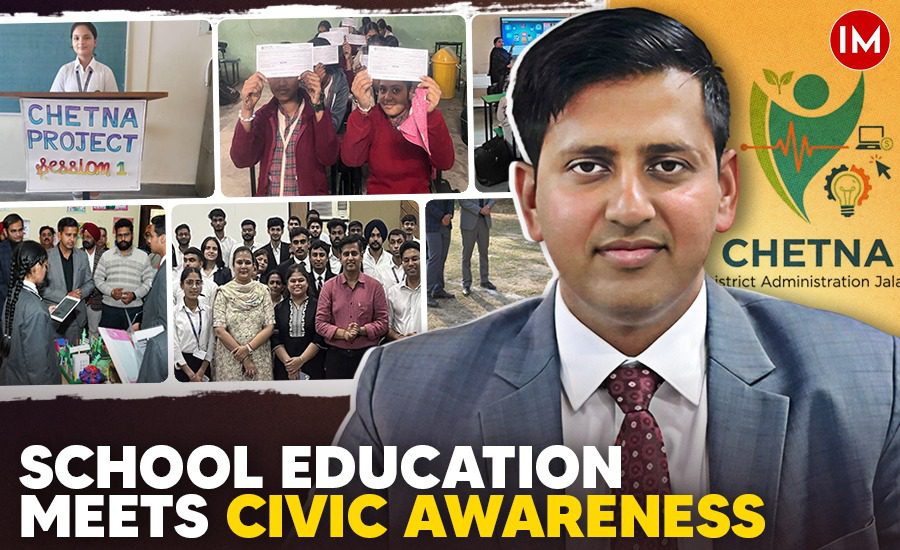
India’s school education system has traditionally prioritised academic outcomes, often equating merit with examination performance. However, administrative experience at the district level increasingly reveals a persistent gap between academic knowledge and practical preparedness. Addressing this disconnect, the Jalandhar district administration launched Project CHETNA (Children’s Health, Education, Training and Nutritional Assistance) on October 17, 2025, positioning life skills as an integral component of formal schooling.
“Designed as a district-wide intervention, Project CHETNA seeks to ensure that students graduating from school are equipped not only with subject knowledge but also with the awareness, confidence, and competence required to navigate everyday challenges. Implemented across more than 70 government and private schools, the initiative has already covered 15,000 students, making it one of the most comprehensive life-skills programmes at the district level.
ADMINISTARTIVE INSIGHT BEHIND THE INITIATIVE
The conceptual foundation of Project CHETNA emerged from field observations made by IAS officer Himanshu Aggarwal, the Deputy Commissioner of Jalandhar and a 2014-batch Punjab cadre officer, during his interactions with government school students. Exposure visits to the District Commissioner’s Office revealed that while many students were academically capable, they often lacked familiarity with basic civic, financial, and administrative processes.
The district administration identified this as an “exposure gap,” where students had limited interaction with real-world systems such as banking institutions, healthcare responses, digital platforms, and governance structures. Mr Aggarwal in a conversation with Indian Masterminds stated, “Education must move beyond textbook knowledge and actively contribute to the development of a student’s conscious civic and social identity.”
IDENTIFYING THE PREPAREDNESS GAP
Project CHETNA was conceptualised to address several systemic gaps observed among school students. One of the most prominent was the lack of practical confidence in handling routine adult responsibilities. Students often found common processes—such as filling bank forms, understanding salary slips, or accessing government services—intimidating and unfamiliar.
Another critical concern was the absence of hands-on emergency preparedness. Despite studying science and health concepts in theory, students lacked functional knowledge of first aid, CPR, and immediate response protocols. The district administration noted that in emergency situations, theoretical awareness alone was insufficient without practice-based learning.
The programme also responded to emerging challenges in the digital domain. With increased internet access among adolescents, students were found to be vulnerable to cyber fraud, phishing, and data misuse. CHETNA introduced structured modules on digital safety, cyber hygiene, and responsible online behaviour. Importantly, students were encouraged to transfer this knowledge to elderly family members, strengthening community-level awareness.
Additionally, a significant disconnect was observed between students and governance institutions. Many perceived district administration as distant and inaccessible, limiting their ability to engage with public systems or claim entitlements. CHETNA sought to directly address this perception through institutional exposure and civic education.
A STRUCTURED, INTEGRATED CURRICULUM
At the core of Project CHETNA is a six-pillar curriculum designed to address essential life competencies. These pillars include Digital Literacy and Safety, Financial Awareness, Gender Sensitivity, Sanitation and Hygiene, First Aid and Emergency Response, and Career Guidance. Each component addresses a practical aspect of everyday life while reinforcing social responsibility and informed decision-making.
Unlike conventional life-skills initiatives that operate as extracurricular activities, CHETNA is formally embedded within the school timetable. Every Friday is dedicated to CHETNA sessions, ensuring continuity and sustained engagement. This institutionalisation underscores the district administration’s position that life skills are not supplementary but fundamental to education.
EXPERIENTIAL LEARNING THROUGH THE SAY-DO-ASK MODEL
To ensure effective knowledge transfer, Project CHETNA follows a “Say–Do–Ask” pedagogy, conceptualised at the district level. Teachers first explain concepts in simple and accessible language, followed by practical demonstrations and simulations. Students then engage in reflective discussions on how these skills apply in their personal and family contexts.
Hands-on learning includes CPR practice using mannequins, simulated banking transactions, and role-based exercises on digital safety and civic processes. To ensure uniform delivery, the district conducted three rounds of intensive teacher training, equipping educators with both technical content and facilitation capabilities.
BRIDGING THE GOVERNANCE DIVIDE
A defining element of Project CHETNA is its emphasis on civic exposure. Students participate in structured visits to Tehsil offices, Police Commissionerates, the District Administrative Complex, and premier institutions such as the National Institute of Technology. These visits provide firsthand insight into how public systems function and how citizens can engage with them.
Through these interactions, students learn about applying for documents, accessing welfare schemes, understanding legal rights, and approaching government offices with clarity and confidence. The initiative positions students as informed intermediaries who can assist their families and communities in navigating administrative processes.
The district administration views this component as central to strengthening democratic participation at the grassroots level, with students emerging as civic facilitators within their households.
DEMONSTRATING OUTCOMES: CHTENA CONFLUENCE
The practical impact of Project CHETNA was showcased during the Chetna Confluence: Skill and Survival, held from November 26 to 28, 2025. The district-level event featured competitive simulations where students demonstrated acquired skills in realistic scenarios.
Events such as CPR relay races and financial literacy challenges required participants to apply knowledge under time-bound conditions. One of the key activities involved financial decision-making exercises modelled on real-world administrative scenarios, including budget planning. The confluence provided measurable indicators of improved confidence, situational awareness, and teamwork among students.
EXPANSION AND SUSTAINABILITY
The future roadmap of Project CHETNA focuses on both horizontal and vertical scaling. “Horizontally, we are working towards aligning the CHETNA curriculum with education department frameworks to enable wider adoption across government schools. Vertically, plans include the introduction of advanced skill modules such as coding and sustainable agricultural practices,” Mr Aggarwal shared with Indian Masterminds.
The development of CHETNA ambassadors is also envisaged, enabling students to extend civic awareness beyond schools into the broader community. “Digital platforms are being explored for teacher training and curriculum dissemination, ensuring scalability without compromising quality.”
SETTING A REPLICABLE DISTRICT MODEL
Project CHETNA represents a structured administrative response to the evolving demands of education. By embedding life skills within formal schooling and strengthening the relationship between students and governance institutions, the initiative offers a replicable model for districts across India. It demonstrates how district leadership, when aligned with educational institutions, can transform schools into spaces that prepare students for both civic participation and everyday realities.