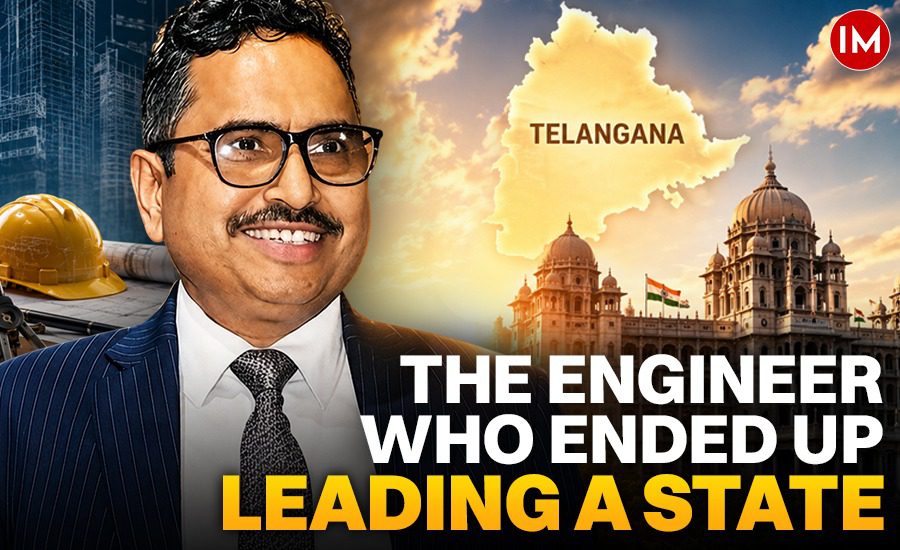
In a world where visibility often becomes a measure of influence, Sanjay Jaju built his career in the opposite direction.
There were no headline-grabbing controversies, no loud public persona, and very few interviews. Yet, for more than three decades, governments, both at the Centre and in the state, kept returning to him whenever the assignment demanded technical expertise, institutional reform, or the ability to steer complex departments. Long before he took charge as Telangana’s Chief Secretary in July 2026, Jaju had quietly become one of India’s most experienced administrators in technology, infrastructure and public systems.
His story is not about one defining moment. It is about a career shaped by consistently solving larger and more complicated administrative challenges.
Also read: How YB Khurania Climbed Every Rung of Policing Before Becoming Odisha’s DGP
AN ENGINEER WHO ENTERED PUBLIC SERVICE
Born on February 26, 1969, in Madhya Pradesh, Sanjay Jaju’s academic journey followed an uncommon path for a civil servant. He first pursued Mechanical Engineering before earning an M.Tech, adding professional qualifications in cost accounting and later strengthening his understanding of management through advanced programmes, including studies at the University of Manchester and IGNOU.
This rare blend of engineering, finance and management would later become one of his greatest strengths. Throughout his career, he was often entrusted with departments where governance intersected with technology, infrastructure, industry and innovation.
Joining the Indian Administrative Service in 1992, he was allotted the undivided Andhra Pradesh cadre, beginning a journey that would eventually span district administration, urban governance, national policymaking and some of the country’s most strategic ministries.
LEARNING GOVERNANCE FROM THE GROUND UP
Like every young IAS officer, Jaju began his career in the field. As Sub-Collector of Vijayawada, he dealt with revenue administration, land management and public grievances, gaining first-hand exposure to the realities of governance.
His early assignments in rural and development administration introduced him to the everyday challenges faced by communities, while his stint with the Rajiv Gandhi Mission shifted his focus towards education and human development. These formative years gave him an understanding of governance that extended well beyond files and policy notes.
Soon came larger responsibilities.
BUILDING CITIES BEFORE THEY BECAME GLOBAL HUBS
Urban administration would become one of the defining chapters of Jaju’s career.
As Municipal Commissioner of Visakhapatnam and later Hyderabad, he found himself managing two rapidly expanding cities at a time when urban India was changing at an unprecedented pace. Roads, sanitation, drainage, municipal finance, public health, civic infrastructure and city planning all came under his watch.
Hyderabad, in particular, was emerging as one of India’s biggest technology destinations. Managing its civic machinery demanded more than routine administration: it required balancing rapid growth with the everyday needs of millions of residents.
The experience also reinforced his reputation as an officer comfortable handling large institutions, multiple stakeholders and projects that demanded long-term planning.
FROM DISTRICT COLLECTOR TO DIGITAL GOVERNANCE
His tenure as District Collector of West Godavari added another dimension to his administrative profile. Agriculture, irrigation, disaster preparedness, rural development and welfare programmes became part of his expanding portfolio.
But perhaps the most defining turn came when he moved into Information Technology and Communications.
Years before digital governance became a national conversation, Jaju was working on technology-led public service delivery, IT policy and e-governance initiatives. His engineering background, coupled with his administrative experience, allowed him to understand both the technical and human sides of governance.
This ability to bridge policy with technology would shape the rest of his career.
A DECADE AT THE CENTRE
In 2014, Jaju moved to the Government of India on central deputation, where his career entered an entirely new phase.
Over nearly thirteen years, he served in key ministries handling highways, defence production, electronics, information and broadcasting, and the development of the North Eastern Region. Few officers from his batch spent such a long and varied tenure at the Centre.
Whether it was strengthening defence manufacturing, supporting the corporatisation of the Ordnance Factory Board, promoting electronics and digital initiatives, or leading the Ministry of Information and Broadcasting as Secretary, his work consistently revolved around strengthening institutions rather than seeking attention.
His assignments reflected the confidence successive governments placed in his ability to manage technically demanding sectors with national significance.
RETURNING HOME TO LEAD TELANGANA
When Telangana sought a new Chief Secretary in 2026, the state turned to one of its own officers with unmatched experience across both state and central governments.
Returning after more than a decade in New Delhi, Jaju assumed office as Chief Secretary on July 1, 2026. Alongside the state’s highest bureaucratic position, he was also entrusted with Industries & Commerce, Information Technology, Electronics & Communications, the Industry & Investment Cell in the Chief Minister’s Office, and the SPEED wing, an indication of the government’s expectation that he would drive investment, technology and administrative coordination simultaneously.
It was a homecoming backed by three decades of experience across almost every level of governance.
THE ADMINISTRATOR BEHIND THE INSTITUTIONS
What makes Sanjay Jaju’s journey different is not a single landmark project or one celebrated reform. It is the remarkable range of responsibilities he has handled: district administration, city governance, infrastructure, irrigation, food security, information technology, defence production, industrial policy and national communication.
Throughout this journey, he has remained one of the least public-facing senior bureaucrats in the country. Very little is known about his personal life because he has consistently allowed his work to speak for itself.
In an era where public attention often shifts quickly, Sanjay Jaju represents a quieter style of leadership, one built on strengthening systems, improving institutions and preparing governments for the future.
From the classrooms of mechanical engineering to the office of Telangana’s Chief Secretary, his journey reflects the power of expertise, adaptability and a lifelong commitment to public service.
Also read: Anurag Dhankar: The Investigator Who Travelled from Kosovo’s Conflict Zones to the Command of Tripura Police