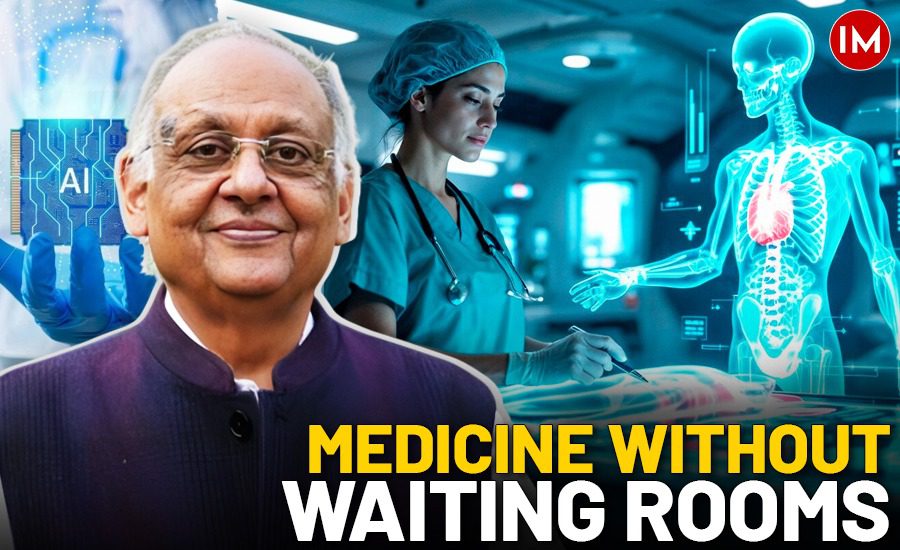
Healthcare in 2035 will feel very different from what we know today. Hospitals will not be the centre of the system. Patients will not wait for hours. Doctors will not drown in paperwork. And diseases will no longer strike without warning.
The real change will not be in machines or gadgets, but in the mindset — a shift from treating illness to building health. AI, biotechnology, genomics, robotics and new forms of medical education will quietly weave themselves into everyday life, creating a system that is fast, smart, affordable, and deeply human.
AI-Powered Doctors
When doctors talk about AI, they do not want a robot to replace them. What they want is freedom from routine and time-consuming tasks. A doctor wants a capable assistant who can take down a patient’s full history in detail, access old records, and present everything clearly and briefly. It helps if a junior doctor can quickly scan through diagnostic reports and offer tentative diagnosis and possible treatment options. They want strong hospital and surgical support whenever required, and they want continuous medical education that keeps them updated with the latest therapies and technologies.
AI can now support every one of these needs. It listens, summarises, compares past cases, scans reports, offers possibilities and flags risks. It does not replace the doctor’s judgment; it strengthens it. The doctor’s real work again becomes what it always should have been: understanding people, reassuring families and guiding healing.
AI-Powered Hospitals
Hospitals today often suffer from delays, queues and repeated tests. The first stage of transformation will fix these problems. Appointments will be easy, waiting will almost disappear, and every doctor will get a patient’s complete record on a screen — with an AI summary of key issues, diagnosis possibilities and a draft prescription that can be corrected on the spot.
But the real shift will come in the second stage. Hospitals will redefine themselves as centres for critical care only, while most routine healthcare will move to homes, neighbourhood booths and virtual clinics. Senior clinicians agree that the future hospital will be smaller, smarter and more focused on emergencies, surgeries and complex cases. Everything else will be handled outside, seamlessly connected by a fast digital backbone.
In simple words, the entire system of patients, doctors and hospitals will function like one intelligent network that learns continuously and responds instantly.
Diagnostics, Surgery Redefined
Diagnostics will be one of the greatest beneficiaries of AI. Medical images, lab results and even genomic data (available from birth), will be analysed with near-perfect accuracy. Diseases that look similar to the human eye will be sharply distinguished by algorithms. Microbiome analysis will guide personalised diets. Wearables will track vitals continuously. Neighbourhood “Health Booths” will offer quick tests, basic scans and instant AI interpretation. Hospitals will provide advanced versions of these tools, but the principles will be the same everywhere: detect early, act early and prevent serious illness.
Surgeries will be transformed into highly intelligent, precision-driven procedures. Operating rooms will be equipped with robotic systems that move with sub-millimetre accuracy, guided by AI that will map every vessel and risk zone from a patient’s digital twin. Surgeons will enter the theatre with the safest approach already simulated hundreds of times, and AI will continuously highlight critical structures and warn of complications in real time. Remote surgery will also be routine, allowing top specialists to operate in district and rural hospitals without patients needing to travel.
Research, Longevity, Medical Education
Drug development is already being transformed by AI. What once took years of study and laboratory trials can now begin with AI tools that predict protein structures, simulate molecules and identify promising drug candidates in weeks. Research, supercharged by AI and quantum computing, can make thirties the decade of miracle cures, including for diseases like cancer and dementia.
Humanity will step into an era of radical longevity, where aging will be treated as a reversible medical condition rather than an unavoidable fate. Advances in gene editing, stem-cell therapies, nanotechnology and organ bio-printing will be slowing, halting and even reversing cellular aging. Scientists are already speaking of longevity escape velocity —adding years to life faster than the body ages— and death becoming optional by 2045. In their book “The Death of Death”, José Luis Cordeiro and David Wood argue that repairing damaged cells, replacing failing organs and lengthening telomeres could make extended, healthy lifespans a scientific reality within our lifetime.
By 2035, medical education will be reshaped by intelligent systems that turn every student into a personalized learner, in sync with Education @2035. Entire campuses will be connected through seamless digital platforms, while AI tutors will guide each learner at their own pace, strengthening weak areas and advancing strong ones. Faculty will teach with AI-powered tools that will simplify complex concepts, and ensure students master both scientific knowledge and clinical judgement. Students will learn anatomy through virtual dissections, practice surgeries on simulations and attend global medical colleges without traveling. Learning will not be restricted to classrooms; it will be continuous, adaptive, and tailored to the abilities, interests, and future specializations of every student.
Healthcare Systems
Healthcare systems will be centred on the human being, not the institution. Treatment plans will be personalised using genomics. Wearables and home sensors will provide gentle alerts long before symptoms appear. Virtual doctors will handle routine consultations, while human doctors focus on complex cases.
Most healthcare will happen at home. Smart devices will monitor essential parameters day and night. Telemedicine will link patients to experts instantly. Only critical care will go to hospitals, which will become highly automated environments with robotic surgeries and intelligent management. Health records will be integrated across clinics, cities and even countries. AI will analyse these records to warn of risks and suggest prevention. Data will be protected by strong privacy technologies, including blockchain.
In the short run, hospitals and clinics will need to invest in AI systems, new equipment and staff training. Costs may appear to rise temporarily. But the long-term picture is different. AI reduces errors, eliminates unnecessary tests, prevents hospitalisations through early detection and brings high-quality care to remote areas. These efficiencies eventually make healthcare more affordable and accessible. The real saving comes from preventing disease rather than treating it.
If handled carelessly, AI could deepen inequality. Those who can pay will get predictive healthcare; those who cannot may be left behind. This is the real danger. To avoid it, nations must treat digital healthcare as a basic right. Services must be affordable, accessible and available in local languages. Ethics and inclusion must guide every policy.
Humane Healing
Despite the power of AI, healing remains deeply human. A machine can detect sadness but it cannot comfort a grieving family. It can predict stress but it cannot offer the warmth of a caring touch. The healthcare systems that succeed in 2035 will be those that combine intelligence with compassion. Mental health will be as important as physical health. Emotional well-being, social connection and a sense of purpose will be treated as vital signs of health.
Many people today combine modern medicine with Ayurveda, physiotherapy, acupuncture, nutrition or yoga. AI will make this integration more reliable. By studying a person’s medical history, genetics, lifestyle and preferences, AI can recommend suitable alternative therapies and list their benefits and limitations. It can also compare scientific evidence, outcome data and patient experiences to help people make informed choice.
Healthcare@2035 is ultimately about empowerment. People will own their data, understand their health, and take simple daily actions guided by AI. Choices will be easier, healthier habits more enjoyable, and community health more visible. The old doctor–patient relationship will evolve into a partnership. Healing will be co-created by the person, the doctor and the intelligent tools around them.
The Journey Ahead
To reach this future, the next few years are crucial. We need a national digital health grid that connects hospitals, labs, pharmacies and citizens. Medical education must be redesigned so that every doctor becomes both tech-comfortable and empathy-competent. Primary healthcare must be strengthened with AI tools. People must be taught their data rights, and AI systems must be explainable and trustworthy. Mental health and lifestyle medicine must become national priorities, and innovation in low-cost health technologies must be encouraged.
The biggest challenge is mindset. Doctors fear losing control, administrators resist sharing data, and citizens worry about privacy. Change will come only through trust, conversation and transparency. Everyone must feel included, not overpowered.
We should start moving towards a society where no one dies of a preventable disease, where every citizen receives a monthly health forecast instead of a surprise hospital bill, where doctors look at patients, not screens, where the measure of success is community well-being, not the number of beds filled.
This is the promise of Healthcare@2035. Technology has created huge possibilities. Now, we have to convert them into reality. We have to synergize machine intelligence and human empathy to help people live longer, better with joy and meaning.The time to act is now — to heal not just individuals but the system itself.
(The Author is 1972-batch IAS Officer of UP Cadre. He has been Secretary to Govt of India & Member, Competition Commission of India. He is a student of Artificial Intelligence for past 10 years.)