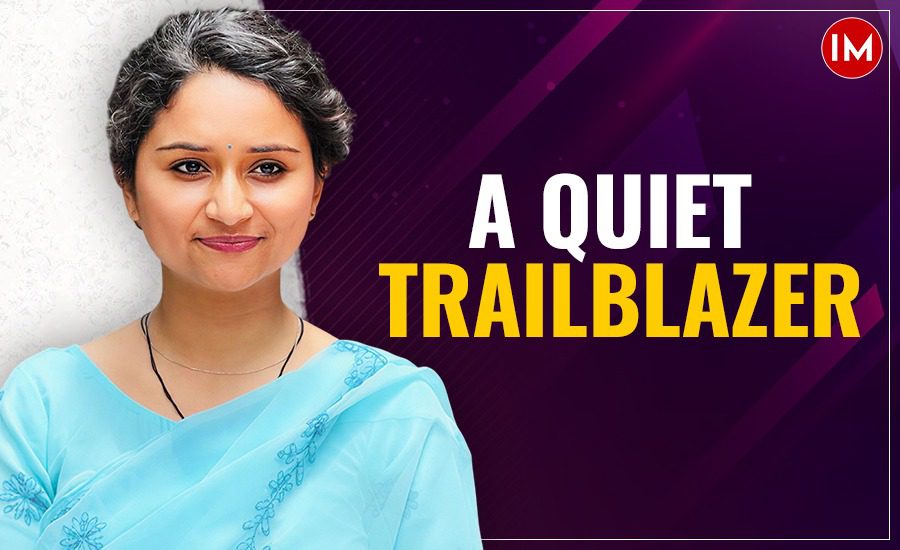
There is a particular kind of quiet courage that does not seek headlines — it simply shows up, does the work, and lets the mountains bear witness. Abhilasha Kour, IAS, 2021 batch, Tamil Nadu cadre, is that kind of officer. Presently serving as Additional Collector (Development) in the Nilgiris — one of India’s most ecologically fragile and administratively complex districts — she has steadily carved a reputation for purposeful governance, deep field connect, and a tenacious commitment to reaching those whom the system has historically struggled to reach, embodying the idea that “Courage does not always roar; sometimes it is the quiet resolve to simply continue.”
Her journey into the civil services was never about a title alone. It was about expanding the horizon of possibility—for herself and for countless girls who grow up being told to aim within limits. Coming from a background where societal expectations often shape ambition, she chose instead to challenge them. The IAS, for her, became a platform to lead by example.
Childhood Dreams
Her path to success, however, was anything but linear. Reflecting on her journey after her selection, she told Indian Masterminds, “Seeds for civil services were sown early in me by my father, who used to collect newspaper clippings of female candidates clearing UPSC exams. That was a big inspiration for me to go for UPSC CSE.”
However, she began her UPSC preparation in 2015 soon after graduation in Engineering. But, she faced the familiar yet formidable cycle of attempts and setbacks. She reached the interview stage in 2017, a milestone that brings hope but no guarantee. When the final list did not carry her name, it could have been the end of the road. Instead, it became a turning point—one that reflected the belief that “Greatness doesn’t lie in never falling, but in rising every time we fall.”
Also Read – How IPS Sandeep M Tamgadge’s Journey Can Guide Your UPSC Preparation
She did not relocate to Delhi, join an expensive coaching institute, or second-guess her approach. Instead, she doubled down on self-study, structured her preparation with remarkable clarity, and returned to the exam with a sharper focus. In the UPSC Civil Services Examination 2020, she secured All India Rank 291 — a number that signified not just selection, but redemption. “In a society that too often equates a girl’s ambition with a threat to family convention, her success also carried a quiet but defiant message: that daughters, too, can dream without apology—proving that Persistence often turns setbacks into turning points”, she says.
Baptism by Fire
After allocation to the Tamil Nadu cadre, Abhilasha’s first posting as Sub Collector was in Paramakudi, a constituency in Ramanathapuram — a region that is anything but easy. Paramakudi, with its history of caste tensions, demands from its administrators a rare combination of alertness, patience, and firmness. It is a posting that separates those who carry the badge from those who truly understand its weight.
Notably, her appointment marked a significant moment for the region, with a woman officer posted as Sub Collector in Paramakudi after nearly two decades.
Abhilasha arrived with no pretensions and wasted no time settling in. Her tenure coincided with the 2024 General Elections, during which she served as the Assistant Returning Officer (ARO) for the Paramakudi Assembly constituency — a logistically demanding, constitutionally critical responsibility. Managing polling infrastructure, voter awareness, and ground-level coordination in a politically charged environment required a steadiness that defines leadership, often measured not in grand gestures but in “Calm, consistent action.”
Governance Where the Map Ends
In June 2025, the Tamil Nadu government transferred Abhilasha to the Nilgiris as Additional Collector (Development). The Nilgiris is not your average district posting. Perched between 900 and 2,636 metres above sea level, with 56 percent of its land under forest cover, it is a district where every administrative decision carries environmental consequence, where roads washed away in monsoon landslides leave villages unreachable for days, and where six Particularly Vulnerable Tribal Groups (PVTGs) continue to live in conditions that remain stubbornly resistant to mainstream development.
As Additional Collector (Development), Abhilasha is tasked with ensuring the last-mile delivery of welfare and development schemes in terrain that tests both logistics and will. From housing under PMAY to employment generation under MGNREGS, from health camps in remote hamlets to livelihood support for tribal farmers — the range of work under her charge is as vast as the hills she now calls her work canvas, reinforcing the idea that “Service is defined by its ability to reach the unreached.”
Stewarding the Hills
Simultaneously, Abhilasha holds charge as Project Director of the Special Area Development Programme (SADP) — a flagship initiative of the Tamil Nadu government that focuses on soil and water conservation, afforestation, biodiversity protection, and livelihood generation in hilly and ecologically sensitive regions. From 2024–25 onwards, the Special Area Development Plan (SADP) in Tamil Nadu has been restructured to include blocks across 20 districts, with a focus on the Eastern and Western Ghats regions.
This is not a ceremonial designation. Under SADP, the Project Director is responsible for coordinating interventions that range from stabilising landslide-prone slopes to the promotion of diversified agricultural livelihoods for hill farmers, from afforestation drives in the buffer zones of protected forests to strengthening the livelihoods of communities who depend on the fragile Western Ghats ecosystem. It demands someone who can hold a wide strategic lens and still drill down to the village-level realities on the ground—because “True governance lies in bridging vision and ground reality.”
Shattering Glass Ceilings
Abhilasha’s story sits within a larger, inspiring narrative of women redefining the face of India’s civil services — particularly in Tamil Nadu, a state that has been at the forefront of deploying women officers in frontline, high-stakes administrative roles. From the Nilgiris to the coastline, women IAS officers in Tamil Nadu have been heading districts, driving development, and managing crises with an authority and empathy that have often outpaced expectations.
What sets Abhilasha Kour apart is not just the path she has taken, but the doors she now walks through—and quietly holds open for others, reinforcing the belief that “The doors we open today become pathways for others tomorrow.” In spaces where entry was never assumed, she chose to walk in anyway. Her postings in Ramanathapuram and now the Nilgiris reflect both her inclination to take on key roles and the administration’s confidence in her capability.
Also Read – ‘I Felt Trapped in My Own Mind’: IPS Officer Aryendra Kumar on Anxiety During UPSC Preparation