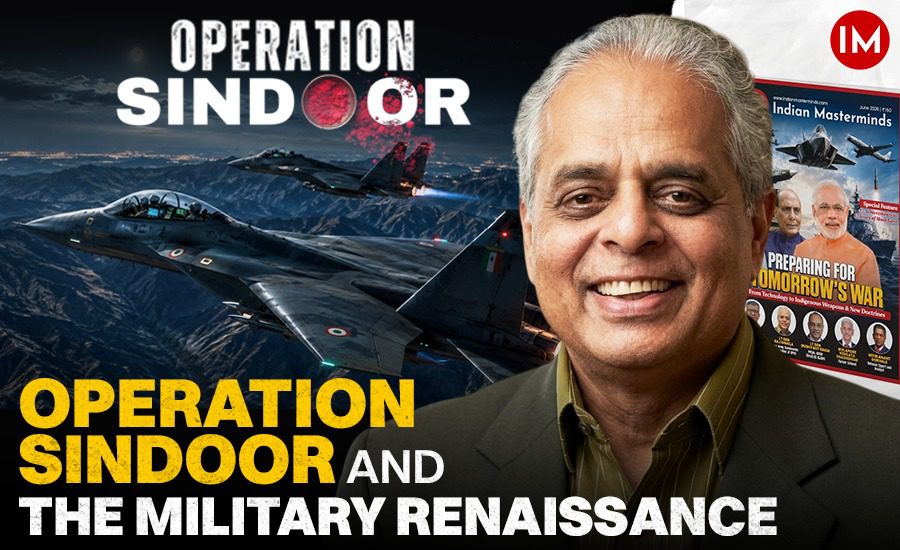
Operation Sindoor was an overwhelming success. Propelled by resolute political will, India demonstrated new normals in its strategic outlook. We called Pakistan’s nuclear bluff. Our airpower was lethal. Our territorial and air defences were robust. Our maritime poise was menacing. Cross-domain synergies were evident. Our leadership was clairvoyant in conflict initiation as also astute in its termination. On the 10th of May 2025, in sharp contrast, the Pakistani State lay battered, its defences shattered, its skies naked, its leadership scampering for cover, begging (through international interlocutors) for mercy.
A Benchmark
Op SINDOOR is indeed a benchmark in India’s strategic evolution, bolstered by a series of path-breaking, reforms: the installation of a CDS/DMA, doctrinal re-jigs, Aatmanirbharta in Defence with the innovation, energy and enterprise of the private sector/start-ups at its heart, defence coming out of the shadows of foreign policy, et al. On the first anniversary of the seminal moment while there is much to celebrate, greater wisdom would lie in leveraging the event as a springboard for wider, deeper, reforms to complete India’s national security makeover.
Five Metrics of a Global Military Renaissance
Accelerating multiple, cultural transitions and structural transformations is critical for two reasons. One, is the need to respond to the gravity of challenges in our strategic calculus and two, more importantly, the imperative of keeping pace with a military renaissance that is sweeping the global landscape. Five metrics of the military renaissance, stand out for embrace in the Indian context: the power of combat asymmetry; a transition from mere jointness & integration to deeper cross-pollination and civil-military fusion; strategic adjustments to the humongous changes in the character of war, business modelling & the military market place; the advent of dronery as supreme warcraft; and the salience of AI & algorithmic warfare in the modern combat taxonomy.
Also Read – Beyond Policing: How IPS Bhojram Patel Is Empowering Villages Through ‘Pahal’ in Chhattisgarh’s Mungeli
The Ukraine Lesson
Consider this – Ukraine, a country without an Air Force or a Navy, on the back of low-cost, technological innovation, has held one of the world’s most powerful militaries, Russia, at bay for more than four years. First-person-view racing drones (FPVs), have been repurposed by Ukrainian soldiers into precision weapons; drone missions now peaking to 11,000 a day, account for an estimated 60 per cent of Russian battlefield losses. In concert with an AI enabled command and control system – Delta, dronery has created a digital, kill web; for about 40 km on either side of the frontier, tanks cannot move, artillery has been pushed back 40 km and therefore outranged, even infantry soldiers are identified by surveillance drones and taken out by FPVs in minutes. Software innovations are being delivered to the frontline every two weeks; drones are moving from remote to algorithmic control; edge and swarming, are taking dronery to a new, lethal, high. This year, Ukraine plans to procure eight million drones, more than the artillery they fired last year. The Russians, who at the start
of the conflict trailed the Ukrainians in AI and dronery by six years, have now narrowed the lag to two. Last month, the Russians fired an AI enabled, fully autonomous (selection and engagement of targets by machines, not humans), drone swarm, with HUMANS OUT OF THE LOOP.
Big Is Not Necessarily Lethal
In EPIC FURY, the $20,000 Iranian Shahed drone has proven to be as potent as the million-dollar Tomahawk. In the missile mathematics too, the Shaheds have a distinct edge – for every dollar Iran spends in manufacturing a Shahed, it costs the adversary $28 to intercept it. Every Shahed engaged by a Patriot PAC-3 interceptor represents a 114-to-1 cost disadvantage for the defender. The Americans and their gulf allies are deploying the Ukrainian MEROP (counter-drone system) along with drone hunting teams, to protect US military bases and other critical infrastructure. The formidable, three carrier group US Navy in the Gulf, has sunk the bulk of the Iranian Navy to the bottom of the sea, yet, is unable to enter the strait and vacate the Iranian blockade because it is not small enough, agile enough, unmanned-enough, asymmetric enough. So, BIG IS NOT NECESSARILY LETHAL. War-winning, combat lethality, at lower cost also seems to be the new combat mantra.
The New Autonomy of War
Across combat theatres meanwhile, Algorithmic warfare has signaled its arrival. A larger number of smaller, swarmable, attritable, cheaper platforms are outperforming the expensive platforms – abundance is more salient than the exquisite. Autonomy is the new buzzword even as offensive AI drives modern combat. Stealth drones, CIA operators on ground, Claude (Anthropic’s LLM) in concert with Maven (Palantir’s AI enabled, command & control system) were central to the development of the ‘pattern of life capacities’ that enabled the extraction of Maduro in ABSOLUTE RESOLVE. Based on weeks of monitoring data, natural language queries were addressed to Claude AI to determine the precise points of insertion and extraction for the Delta Force. A combination of LEO capacities in space, cyber expertise and cutting-edge talent honed in Units 8200 and 9300 have given Israel the OFFENSIVE ISR capacities to penetrate adversary regimes, decapitate Hassan Nasrallah on 27 September 2024 and fifty top Iranian leaders between 8.10 and 8.15 am on 28 Feb 2026. The 15,000 airstrikes that the American and Israeli air forces have carried out in EPIC FURY have been possible only because the targeting packages are powered by AI-driven machine and not human speed. The vehicles of combat delivery are also metamorphosing – startups like Palantir, Space-X, Buntar Aerospace, Airlogix, and Anduril, and not traditional primes like Boeing and Lockheed Martin, are leading the military renaissance. Anduril with Palmer Luckey at the helm has turned out an AI-enabled, unmanned, near-stealth, fighter platform, YFQ-44 Fury in a mere 568 days – such is the business agility and pace of delivery.
Budgeting for Tomorrow’s Wars
The Union Budget 2026-27, pledges 2.2 lakh crores, specifically, for defense modernization. In the light of the ongoing military renaissance, MoD and the wider national security system, need to re-imagine the metrics of our defence budgeting. What we need most, is an urgent, review of how we spend the 2.2 lakh crores to achieve greater lethality at lower cost? At least 40-50% of the allocations for modernization, should be funneled into dronery, data readiness, sovereign AI, algorithmic warfare, military robotics, cloud infrastructure, space, electronic attack, cyber, maritime dominance, pattern of life competencies, offensive ISR, et al, if the Indian military is to modernise at the speed of relevance. Transformation@tinkering will not do. If our defence spending does not reflect the afore stated transformations, we are preparing for the last and not the next war, with debilitating consequences for our military readiness. If at least 30% of the orders are not going to start-ups, our defence procurement pipelines are simply not futuristic and agile enough.
Deregulate and Deliver
Whence combat innovations are being delivered in weeks, we cannot be churning out RFPs in months and years. The financial management structure needs a revamp: the processes and procedures in vogue, were designed for a monopsony market (one buyer, monopoly sellers, no competition, limited choices); they need to be unwritten and re-framed for a technology/innovation driven market. The problem in defence is not paucity of funds, but an over-regulated framework and a lack of orders at pace and scale. If we de-regulate with purpose, we will find that there is no dearth of business opportunities in national security; such opportunities are only waiting to explode.
Time to Step Up
In sum, a re-think in our strategic outlook, our culture and structures, a re-imagination of our defence budgeting a re-modelling of acquisition modalities, and the military market-place are called for.
India, today, is not only the fourth largest economy (the marginal drop is temporary); the 2025 Global AI Vibrancy Tool released by Stanford University ranked India third globally in AI competitiveness; the Lowy Institute’s 2025 Asia Power Index, ranked India the third most powerful country in Asia, describing it as a “major power.” In many metrics of weight, influence and capacity, India trails just the two super-powers, USA and China. Now that India is in the big league, it needs to step up its game in national security; focus on ways to convert its considerable weight and influence into ready and deployable power.
There is a huge reservoir of political will for further reform; for the right initiatives, economic resourcing will also be forthcoming.
The leadership of the civil-military-technological-financial-administrative bureaucracies, must now pick up the gauntlet and complete a historic, national security makeover.
(Lt Gen Raj Shukla (Retd) is a former Army Commander and member of UPSC.)
Also Read –The New Power Cadres: How Haryana and Rajasthan Became the Top Choice for Civil Service Couples