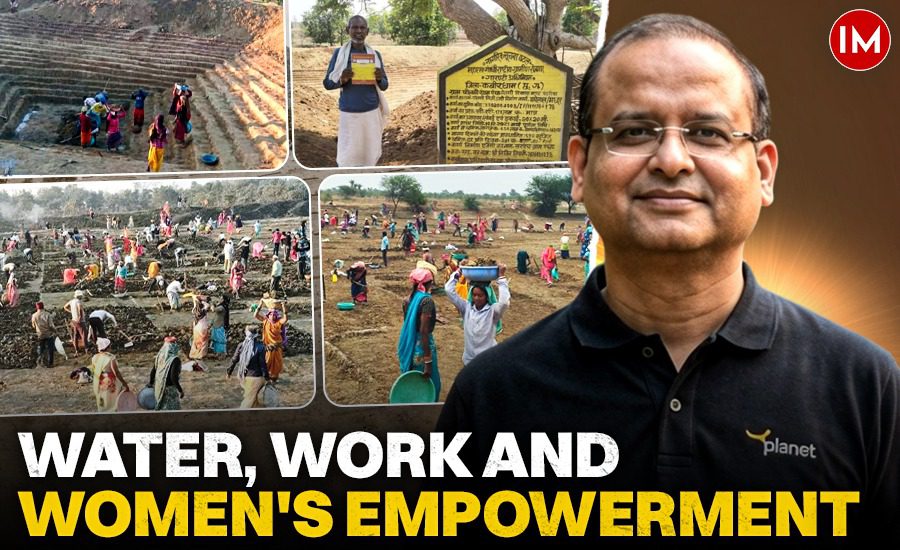
When people think of MGNREGA (VB-G RAM- G) , they often think of rural employment and wage generation. But in Chhattisgarh, the programme has quietly evolved into something far more transformative. Across villages, ponds are filling up, groundwater is improving, livelihoods are expanding, and communities are beginning to take ownership of their natural resources.
At the heart of this transformation is Taran Prakash Sinha, IAS, a 2012-batch Indian Administrative Service officer of the Chhattisgarh cadre. Currently serving as Commissioner, MGNREGA, Chhattisgarh, with additional charge as Director, Pradhan Mantri Awas Yojana-Gramin, Sinha has reimagined the country’s largest rural employment programme as a vehicle for long-term water security, ecological restoration and sustainable livelihoods.
Under his leadership, Chhattisgarh launched the ambitious “Mor Gaon–Mor Paani” (My Village, My Water) campaign on April 24, 2025. What began as a water conservation initiative has today grown into one of India’s largest community-led rural development movements, creating over one lakh water conservation and augmentation structures worth nearly ₹1,610 crore while providing employment to more than 11 lakh rural workers every day.
Speaking to Indian Masterminds, Sinha explained that the campaign was never meant to be just another government scheme—it was designed to fundamentally change how villages think about water.
A VISION BEYOND EMPLOYMENT
For decades, MGNREGA has been viewed primarily as an employment guarantee programme. Sinha believed it could do much more.
“The basic vision was to use MGNREGA not only for providing employment but also for creating long-term assets for water security, livelihood improvement and sustainable rural development. We wanted to move from a blue water economy to a green water economy, where water conservation is connected with agriculture, ecology and income generation,” he told Indian Masterminds.
Also Read – Jal Ganga Samvardhan Abhiyan: How Madhya Pradesh Is Turning Water Conservation into a People’s Movement
That vision reshaped the programme’s priorities.
Instead of viewing water conservation merely as an infrastructure activity, Chhattisgarh began integrating it with agriculture, watershed management, climate resilience and rural incomes. Every village was encouraged to understand its own water resources and become responsible for protecting them.
MOR GAON–MOR PAANI: A PEOPLE’S MOVEMENT
The campaign’s greatest achievement lies not in the number of structures created but in the change in public participation.
Over one lakh water conservation and augmentation assets have been created across the state. These include check dams, farm ponds, recharge structures and watershed interventions designed using scientific planning principles.
Rather than treating villagers as beneficiaries, the programme encouraged them to become planners, implementers and custodians of their own water resources.
Gram Sabhas, Panchayati Raj Institutions, women’s groups, youth organisations and civil society have all become active partners in planning and maintaining these assets.
The campaign reflects the philosophy of “Sabka Saath, Sabka Vikas, Sabka Prayas,” where government and communities work together to build long-term resilience.
TURNING WATER INTO LIVELIHOODS
One of the most innovative aspects of the initiative has been linking water conservation directly with income generation.
More than 14,000 Aajeevika Dabaris—small livelihood ponds—have been created on the private lands of vulnerable rural families.
These ponds are no longer simply water storage structures. They have become income-generating assets supporting fisheries, horticulture, agriculture and allied activities.
Similarly, over 600 community ponds under the “Nava Tariya–Aay Ke Jariya” (New Pond, New Source of Income) initiative are creating shared livelihood opportunities, particularly for Women’s Self-Help Groups.
Another remarkable example is the convergence with Pradhan Mantri Awas Yojana-Gramin, where beneficiaries of over 1.5 lakh rural houses voluntarily installed rainwater harvesting systems using their own resources, reinforcing a culture of water conservation at the household level.
SCIENCE AT THE HEART OF PLANNING
Unlike conventional rural development programmes that often rely on local estimates, Chhattisgarh has integrated modern technology into every stage of planning.
GIS-based Yuktadhara planning, the CLART application and ridge-to-valley watershed principles help identify the most suitable locations for water conservation works.
The Jaldhoot groundwater monitoring system regularly measures groundwater levels through open wells, while Panchayats publicly display groundwater data and village water budgets.
These innovations allow communities to understand how much water they have, how much they consume and what they need to conserve.
The result is scientific planning rooted in local realities.
MAKING TRANSPARENCY A DAILY PRACTICE
Transparency has become another defining feature of the Chhattisgarh model.
Every Gram Panchayat now has QR codes through which villagers can access details of sanctioned, ongoing and completed works.
Regular initiatives such as Employment Day, Housing Day, public dialogues and social audits have strengthened accountability and improved trust between citizens and government institutions.
Digital governance has ensured that transparency is no longer confined to government offices but reaches every village.
FROM PARTICIPATION TO PARTNERSHIP
For Sinha, perhaps the biggest success has been changing people’s mindset.
“The biggest achievement has been the shift from government-led work to a people-led movement. Communities should move from participation to partnership and take ownership of assets. When water conservation is linked with livelihoods, ownership becomes much stronger because people see direct economic benefits,” he said.
Districts such as Rajnandgaon, Balod and Kanker have emerged as examples where Panchayats, civil society organisations and local communities have jointly created and maintained water assets while generating sustainable livelihoods.
The focus has shifted from constructing physical structures to building lasting community institutions.
THE ROAD TO VIKSIT BHARAT 2047
The journey is far from over.
From 1 July, the new VB-G RAM G framework will build upon the achievements of MGNREGA, with renewed emphasis on employment generation, water security, infrastructure creation and sustainable livelihoods.
Drawing lessons from the success of “Mor Gaon–Mor Paani,” the future roadmap will continue focusing on watershed development, groundwater conservation, scientific planning and livelihood-oriented assets.
The larger goal is to contribute to the vision of Viksit Bharat 2047 by creating villages that are not dependent on government schemes but capable of shaping their own future.
As climate change makes rainfall increasingly unpredictable, Chhattisgarh’s model offers an important lesson for the rest of the country. Water conservation cannot succeed through government spending alone. It requires scientific planning, community ownership and economic incentives that make conservation meaningful for ordinary citizens.
Under the leadership of Taran Prakash Sinha, IAS, MGNREGA in Chhattisgarh has become much more than an employment programme. It has evolved into a blueprint for sustainable rural development—where every pond created, every drop conserved and every livelihood generated strengthens not only villages but also India’s journey towards long-term water security.
Also Read – How IRS Dr. Sudhakar Naik and a Young Environmentalist Built a Water Conservation Model for Rural Telangana