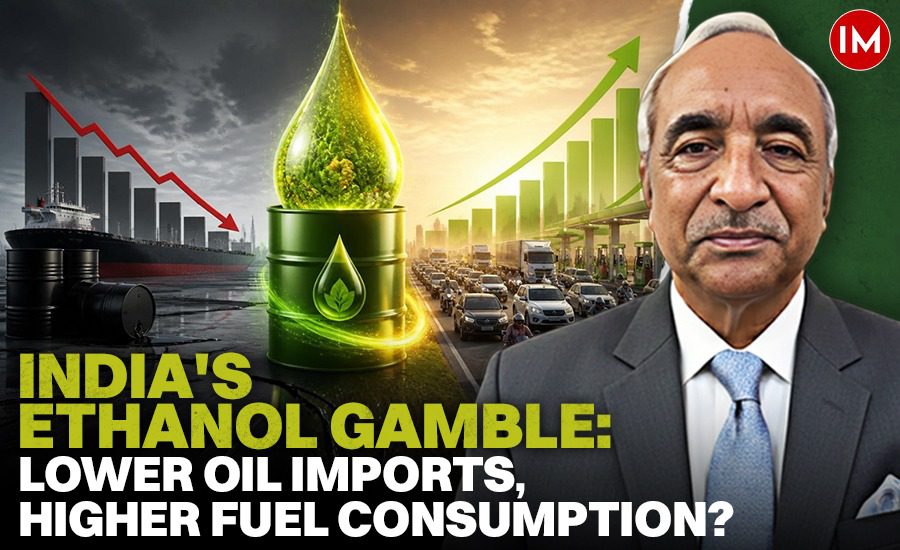
Ethanol contains roughly 30-33% less energy per litre than pure gasoline. Pure petrol delivers about 32-34 megajoules per litre; ethanol hovers around 21-23 MJ/L. A 20% blend therefore packs roughly 6-7% less energy by volume. This inherent energy deficit is the root cause of any mileage reduction, writes former IAS officer V.S.Pandey
As motorists across India fill up at petrol pumps, a quiet but heated debate simmers: Is the government’s ambitious ethanol blending programme saving the nation’s foreign exchange at the cost of your wallet and vehicle health? With E20 — petrol mixed with 20% ethanol — now standard, my own experience and plethora of drivers report varying drops in mileage, while officials insist the benefits far outweigh the drawbacks. But what does the science actually say?
The physics is straightforward. Ethanol contains roughly 30-33% less energy per litre than pure gasoline. Pure petrol delivers about 32-34 megajoules per litre; ethanol hovers around 21-23 MJ/L. A 20% blend therefore packs roughly 6-7% less energy by volume. This inherent energy deficit is the root cause of any mileage reduction.
Real-world testing confirms this. A September 2025 Autocar India study on contemporary vehicles — Maruti Dzire, Tata Punch, Skoda Kylaq, and Hyundai Creta N Line — found mileage drops ranging from 3.8% in the Dzire to a sharper 12.6% in the Creta when switching from E10 to E20 under controlled conditions. Carmakers privately acknowledge 7-8% impacts in some cases, while the Automotive Research Association of India (ARAI) estimates 1-6% overall. Government sources, including the Ministry of Petroleum and Natural Gas, maintain that modern E20-calibrated vehicles (mandatory for new models since 2023) see only 1-2% loss, with older vehicles experiencing 3-6%.
Also Read – World Camel Day Special : How Rajasthan Is Fighting to Bring Back Its Camels
Consumer surveys tell a more varied story. A LocalCircles poll of over 36,000 respondents found significant numbers reporting 10-20%+ drops, particularly in pre-2023 vehicles. Social media amplifies these anecdotes, with some claiming 20% or more. However, officials attribute much of this to confounding factors: driving habits, traffic, tyre pressure, AC usage, maintenance, and the transition period itself. Long-term ARAI tests on legacy vehicles over 1 lakh km reportedly showed no engine failures, no abnormal wear, and only marginal mileage impacts (2-6%).
Ethanol’s solvent properties raise legitimate concerns about rubber seals, hoses, fuel pumps, and other components in older vehicles. Yet, extensive testing by ARAI, Indian Oil Corporation (IOCL), and the Society of Indian Automobile Manufacturers (SIAM) suggests compatibility for most vehicles, especially those post-2009 from certain makers. Newer BS-VI Phase 2 models are fully tuned for E20, often benefiting from ethanol’s high octane rating (around 100+ RON), which improves knock resistance and can allow slight efficiency gains in optimized engines through advanced timing or higher compression. International studies, including from the US DOE and others, align broadly: volumetric fuel economy drops near the energy content deficit, but some optimized or high-compression setups partially offset this via better thermal efficiency. In India, SIAM emphasizes that any individual pain is dwarfed by national gains.
India imports over 85% of its crude oil. The Ethanol Blended Petrol (EBP) programme, ramped up since 2014, has delivered tangible results. Cumulative savings are reported at ₹1.4-1.67 lakh crore in foreign exchange, substituting 245-302 lakh metric tonnes of crude and cutting CO₂ emissions by 700-850 lakh tonnes — equivalent to planting hundreds of millions of trees.
At E20 scale, annual forex savings are projected around ₹40,000-43,000 crore, with substantial payments to farmers (₹35,000-40,000 crore yearly). It supports rural economies, reduces sugar sector arrears, and provides a buffer against global oil shocks. The programme hit E20 targets ahead of schedule in 2025, a policy success by any measure.
However, the mileage penalty complicates the math. To travel the same distance, vehicles consume more blended fuel by volume. While ethanol displaces imported petrol components, the net crude oil reduction is somewhat less than the nominal 20% blend suggests. Ethanol pricing, subsidies, and domestic production costs also factor into the true economic picture. Still, officials argue the overall energy security, farmer income, and environmental dividends justify it.
Critics highlight deeper trade-offs. Much ethanol comes from 1G (first-generation) sources — sugarcane (water-guzzling) and food/feed grains like maize and rice, sometimes from public stocks. This shifts agricultural priorities. The Economic Survey and experts have flagged risks to pulses, oilseeds, and nutritional security, plus groundwater strain and potential food price volatility. Diversion of maize and rice raises “food versus fuel” concerns, especially amid erratic monsoons. Scaling second-generation (2G) ethanol from agricultural waste, stubble, and non-food biomass is critical to mitigate this, but 2G capacity lags. Without faster progress here, the programme risks unintended consequences for India’s food system.
Lifecycle emissions benefits are real for tailpipe pollutants (lower CO, HC in many cases) but depend heavily on feedstock and production methods. Full well-to-wheel accounting is more nuanced than simple tailpipe claims.
Is E20 a wise decision? In India’s context — massive oil import dependence, vast agricultural base, and need for rural support — it represents a pragmatic, scalable intervention. It has demonstrably cut the oil import bill, boosted farmer incomes, and advanced cleaner fuel goals. New vehicles handle it well, and legacy fleet issues appear manageable with routine maintenance.
Yet expectations must be tempered. The mileage reduction is real, rooted in basic thermodynamics, and imposes a modest but noticeable cost on consumers, especially owners of older vehicles. It does not fully “defeat” the import reduction objective but dilutes it. Broader challenges around food security, water use, and 2G scalability persist. Higher blends (E22-E30 incentives are emerging) or flex-fuel vehicles could amplify both benefits and drawbacks.
Complementary strategies are essential- stricter fuel efficiency norms, accelerated EV adoption, public transport investment, and aggressive 2G/3G biofuel development. As India eyes net-zero by 2070, ethanol blending is one tool in the kit — valuable, but requiring careful stewardship.
For the average driver, the advice is practical: Maintain your vehicle, monitor real mileage under consistent conditions, and consider E20-compatible upgrades if issues arise. Manufacturers generally honor warranties. Nationally, continued transparent monitoring, data-driven adjustments, and a shift toward non-food ethanol pathways will determine if this bold experiment delivers enduring success.
As of mid-2026, with E20 entrenched and discussions of further increases underway, the programme stands as a significant achievement in energy diversification. The full picture, however, reveals it as a complex balance of physics, economics, agriculture, and environmental priorities — one that demands open and honest ongoing scrutiny and adaptation. Government is duty bound to present the true picture of the pros and cons and not shy away from transparent debate on the subject.
(Vijay Shankar Pandey is former Secretary Government of India)
Also Read – The CBSE Crisis And The Government Procurement Process: The devil is in the details