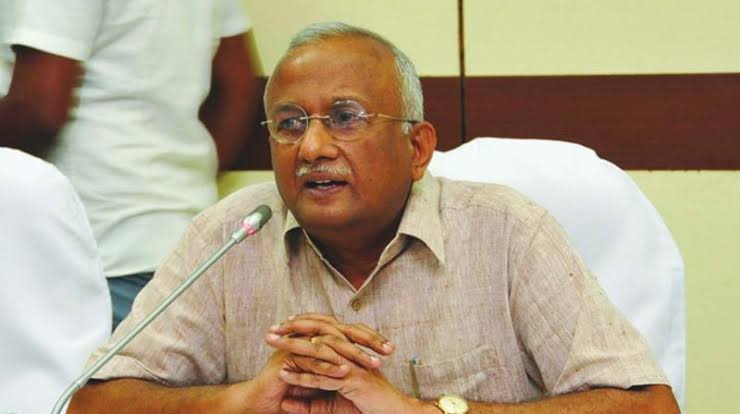
Thiruvananthapuram/New Delhi: Former Kerala Chief Secretary S.M. Vijayanand, a retired IAS officer of 1981 batch, one of the architects of Kerala’s landmark People’s Planning initiative, has strongly criticised the growing trend of serving IAS officers making political comments in public, saying such conduct violates the very principles of the civil services.
In an interview with The New Indian Express, the Kerala cadre IAS officer also reflected on three decades of decentralised governance, his experiences working with different political dispensations, Prime Minister Narendra Modi, and the future of India’s bureaucracy.
Public Political Commentary by IAS Officers ‘Unacceptable’
Mr Vijayanand was unequivocal in his criticism of bureaucrats engaging in political debates or publicly criticizing governments.
According to him, civil servants voluntarily surrender a part of their freedom of public expression when they join the service. Differences with ministers or governments should be expressed only through institutional mechanisms such as official files, meetings, or recorded dissent—not through media appearances or social media.
Read Also: What Is Article 300A? Why Did the Kerala High Court Strike Down the Kerala Minerals Vesting Act
He warned that the growing culture of self-projection and public political commentary could undermine the neutrality and credibility of the civil services.
“The civil service academy teaches three core principles—anonymity, integrity and neutrality. Officers are part of an institutional machinery, not individual celebrities,” he observed, attributing much of the recent trend to the rise of social media and weakening enforcement of conduct rules.
People’s Planning: A Success, But Momentum Has Slowed
Looking back at Kerala’s celebrated People’s Planning initiative, which completes 30 years, Vijayanand gave the programme “pass marks” when measured against its original ambitions but called it a phenomenal achievement compared to the rest of India.
He said the initiative significantly improved rural participation in development, expanded minimum-needs infrastructure, and transformed public service delivery, particularly in government hospitals.
However, he acknowledged that the strong political commitment that initially drove decentralisation has weakened over time.
According to him, People’s Planning requires:
- Strong political commitment and ideological clarity.
- Active involvement of the top bureaucracy.
- Continuous engagement of district collectors and local bodies.
He also noted that while the second Pinarayi Vijayan government announced a “Second People’s Plan,” it never gained sufficient political momentum.
Unsung Leaders Behind Decentralisation
Vijayanand credited former Local Self-Government Minister Paloli Mohammed Kutty for his quiet but invaluable contribution to decentralisation.
He also praised former Chief Minister A.K. Antony, saying Kerala’s decentralisation process could have suffered serious setbacks without his support in 2001.
He recalled that the original vision of People’s Planning extended beyond administrative reforms to reducing corruption, narrowing the gap between citizens and government, and making governance more participatory.
Waste Management Still a Work in Progress
On Kerala’s long-standing waste management challenge, ex-IAS Vijayanand admitted that a complete solution remains elusive.
However, he highlighted the Kudumbashree waste collection model as a major innovation covering nearly 70-80 percent of the state and simultaneously creating livelihood opportunities for poor women. Even so, he said much more remains to be done, especially in urban areas.
From Kerala to Delhi: Lessons in Rural Development
Reflecting on his decade-long tenure with the Union Government, Mr Vijayanand described it as one of the most rewarding phases of his career.
Initially serving under Jairam Ramesh, he later became Secretary in the Ministry of Panchayati Raj.
He revealed that despite severe budget cuts reducing the ministry’s allocation from ₹8,000 crore to just ₹90 crore, his team transformed the department by introducing the Gram Panchayat Development Plan (GPDP), inspired by Kerala’s decentralisation model.
Remarkably, all 29 states at the time voluntarily adopted the framework without any formal directive from the Centre, with Telangana becoming the first state to implement it.
Working with PM Narendra Modi
Sharing his interactions with Prime Minister Narendra Modi, Mr Vijayanand described him as approachable, development-focused and deeply interested in rural development during his early years in office.
He recalled that Modi personally reviewed rural development programmes and held several one-to-one meetings to discuss implementation.
According to Vijayanand, the Prime Minister showed particular interest in rural roads and centrally sponsored schemes, although he was less enthusiastic about MGNREGA.
He also recounted how Modi had appreciated Kerala’s Kudumbashree model even before becoming Prime Minister and publicly acknowledged learning from Kerala’s experience in Parliament.
Oommen Chandy and Pinarayi Vijayan: Different Styles, Shared Focus
Having served as Chief Secretary under both Oommen Chandy and Pinarayi Vijayan, Mr Vijayanand avoided political comparisons but praised both leaders for different qualities.
He described Oommen Chandy as deeply pro-poor and someone who could separate politics from personal compassion.
Pinarayi Vijayan, on the other hand, was described as highly decisive, systematic and focused on leaving a lasting administrative legacy. Vijayanand recalled enjoying significant administrative freedom during his tenure and said the Chief Minister regularly held one-on-one review meetings with him.
He also noted that Kerala’s coalition-based political structure naturally limits the authority of the Chief Secretary compared to several other states.
Views on Governance and Civil Service Reforms
The veteran bureaucrat also shared his views on several contemporary issues.
He questioned the effectiveness of lateral entry into senior civil service positions, arguing that administrative experience accumulated through years in government cannot easily be replicated by outside professionals, though he acknowledged that specialists could contribute in technical domains.
On Kerala’s finances, he advocated stronger revenue mobilisation instead of attempting unrealistic expenditure cuts, suggesting user charges and other innovative revenue sources.
He also said local governments remain underutilised and should be entrusted with greater responsibilities in healthcare, elderly care, agriculture, disability services, tribal welfare and fisheries.
Reflecting his personal philosophy, Vijayanand revealed that after retirement he declined remuneration for official assignments, inspired by legendary civil servant S.R. Sankaran, believing that post-retirement public service should not be viewed as a personal entitlement.
Read also: Kerala High Court Cracks Down on Cybercrime-Linked Bank Account Petitions Warns Junior Lawyers