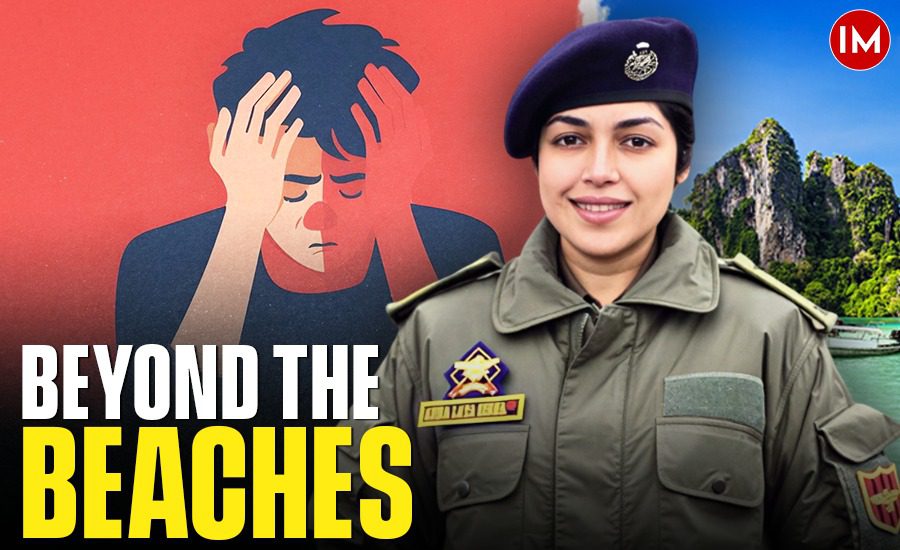
By all appearances, the Andaman and Nicobar Islands are a postcard paradise.
Every evening in Port Blair, tourists walk along the shore beneath orange-pink skies, children run across beaches, and the sea glimmers under fading sunlight. For many visitors, the islands are a place of escape and happiness.
But for IPS officer Anna Sinha (2022 batch, AGMUT cadre), who served as a probationer in Port Blair, the beauty of the islands stood in sharp contrast to a troubling reality.
Behind the postcard image lies one of the country’s most alarming suicide crises.
The Union Territory records a suicide rate of 37.89 per lakh population — more than three times the national average of 12.4 in 2022. South Andaman district is the most vulnerable, with a suicide rate of 51.09, nearly four times the national average.
For a police officer, the numbers raised difficult questions.
THE DISTURBING NUMBERS
Why, in a place where violent crime and stress-related offences are not as widespread as in many other regions, are so many people choosing to end their lives?
To understand the crisis, Anna Sinha turned to State Crime Records Bureau data.
The data revealed that the most vulnerable sections are government employees and private salaried workers. Government servants have a suicide rate nearly ten times the national average, while private salaried employees face a rate almost five times higher.
The most affected age group is between 30 and 45 years old, accounting for nearly 40 per cent of all suicide cases.
The reasons behind these deaths also differ sharply from the rest of India.
Across the country, family problems remain the leading cause of suicide, accounting for nearly one-third of cases according to the National Crime Records Bureau. In the Andaman and Nicobar Islands, however, illness and old age emerge as the leading causes, followed by depression and loneliness.
This suggests that the crisis is not merely economic or domestic. It is deeply emotional, psychological, and social.
THE GEOGRAPHY OF ISOLATION
One explanation lies in the geography of the islands themselves.
The field of geographical psychology suggests that isolation can intensify feelings of helplessness. When people feel trapped, with limited access to support systems or opportunities for change, they may begin to see life as a dead end.
The Andaman and Nicobar Islands are particularly vulnerable to this phenomenon.
With a sparse population density of just 46 persons per square kilometre, people are spread across far-flung islands separated by long stretches of sea. Direct connectivity to mainland India remains limited, with only a handful of flights and ships available.
For many residents, emotional isolation is reinforced by physical isolation.
A SOCIETY IN TRANSITION
The islands are also home to a uniquely mixed society. Local tribal communities, descendants of freedom fighters, and settlers from states such as Tamil Nadu, Kerala, Bihar, and West Bengal have lived together for decades.
Over time, inter-community marriages and migration weakened many traditional kinship networks. Extended family structures that once provided emotional support became less prominent.
At the same time, social problems such as alcoholism, drug abuse, domestic violence, and extramarital affairs became increasingly common in some areas. These unstable family environments often create long-term emotional distress.
THE LONG SHADOW OF THE TSUNAMI
The 2004 tsunami also transformed island life in ways that continue to be felt.
Families displaced by the disaster were relocated to safer areas and supported with land, monthly rations, and financial assistance. While the assistance helped rebuild lives materially, it also disrupted traditional ways of living.
Communities that had once depended on physically demanding occupations and tightly knit social structures gradually became detached from their roots.
According to IPS Anna Sinha, “A society that once survived on resilience and hardship slowly became more emotionally fragile.”
In some cases, even relatively minor disappointments — such as not receiving an expensive gadget or failing to meet social expectations — have reportedly triggered extreme reactions.
WHAT NEEDS TO CHANGE
For Ms Sinha, addressing the crisis requires far more than reactive policing.
The first step is better data.
The unnatural deaths proforma currently used to record suicide cases often captures only surface-level causes. It rarely documents important risk factors such as unemployment, education levels, substance abuse, income status, or family history.
Without such information, it becomes difficult to identify patterns, high-risk communities, or emerging hotspots.
Ms Sinha argues that suicide data collection should be redesigned with detailed tick-box categories, allowing investigating officers to record multiple socioeconomic and emotional factors behind each death.
She also recommends regular audits of suicide records by the State Crime Records Bureau to prevent errors and improve the quality of data.
Another major gap lies in the investigation process itself.
Inquest officers often record the cause of death superficially, without probing deeper into the emotional, financial, or social circumstances that may have pushed a person toward suicide.
Training investigating officers to identify underlying mental health issues could help create a much clearer picture of the crisis.
BUILDING SUPPORT SYSTEMS
At the community level, Ms Sinha believes the islands urgently need a dedicated 24×7 suicide prevention and surveillance cell staffed by mental health professionals.
Such a system could work in collaboration with schools, NGOs, Panchayati Raj institutions, district administrations, and the Directorate of Health Services.
She also advocates targeted outreach programmes, especially for the elderly and those suffering from illness, who make up a large share of suicide victims.
Healthcare professionals should be present at public melas, welfare camps, and police outreach programmes. Schools and colleges can incorporate emotional resilience training, peer support groups, and anger management workshops.
Small-scale crowd-funded insurance schemes and welfare initiatives may also help reduce feelings of insecurity among vulnerable families.
The Andaman and Nicobar Islands are often remembered by travellers as a place of beauty, peace, and escape.
But for many residents, life on the islands can feel lonely, uncertain, and emotionally exhausting.
Anna Sinha believes the crisis can no longer remain hidden behind the region’s tourist image.
If the islands are to become a true paradise, they must not only offer happiness to visitors but also hope to the people who call them home.
Those in distress can contact the Lifeline Foundation at (033) 24637401 / 32.