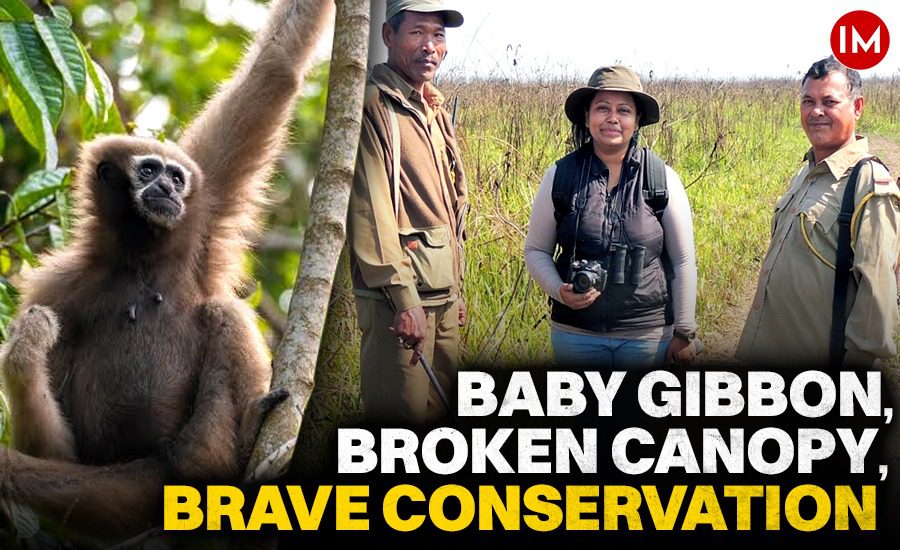
A baby western hoolock gibbon rescued from Assam’s Golaghat district in April 2026, after her mother died due to electrocution, has become the focus of a wider conservation story at the Centre for Wildlife Rehabilitation and Conservation near Kaziranga. The recovery is an example of growing scientific effort to rehabilitate India’s only ape species, which is increasingly threatened by habitat fragmentation and power-line infrastructure.
The case also highlights the evolving conservation approach led by officers like Sonali Ghosh, whose work in Kaziranga and beyond has strengthened ecosystem-based management, scientific monitoring, as well as greater inclusion of women in frontline forest protection.
In exclusive conversation with Indian Masterminds, 2000 batch Indian Forest Service (IFS) Officer Sonali Ghosh talks about the Hoolock Gibbon’s rehabilitation, her own experiences in the Forest Service and learnings from the field.
Baby gibbon lost in a ‘broken forest‘
‘A single rescue in Golaghat shows larger crisis of fragmented forests and broken canopy corridors.’
In April 2026, a few-week-old western hoolock gibbon was found in Assam’s Golaghat district clinging to her dead mother, who had been electrocuted by a live power line. The infant was barely three to four weeks old, completely dependent on maternal warmth and care. She was immediately shifted to the Centre for Wildlife Rehabilitation and Conservation near Kaziranga National Park, where intensive neonatal care began.
Read Also: From Disappointment to Destiny: How an IFS Officer Found His Purpose in Bihar
The incident once again brought attention to how linear infrastructure- power lines, roads, and plantations has fragmented Northeast India’s canopy forests. With estimates suggesting fewer than 5,000 hoolock gibbons remaining in India, every such loss carries disproportionate ecological weight. The species survives only in scattered forest patches, where even a single gap in tree cover can become fatal.
Inside the rehabilitation room: Science built on patience, not speed
‘Rehabilitation of a gibbon is less about rescue and more about rebuilding a childhood interrupted.’
At CWRC, the infant gibbon was placed under continuous monitoring, receiving warmth, specialised milk, and gradually, natural foods like figs and bamboo shoots. Within weeks, she began showing signs of recovery: weight gain, alertness, and tentative movement. Caregivers introduced climbing structures to rebuild what the forest would normally teach in the first months of life. Hoolock gibbons, being highly social primates, depend entirely on maternal learning for survival, especially for foraging and canopy navigation.
In many cases, even successful physical recovery does not guarantee survival in the wild unless behavioural instincts are carefully restored. Experts involved in such rehabilitation stress that human imprinting remains the most serious risk, often deciding whether an animal can ever rejoin a wild troop.
Sonali Ghosh: Forest officer shaped by field, science, and continuity of work
‘Lived field experience and academic grounding can reshape the way conservation is understood and practiced in India.’
Indian Forest Officer Sonali Ghosh was born in Dehradun in a family with an Army background, a childhood that moved across landscapes and exposed her early to forests, wildlife, and field life. This early familiarity with nature gradually shaped her path toward forestry, leading her to join the Indian Forest Service in the 2000 batch, where she emerged as a topper of her batch. Her academic journey is equally layered, combining forestry and wildlife science with a Master’s in Wildlife Conservation, a postgraduate diploma in Environmental Law, a degree in Systems Management, and a PhD in Geography focused on landscape ecology and habitat modelling.
Her field career runs across some of India’s most ecologically sensitive landscapes, including Assam’s Kaziranga and Manas regions, Chakrashila Wildlife Sanctuary, and later institutional and research roles at national level. In these early postings, she worked closely on issues like golden langur conservation, protected area management, and forest governance in challenging field conditions. Over time, her work also extended to the Wildlife Institute of India and later to senior conservation administration, bridging field ecology with policy frameworks.
Her most defining field leadership came when she became the first woman Field Director of Kaziranga National Park, one of India’s most important protected landscapes. Here, conservation thinking moved beyond rhinos alone to a wider ecological frame such as wetlands, freshwater biodiversity, birds, fish, and lesser-known species began receiving structured attention. Long-term ecological datasets, camera trapping, and systematic monitoring became part of daily management, shifting Kaziranga further toward evidence-based conservation. During this period, she also supported the inclusion of women frontline forest personnel, strengthening field protection systems and changing the social fabric of conservation work on the ground.
In her current national roles, including as Director of the National Zoological Park and senior position with the Central Zoo Authority, her focus extends into conservation breeding, zoo governance, and public education. With over 70 species under structured conservation breeding programmes in India, zoos today are being reimagined as conservation institutions rather than display spaces alone.
Kaziranga under her leadership: Megafauna protection to Ecosystem Thinking
‘Kaziranga’s conservation model expanded beyond rhinos into a broader ecological framework during her tenure.’
During her tenure as the first woman Field Director of Kaziranga National Park, Ghosh’s leadership marked a visible shift in conservation priorities. While Kaziranga remained globally known for its one-horned rhinoceros population, which contributes to India’s largest concentration of the species, management attention expanded toward wetlands, fisheries, and lesser-known fauna.
Reports and institutional documentation from this period highlight increasing use of scientific tools such as camera trapping, GIS mapping, and long-term ecological monitoring. The park also recorded strong wildlife numbers in recent years, including a tiger population estimated at around 148 individuals in 2024.
Importantly, Kaziranga also became a space where ecological research extended into less-studied groups such as freshwater fish, turtles, and wetland birds. This show a change in conservation thinking from single-species protection to ecosystem-level understanding, where each species plays a role in ecological stability.
Women in Forest Services: From representation to decision-making roles
‘Rise of women officers is reshaping how forests are protected and managed on the ground.’
Some of the most visible changes during Ghosh’s tenure are the increasing role of women in frontline forest protection and community participation. In Kaziranga and surrounding divisions, over a hundred women forest personnel have been inducted into field roles in recent recruitment cycles. Their presence has been particularly significant in anti-poaching operations and community interface work.
Her leadership also coincided with the establishment of one of India’s early all-women anti-poaching teams, often referred to as “Van Durgas,” operating in challenging floodplain terrain. This shift has not only changed workforce composition but also field dynamics, especially in how communities engage with forest authorities. Women officers and frontline staff are often seen as playing a bridging role in conflict resolution, particularly in areas where wildlife frequently enters human settlements. In many ways, this reflects a larger transformation, where conservation is no longer only enforced from authority, but also built through trust and shared responsibility.
Electrocution lines and broken canopies: Hidden cost of development
‘The greatest threat to arboreal species today is not direct hunting, but invisible fragmentation.’
Across Northeast India, habitat fragmentation has become one of the most critical conservation challenges. For species like the hoolock gibbon, which never descend to the ground, continuity of canopy is essential for survival. When forests are broken by roads, plantations, or transmission lines, animals are forced into unnatural movement patterns.
Electrocution incidents have emerged as a recurring threat where gibbons attempt to cross gaps using power lines. While mitigation measures such as insulated wiring and canopy bridges exist, their implementation remains uneven across landscapes. Conservation practitioners increasingly emphasise that infrastructure planning must integrate ecological connectivity at the design stage itself, rather than as a corrective measure later.
Conservation as governance: Career that bridges field and policy
Now modern conservation leadership is no longer limited to field protection alone.
Beyond Kaziranga, Ghosh’s career includes work in institutional conservation frameworks, including roles linked to the Central Zoo Authority and the National Zoological Park in Delhi. These roles reflect the expanding scope of conservation governance in India, where zoos are increasingly recognised as centres for conservation breeding and public education rather than only exhibition spaces. National frameworks now include over 70 species under structured breeding programmes aimed at long-term species preservation.
Her broader philosophy, as seen across her postings and interviews, emphasises “active management” in conservation where technology, rapid response systems, and community engagement are used alongside traditional protection measures. This approach marks a shift from earlier conservation models that relied primarily on passive protection of habitats.
Small life, and a larger reflection on India’s forest future
‘The survival of one gibbon mirrors the larger question of how India manages coexistence between development and ecology.’
The rescued gibbon in Golaghat continues her gradual recovery, slowly learning to climb, forage, and regain instincts necessary for survival. Her future remains uncertain, dependent on successful behavioural rehabilitation and eventual acceptance into a wild troop. But her story has already become part of a wider narrative, of how fragmented forests, expanding infrastructure, and evolving conservation systems intersect in modern India.
It also limelight the growing presence of women like Sonali Ghosh in leadership roles within conservation, professionals who combine scientific understanding, field experience, and institutional decision-making. In this intersection of a fragile life and a changing leadership landscape lies a deeper truth: conservation today is not only about protecting wildlife, but about rebuilding the conditions that allow forests and the people who protect them, to continue evolving together.