
Deep inside the forests of Chhattisgarh, in a landscape meant to echo with the sounds of elephants, wild buffaloes, and tigers, a silent ecological catastrophe unfolded for over 15 years. Trees were not cut overnight with roaring chainsaws or dramatic forest fires. Instead, they were killed slowly, methodically, and almost invisibly — one girdled trunk at a time.
What was once a dense forest inside the core area of the Udanti-Sitanadi Tiger Reserve gradually transformed into agricultural land dotted with huts and boundary bunds. By the time the full scale of the destruction emerged, nearly 106 hectares of protected forest land had been encroached upon and over one lakh trees had vanished.
The devastation remained hidden for years in a Naxal-affected region where forest patrolling was weak and enforcement inconsistent. But in 2022, when Indian Forest Service (IFS) officer Varun Jain took charge as Deputy Director of the Udanti-Sitanadi Tiger Reserve, the story began to change.
Armed not with weapons but with satellite imagery, drone surveys, digital evidence, and relentless field action, Jain and his team exposed one of the most shocking cases of ecological destruction in recent years. The battle since then has not just been against encroachers, but also against years of institutional neglect, political pressure, violent resistance, and a collapsing ecosystem.
In an extensive conversation with Indian Masterminds, the 2017-batch IFS officer opened up about how the encroachment happened, why it went unchecked for so long, the attacks his team faced, and the ambitious plan now underway to restore the forest and protect one of central India’s most sensitive ecological zones.
A Tiger Reserve Slowly Turned Into Farmland
The Udanti-Sitanadi Tiger Reserve, officially notified in 2009, is among Chhattisgarh’s most ecologically important landscapes. It is home to elephants, leopards, tigers, and one of India’s last remaining wild buffalo populations. It also forms a crucial elephant corridor and contains the catchment area and origin zone of the Mahanadi River — the lifeline of both Chhattisgarh and Odisha.
But soon after the reserve received official notification, a dangerous trend began to emerge.
Also Read – How Prajesh Kanta Jena Used One Tribal Flower to Stop Forest Fires and Double Village Incomes
According to Varun Jain, many people believed that if they occupied land inside the Tiger Reserve, they would eventually receive hefty compensation during relocation drives.
“This Tiger Reserve was officially notified in 2009. At that time, a certain trend was emerging — encroachment was taking place on a massive scale,” Jain told Indian Masterminds.
“The mindset was: ‘Let us encroach upon land inside the Tiger Reserve. When displacement happens later, we will receive compensation from the government.’ Many of these people already had homes and land outside the reserve, but they still entered the forest out of greed,” he explained.
The problem worsened because the region was heavily affected by Naxal activity for years.
“It was a Naxal-affected area back then. The staff members were hesitant to take strict action. There were lapses in patrolling duties,” Jain admitted candidly.
The Warning Signs Were There Since 2011
The shocking part of the story is that authorities were aware of the issue as early as 2011.
An FIR had already been registered against 176 individuals that year for encroachment activities. At the time, around 45 hectares of forest land had been illegally occupied.
“Yes, an FIR was registered back in 2011. Around 176 individuals were sent to jail. But we could not sustain the case effectively,” Jain said.
“There were flaws in the investigation process. We failed to prove guilt beyond reasonable doubt, and they were acquitted in 2012. After that, the encroachment started again.”
Over the next decade, the illegal occupation expanded rapidly.
When Jain’s team revisited the old records and compared them with present-day surveys, they realized the encroached area had ballooned from 45 hectares to over 106 hectares.
But the real horror became evident only when they began examining satellite imagery.
ISRO Images Exposed the Scale of Destruction
Initially, officials believed the area may have naturally been sparse or barren. There were very few visible stumps left on the ground, making it difficult to estimate the original forest density. To verify the reality, Jain’s team turned to ISRO.
They procured CARTOSAT satellite imagery from 2006, 2008, 2010, 2012, and 2022 and compared it with high-resolution drone surveys conducted in 2026. The results were devastating.
The images revealed that what is now largely barren agricultural land was once a thick, thriving forest with a density of nearly 1,000 to 1,530 trees per hectare.
Today, that number has collapsed to barely 25–50 trees per hectare. “So, essentially, the density has plummeted from over a thousand trees per hectare down to a mere 25 to 30 trees per hectare,” IFS Jain said.
“You can imagine then that around 900 to 950 trees per hectare have vanished. That is why we are saying approximately one lakh trees have been cut over the last 15 years.”
The evidence gathered through satellite imagery and drone mapping became the backbone of the new legal crackdown.
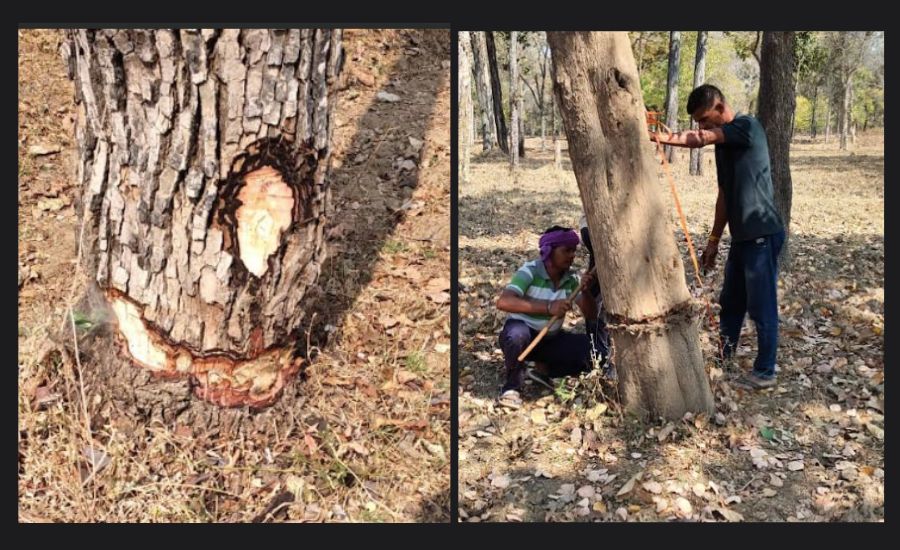
Trees Were Killed Slowly Through ‘Girdling’
Investigators discovered that the destruction was not always carried out through obvious tree-felling operations.
Instead, many trees were killed using a covert method known as “girdling.”
The process involves stripping away a ring of bark around the tree trunk, cutting off nutrient flow and causing the tree to die slowly over several years.
“They peel off the outer skin of the tree in a circular pattern. The tree slowly withers and dies over three or four years,” Jain explained.
This method allowed encroachers to destroy forests gradually without attracting immediate attention through smoke, noise, or large-scale cutting.
Drone surveys later captured evidence of burnt stumps, felled trunks, and girdled trees spread across the encroached land.
Digital Evidence Changed the Game
Unlike earlier investigations that failed in court, Jain’s team built a comprehensive digital evidence system.
Every encroached field was mapped using drones and GPS technology. Officials identified precisely how much land each encroacher had occupied.
The survey found that 166 encroachers from Jaitpuri village had illegally occupied 106 hectares of core forest land.
“We had every single tree measured using drones and GPS technology. We identified exactly how many hectares each person had encroached upon,” Jain said.
The team also photographed accused individuals at the encroachment sites and cross-referenced all findings with ISRO imagery.
This time, the legal approach was far stronger.
Fresh Preliminary Offense Reports (PORs) were registered under the Wildlife Protection Act and the Prevention of Damage to Public Property Act.
The accused now face imprisonment of up to seven years.
Authorities have also initiated proceedings to attach assets allegedly acquired through earnings generated from the encroached land.
Violent Resistance and Deadly Attacks
Taking action inside a deeply entrenched encroachment network was never going to be easy. Mr Jain revealed that his teams faced violent attacks while conducting operations in the forest.
“We have faced four deadly attacks in 2023 and 2024, but still managed to free 850 hectares of forest land from encroachment,” he said.
In one recent operation, Jain himself accompanied a small force of 40–50 personnel, including women staff members, to conduct action on the ground.
The team deliberately went unarmed and carried out continuous videography to document any confrontation. Yet, they were attacked.
“These individuals launched an attack against us. We had gone there unarmed. We were recording everything so that if any attack happened, we could register a separate FIR,” Jain recalled.
Despite the assault, forest officials managed to arrest four accused individuals. Following the crackdown, pressure mounted rapidly.
“Today, 36 people came forward to surrender. The remaining individuals are expected to surrender gradually within the next few days,” he said.
An Ecological Crisis Beyond Trees
The destruction inside Udanti-Sitanadi is not merely about lost forest cover.
The encroached land lies inside a critically important ecological zone connected to the Mahanadi River basin and elephant movement corridors.
“This is the source region of the Mahanadi River,” Mr Jain emphasized. “These people do not even realize that the place where they were cutting trees is only about five kilometers away from the actual origin of the Mahanadi.”
He described the region as vital for water security in both Chhattisgarh and Odisha. “It is an extremely important catchment area that provides water to entire states.”
The encroachment also disrupted elephant movement patterns.
According to Jain, elephants crossing through the corridor often entered encroached agricultural fields. Since the occupants had no legal ownership over the land, they were ineligible for crop compensation from the government.
As a result, villagers aggressively drove elephants away using torches, firecrackers, and flaming sticks.
“They would force the elephants back instead of allowing them to move naturally across the landscape,” Jain explained.
“The natural load distribution of elephants was getting disturbed. The animals became concentrated in one area, increasing human-elephant conflict.”
The Tiger Reserve team highlighted this issue before the court as evidence that the encroachment posed a serious long-term ecological threat.
A Reserve That Lost Its Tigers
The crisis unfolding in Udanti-Sitanadi also mirrors the decline of its wildlife.
The reserve, once estimated to have six to eight tigers in 2006, is now believed to have only one remaining tiger.
The collapse of forest cover, fragmentation of habitat, and prolonged human pressure have severely impacted biodiversity.
The Wildlife Institute of India itself acknowledged that the reserve’s protection infrastructure was poor and that effective regular monitoring was difficult in the core area.
For years, this lack of monitoring enabled the destruction to continue almost unnoticed.
Reclaiming the Forest: The Restoration Plan
While the legal battle continues, restoration work is already being planned.
Once the encroached land is fully reclaimed, the Forest Department intends to begin ecological regeneration immediately.
According to Jain, the restoration strategy will focus on low-cost natural regeneration methods. “We will terrace the area and carry out bund-to-trench contouring to retain rainwater,” he explained.
The most encouraging part, he said, is that many tree root systems still remain underground.
“The root stock that has survived beneath the soil will naturally sprout again. That is our biggest advantage.”
The department also plans to launch large-scale plantation drives involving local communities, schoolchildren, forest staff, and volunteers during Van Mahotsav.
“We will organize community plantation drives with saplings and seed balls. Within five to seven years, the area can regain the shape of a natural forest.”
Technology, Courage, and Accountability
Perhaps the most significant aspect of the Udanti-Sitanadi story is what it represents beyond one forest.
It is a case study in how technology — from ISRO satellite imagery to drone mapping — can expose ecological crimes that remain hidden for years.
But it is also a reminder of the consequences of weak enforcement and administrative failure.
For over 15 years, thousands of trees disappeared from the core area of a notified Tiger Reserve. Dense forests became farms. Elephant corridors were blocked. Tiger habitat collapsed.
Now, with digital evidence, legal action, and aggressive ground operations, the system is finally attempting to reverse the damage. For Varun Jain and his team, however, the mission is far from over.
“We intend to fight this case vigorously,” he said.
And in the forests of Udanti-Sitanadi, where silence once concealed destruction, that fight may ultimately determine whether one of central India’s most fragile ecosystems survives.
Also Read – How IPS Officer Vikas Vaibhav Turned a Dream Into Bihar’s Biggest Youth Movement