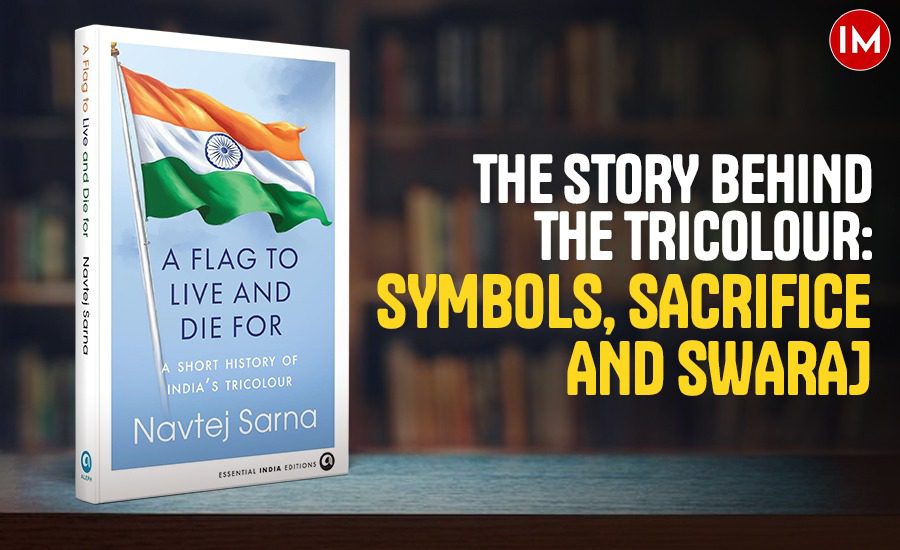
In A Flag to Live and Die For: A Short History of India’s Tricolour Navtej Sarna begins his story by drawing our attention to the very first chapter of the Bhagwad Geeta. While describing the scene in the battlefield of Kurukshetra, we get a description of the flags of the most important warriors and military commanders: Arjuna carried the kapi-dhvaja – with the ensign of Lord Hanuman, Bhima’s standard had the image of a lion, Yudhishthira’s flag bore a pair of mridangams while Duryodhana exhibited a serpent on his standard.
Flags are also seen in Kautilya’s Arthashastra, as markers of royal persona, authority as well as territory. Among the Rajputs, the Ranas of Chittor saw themselves as Suryavanshis (descendants of the sun) and had a crimson flag with the sun in the centre. The Mughal flag – known as Alam – was made of scarlet and green cloth, featuring a crouching lion and a rising sun.
Soon after the British Crown took over the administration of India from the East India Company (EIC), the Viceroy – who was also called the Knight Commander of the Star of India – was given a flag which carried the Imperial symbol of the Union Jack along with the crown and a star in homage to the new honorific. However, another important change that took place was that the flags moved from the traditional triangular pennant to the rectangular format favoured with heraldic symbols as in most of Europe.
Rise of Nationalist Flags
As expected, the official flag of British India was not accepted by the nationalists, and they decided to create their own flag(s). The first in the series was the double pennant flag designed by a twenty-three-year old young man, Srish Chandra Bose, who paraded through the streets of Lahore in 1883 to protest the imprisonment of Surendra Nath Banerjee for writing against a judge of the Calcutta High Court in his paper Bengalee.
Read Also: Between Light and Silence: Reading Morning Twilight as a Journey of Voice and Memory
The Lahore of that time was indeed one of India’s most cosmopolitan cities, the other of course being Calcutta which had been shaken to the core by Curzon’s unpopular decision to partition Bengal in 1905.
The First Tricolour and the Vande Mataram Flag
On the first anniversary of this day, Bhupendra Nath Dutt, the younger brother of Swami Vivekanand, presented a Vande Mataram flag to Surendra Nath Banerjee. This had been designed by Sachindra Prasad Bose and Sukumar Mitra and was the first tricolour, with three horizontal stripes of red, yellow and green and eight half-open lotuses representing the eight provinces of British India, along with a sun and crescent moon to represent Hindus and Muslims respectively.
The words “Vande Mataram” were inscribed in Devanagari script in deep blue in the middle of the yellow strip. The same flag was hoisted by Dadabhai Naoroji at the Congress session held at Calcutta that year, where each of the 1600 delegates also wore a badge with the same design. However, after the annulment of Partition, this design receded from public memory.
Sister Nivedita and Bhikaji Cama’s Contributions
Meanwhile, Swami Vivekananda’s Irish disciple Sister Nivedita designed another flag for India which had the Vajra (thunderbolt) at the centre of a rectangular scarlet flag. One hundred and eight jyotis (oil lamps) decorated the border, and Vande Mataram was inscribed in Bangla; this is currently preserved in the erstwhile residence of Acharya Jagadish Chandra Bose.
A year later, in August 1907, another woman Bhikaji Cama unfurled the Indian flag at the International Socialist Conference in Stuttgart. This was on the lines of the Calcutta Vande Mataram flag, with three stripes of green, golden saffron and red, eight lotuses on the green strip, and misspelt spellings of Vande Mataram on the saffron strip with the sun and the crescent moon on the red strip.
The Home Rule Movement Flag
In a slight departure from this emerging pattern came the flag of the Home Rule movement – five red and four green horizontal alternating stripes with the Union Jack on the top left hand corner, a crescent moon and a star to the right,and seven stars across the stripes.
Pingali Venkaya and the Search for a National Flag
We now turn to the remarkable Pingali Venkaya of the Pedakallepali village of Krishna district in Andhra who published a slim volume called A National Flag for India with no less than 24 alternate designs. He displayed all of them at the Congress sessions and also urged the Congress to invite more designs from the public.
The rainbow became a leitmotif for the seven religious sects of the country, with white representing Jains. The lotus, Lakshmi, Saraswati, Kali, Bhishma, Arjuna, the trishul, the peacock, bow and arrow, Mt Kailash, the vajra and nineteen stars as representing nineteen languages of the country also found a place on the flag.
Gandhi, the Charkha, and the Swaraj Flag
While the Mahatma was not too impressed with this medley of colours and symbols, at the Vijayawada session of the Congress in 1921, he turned to Venkaya to design a flag with a spinning wheel on a Khadi cloth. The Mahatma acknowledged that the idea came from Lala Hansraj of Jullender (now Jalandhar).
Thus came the Swaraj flag on coarse Khadi – with white on the top (for all minorities) followed by green (for the Muslims) and red for Hindus as the base – the idea being that “the strongest should act as a shield for the weakest”.
In the years that followed, the Swaraj flag became a symbol of nationalist protest and resistance; from July 1923, it was decided that Flag Day would be celebrated across the country on the last Sunday of every month at 8 a.m. Hoisting and saluting of the flag would be followed by the singing of the National Anthem.
This was the flag unfurled by Jawaharlal Nehru on the left bank of Ravi under the shadow of the Lahore fort on the night of 29th December 1929 as a symbol of national unity: the ‘national flag of Hindustan’. It was under this flag that Congress members took the pledge and read the declaration of Purna Swaraj.
Debate Over Communal Colours
Yet there were murmurs of dissent about the communal colours of the flag. In 1931, the Congress set up a seven-member flag committee – Pattabhi Sitaramayya (convenor), Jawahar Lal Nehru, Sardar Vallabhbhai Patel, Maulana Azad, Master Tara Singh, Dr N. S. Hardikar and D.B. Kalekar to decide on the final contours of the national flag.
The response which resonated most with the members of the committee came from Suniti Kumar Chatterji, the editor of Modern Review, who wrote that ‘equating the colours of the flag with any religion or community would be pernicious and anti-national: rather the colours should represent ideas and aspirations of a universal significance’.
Finally, the committee decided that ‘the colours shall be saffron, white and green in the order stated here, from top to bottom, with the spinning wheel in dark blue in the centre of the white strip, with the colours standing for qualities, not communities.’
The saffron was to represent courage and sacrifice, white was for peace and truth, and green would represent faith and chivalry. The charkha stood for hope of the masses. It was decided to celebrate August 30 as the day of the flag — and it was hoisted on public buildings, municipalities, district boards as well as in educational institutions. One was even smuggled into the precincts Alipore jail where it was put up in one of the wards as a mark of celebratory defiance!
Chakra over the Charkha
Just before Independence, the issue of whether to replace the charkha with the chakra came up. Savarkar was amongst the vociferous supporters of Chakra – for it symbolized progress and strength. Finally, the committee under the president of the Constituent Assembly Dr Rajendra Prasad decided that the emblem on the flag should be ‘the exact reproduction of the wheel on the capital of Ashoka’s Sarnath pillar, superimposed (in dark blue) in the middle of the central band (white) of the flag’.
This, in its final and current iteration, is the flag we live and die for.
Read Also: From Vedas to Constitution : How Sanskrit Shaped India Without Being Widely Spoken