For decades, political analysts and economists viewed Uttar Pradesh through a singular, challenging lens- its sheer size. Housing over 240 million people, managing food security here wasn’t just an administrative task; it was a complex logistical challenge. A tiny error in the state’s Public Distribution System (PDS) could impact millions of lives.
Fast forward to 2026, and the narrative has shifted dramatically. Under Chief Minister Yogi Adityanath, Uttar Pradesh has transitioned from being vulnerable to supply chain issues to becoming a leading example of robust food infrastructure. By combining technology-driven delivery, extensive storage expansion, and aggressive food processing policies, the state has built a highly reliable food security net for its underprivileged citizens.
The Lifeline
The foundation of Uttar Pradesh’s food strategy rests on a complete modernization of its PDS ecosystem. Through the implementation of Aadhaar-authenticated electronic Point of Sale (ePoS) devices across 78,455 Fair Price Shops, the state has largely eliminated systemic leakages and ghost ration cards.
Also Read – Why India’s Ethanol Policy Needs a Food Security Reality Check
Today, the state seamlessly manages a massive network of over 3.63 crore (36.3 million) active ration cards, which covers:
Antyodaya Anna Yojana (AAY): 40.81 lakh households representing the poorest of the poor.
Priority Households (PHH): 3.22 crore households
Uttar Pradesh PDS Infrastructure at a Glance:
Fair Price Shops Operational 78,455
Total Active Ration Cards 3,63,73,543
Antyodaya Households (AAY) 40,81,014
Priority Households (PHH) 3,22,92,529
The impact scale expands significantly when integrated with the Pradhan Mantri Garib Kalyan Anna Yojana (PMGKAY). To ensure smooth delivery, the UP Government’s capital outlay for the Food & Civil Supplies Department reached Rs- 17,876.77 crore in the FY 2026-27 State Budget, securing a spot among the top five departments for capital expenditure.
Furthermore, with the introduction of the central government’s SARTHAK-PDS scheme (running from 2026 to 2031), UP is integrating advanced technologies like real-time tracking, blockchain logistics, and data-driven State Command Control Centres to optimize delivery routes from warehouses straight to the consumer.
Warehousing & Storage Infrastructure
Distributing food effectively requires adequate storage capacity. The state government recognized that preventing grain decay due to poor weather was just as critical as sourcing it. As a result, UP launched a major warehouse and silo construction initiative.
Through a mix of state funding and public-private partnerships via the Agriculture Infrastructure Fund (AIF), the state has built a network of scientific warehouses. This decentralized storage model positions godowns closer to production hubs and blocks, delivering two clear benefits:
Lower Logistics Costs: Reduces the transport distance for intra-state grain movement.
Maintained Quality: Keeps grain safe from damp conditions and pests.
Additionally, under the Capital Investment Subsidy Scheme, the state offers 35% to 50% credit-linked subsidies to build and modernize large-scale storages (ranging from 5,000 MT to 20,000 MT), ensuring that buffer stocks remain secure year-round.
The Food Processing Revolution
To make farming more profitable and reduce post-harvest losses, Uttar Pradesh is aggressively promoting agro-processing through its updated Food Processing Industry Policy.
The state’s approach focuses closely on the farm gate:
Linkage Assistance: The state provides a 35% subsidy (up to Rs- 5 crore) for projects that build primary processing centres directly in rural fields. These facilities handle weighing, cleaning, sorting, and grading right after harvest.
Agro-Processing Clusters: Under the modern cluster approach, developers receive financial help to establish mini-hubs of at least 10 acres. These clusters feature shared facilities like industrial dry warehouses, cold storages, and rapid-freezing units alongside processing plants.
Mega Food Parks: Operating under a hub-and-spoke model, these parks connect rural collection centres directly to centralized processing units, allowing farmers to sell their yield directly to major food brands.
War on Waste
The final piece of Uttar Pradesh’s food strategy involves reducing waste. Preventing food loss helps extend the reach of the state’s welfare programs.
Harvest ──► Primary Processing ──► Scientific Silo ──► AI-Tracked PDS ──► Consumer
(Subsidy Backed) (Loss Prevention) (SARTHAK System) (Zero Leakage)
The state addresses waste management from two angles:
Preserving Perishables at the Source
By incorporating specialized multi-product food irradiation units and advanced cold chain systems, the state has significantly extended the shelf life of delicate produce. These investments help protect farmers from sudden market price drops and keep food fresh for consumers.
Recycling Waste into Resources
For food that cannot be consumed, UP’s updated urban and rural sanitation programs have streamlined solid waste management. Across the state, Material Recovery Centres have scaled up processing capacity from a low 16% back in 2014 to an impressive 82% in 2026. Organic food waste is systematically separated and processed into bio-compost, returning valuable nutrients back to the agricultural fields.
By pairing large-scale welfare initiatives with modern infrastructure, Uttar Pradesh has shown that smart planning can transform food security management. The state’s transition from old-school ration management to an integrated, tech-supported supply chain offers an encouraging blueprint for developing economies worldwide.
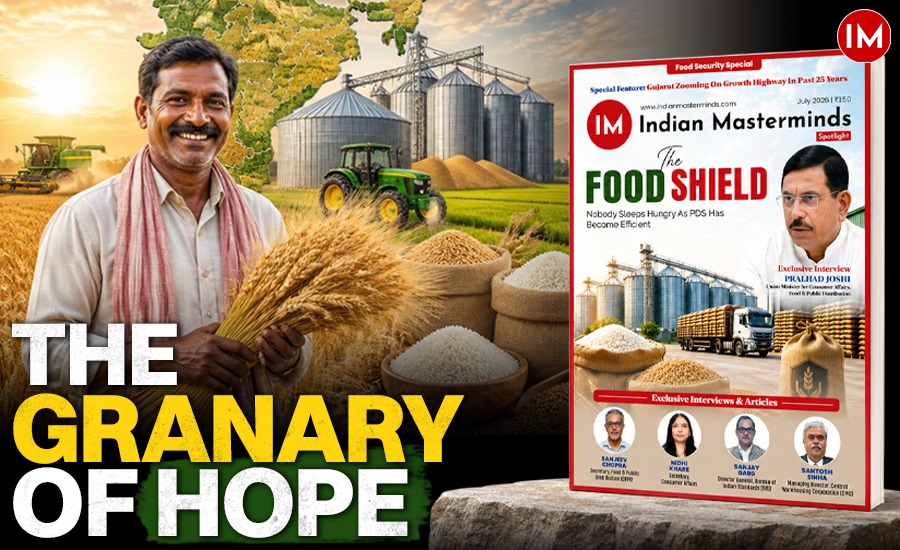
Through continued investments in food storage and processing, UP is well-positioned to maintain its status as a reliable granary of hope for its citizens.
Also Read – How Retired IRS Officer Patanjali Jha Built a Food Forest That Cools the Land by 7°C