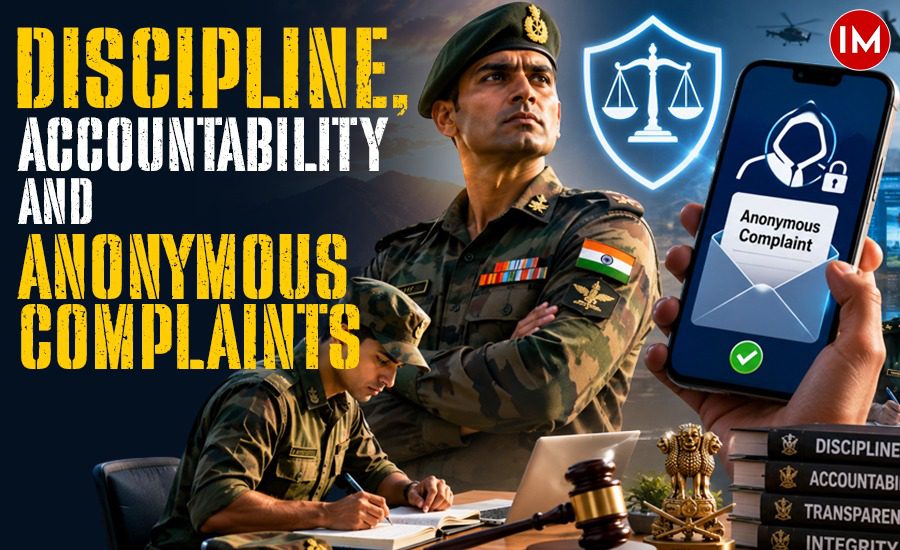
Few institutions in India enjoy the level of public trust and admiration that the Indian Army does. Its record of service, sacrifice, and professionalism has earned it a unique place in the nation’s collective consciousness. That reputation is built not only on battlefield achievements but also on the values of discipline, accountability, and integrity that the institution upholds.
It is precisely because of this stature that an important policy question deserves thoughtful discussion: should the Indian Army continue to maintain a different position from the broader Government of India framework on anonymous and pseudonymous complaints?
For several decades, the Department of Personnel and Training (DoPT) and the Central Vigilance Commission (CVC) have examined the implications of anonymous complaints in public administration. Their conclusion has largely been that disciplinary or vigilance action should not ordinarily be initiated solely on the basis of anonymous or pseudonymous complaints. The rationale is straightforward. Such complaints can be difficult to verify, may be motivated by personal grievances, and can sometimes become instruments of harassment rather than accountability.
Over time, this approach has found acceptance across much of the government system. It has also reportedly been adopted by other uniformed services, including the Indian Navy and the Indian Air Force. For a period, the Indian Army too appeared to align itself with this broader policy framework.
Also Read – From History to Heroism: How NDA’s First Women Cadets Changed the Academy Forever
However, the Army subsequently chose a different course, reportedly retaining a mechanism that allows consideration of anonymous complaints under certain circumstances. Supporters of this approach may argue that the Army operates in a unique environment where maintaining discipline, preventing misconduct, and ensuring internal accountability require additional channels of information.
That argument deserves serious consideration. Military institutions function under conditions that differ significantly from most civilian organisations. The chain of command, operational sensitivities, and the need to preserve discipline often demand specialised administrative practices.
At the same time, the divergence from the wider government framework raises legitimate questions.
If the concerns that led the DoPT and CVC to discourage action on anonymous complaints remain valid, what specific circumstances make a different approach necessary within the Army? Have there been institutional experiences that justify this distinction? Are there safeguards in place to prevent misuse of such complaints while still enabling genuine grievances to surface?
These are not questions that challenge the Army’s commitment to discipline. Rather, they seek to understand the reasoning behind a policy choice that differs from the approach followed elsewhere in government.
In a democracy, institutional credibility is strengthened when policies are accompanied by transparency and reasoned explanation. When an organisation adopts a different framework from the broader system, public understanding of that decision often helps reinforce confidence rather than diminish it.
The issue therefore is not whether the Indian Army values discipline and accountability. Few would dispute that it does. The discussion is about whether greater clarity regarding its approach to anonymous complaints could contribute to a better understanding of how accountability mechanisms operate within one of India’s most respected institutions.
If the current policy serves an important operational purpose, explaining that rationale could help address concerns and enrich public debate. If there are lessons that other institutions can learn from the Army’s experience, those too deserve consideration.
Ultimately, the conversation is not about questioning the Army’s integrity. It is about examining how institutions balance accountability, fairness, and transparency—and whether a fuller public explanation of the Army’s position would strengthen confidence in a policy that continues to generate discussion.