Artificial Intelligence is often associated with big cities, corporate boardrooms and futuristic laboratories. But India’s first AI-powered district did not emerge from Bengaluru, Hyderabad or Delhi. It took shape in the quiet coastal district of Sindhudurg in Maharashtra.
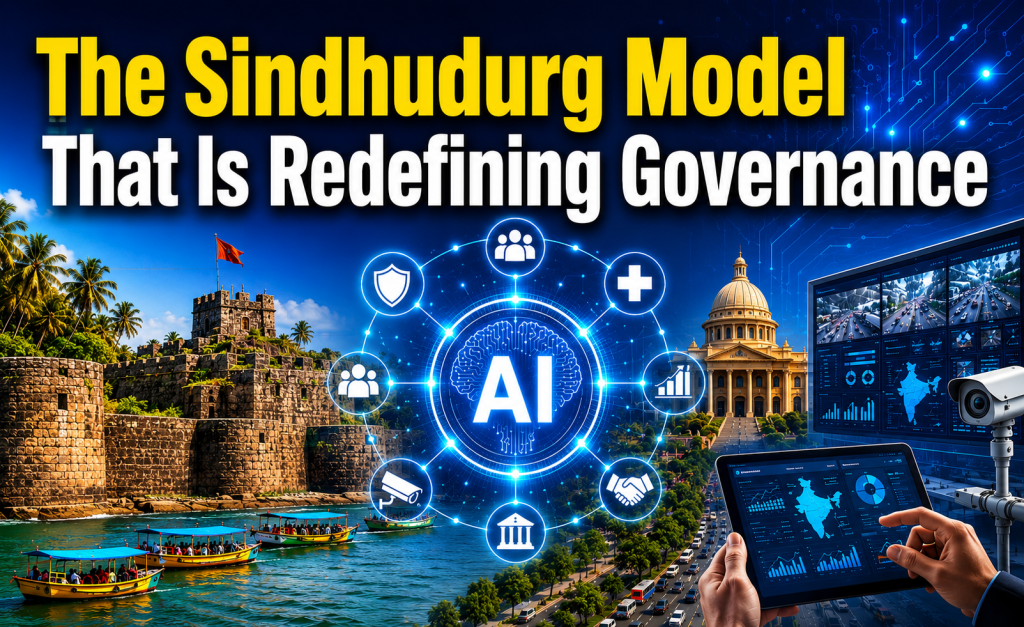
On May 1, 2025, Sindhudurg became the country’s first AI-enabled district, marking a major milestone in technology-driven governance. The ambitious initiative introduced Artificial Intelligence across multiple government departments to improve public safety, healthcare, administration and citizen services.
One of the key officers behind this transformation was Krushikesh Rawale, a 2019-batch IPS officer of the Maharashtra cadre, who was then posted in Sindhudurg and played a leading role in implementing the AI District initiative. Now serving as Deputy Commissioner of Police (Zone 1), Pune, Rawale believes technology is no longer an option in policing—it is becoming its backbone.
Speaking to Indian Masterminds, he explained how his engineering background helped him think differently, solve problems systematically and eventually contribute to building India’s first AI district.
BUILDING A SMARTER DISTRICT THROUGH ARTIFICIAL INTELLIGENCE
For decades, governance largely depended on manual monitoring, paperwork and reactive decision-making. Sindhudurg sought to break away from this conventional model by partnering with technology company MARVEL to develop what is now known as the AI Sindhudurg Model. Rather than introducing isolated technological interventions, the district administration adopted a holistic approach, deploying Artificial Intelligence across eight major departments.
The objective was simple yet transformative: instead of responding to problems after they occurred, the administration wanted AI to help predict, monitor and prevent them.
The initiative covered an impressive range of sectors. AI was introduced to strengthen crime prevention, optimise traffic management, monitor public health, identify cases of malnutrition, track the implementation of welfare schemes and even reduce human-animal conflict through intelligent monitoring systems. The project quickly attracted national attention, prompting officials from NITI Aayog to visit Sindhudurg and examine whether the model could be replicated across other districts in the country.

AN ENGINEER WHO ALWAYS DREAMT OF THE IPS
Rawale’s journey into the Indian Police Service was guided by a lifelong aspiration rather than circumstance. Although he pursued engineering, he never considered it his final destination.
“Engineering was never my final career goal. I always wanted to become an officer. Whenever we imagine someone taking action and ensuring justice, the first image that comes to mind is a police officer in uniform. That inspired me to choose the IPS,” he said.
Interestingly, the IPS was not his first service preference during the Civil Services Examination. However, once he entered the police service, he found that his engineering education became one of his greatest professional strengths.
WHY ENGINEERS HAVE AN EDGE IN MODERN POLICING
According to Rawale, policing today bears little resemblance to the traditional image of officers relying solely on physical investigation. The profession now revolves around digital technologies such as mobile and computer forensics, cryptocurrency investigations, cybercrime analysis, dark web monitoring, deepfake detection and Artificial Intelligence.
He believes engineering develops a structured way of thinking that proves invaluable in policing.
“Engineering develops an analytical mind. Every problem has a root cause. In policing too, if a crime occurs, there is always a broken link somewhere that needs to be identified and fixed. That way of thinking has helped me immensely,” he explained.
Instead of viewing crimes as isolated incidents, he believes technology enables officers to identify recurring patterns, analyse behaviour and prevent future offences before they occur.
AI THAT GOES FAR BEYOND POLICING
The AI District initiative was never designed as a policing project alone. Its real strength lay in creating a technology-driven ecosystem where multiple government departments could work more efficiently through Artificial Intelligence.
In healthcare, AI systems helped identify cases of malnutrition and monitor health indicators. Wildlife management adopted bioacoustic technology to alert villagers about elephant movement, reducing instances of human-animal conflict. Administrative departments used AI to monitor government schemes and identify implementation gaps, while traffic authorities analysed movement patterns to detect congestion and accident-prone zones.
By integrating these diverse functions into a single technological framework, Sindhudurg demonstrated how AI could improve governance across sectors rather than benefiting only one department.
WHEN TECHNOLOGY SAVES LIVES
For Rawale, technology must ultimately improve public safety.
That philosophy continues to guide his work as DCP of Pune Zone 1. During Pune’s Ganesh Festival—one of Maharashtra’s largest crowd management exercises attracting nearly 16 lakh visitors—he introduced several technology-led innovations aimed at preventing accidents and ensuring smoother crowd movement.
One of the most effective interventions was the introduction of one-way turnstile barricades. Unlike conventional barricades that restricted movement in both directions, the new design allowed devotees to exit crowded areas without permitting fresh entry from the same route. This proved particularly beneficial for elderly people, women, children and anyone feeling uncomfortable in densely packed crowds, significantly reducing the risk of panic and stampedes.
The police also deployed boom barriers that could be operated instantly to regulate crowd flow whenever required. AI-powered cameras continuously estimated crowd density in real time, while facial recognition systems and mobile surveillance units strengthened security across the festival area.
For Rawale, these technologies do not replace police personnel. Instead, they equip officers with better information, enabling faster and more informed decision-making.
INTEGRITY REMAINS THE STRONGEST TECHNOLOGY
While technology has transformed policing, Rawale believes leadership continues to rest on timeless values.
Serving in one’s home state offers several advantages, including familiarity with the local language, culture and social dynamics. At the same time, it also creates pressures, as acquaintances often expect preferential treatment.
Rawale believes such expectations must be firmly resisted.
“You can always speak politely and respectfully to people. But you cannot compromise your principles. The moment you make exceptions, your own team stops taking you seriously,” he said.
According to him, integrity remains the foundation upon which public trust is built, irrespective of how advanced technology becomes.
A BLUEPRINT FOR THE FUTURE OF GOVERNANCE
The Sindhudurg experiment has established that Artificial Intelligence is not the exclusive domain of metropolitan cities or corporate technology parks. With visionary leadership, administrative commitment and a willingness to embrace innovation, even a relatively small district can emerge as a national model for smart governance.
For Krushikesh Rawale, the journey from an engineering classroom to the Indian Police Service has always revolved around solving problems through logic and innovation. The AI District initiative simply expanded the scale of that mission.
Today, as he leads policing initiatives in Pune, he continues to champion the use of technology not as a showcase of modernity but as a practical instrument for improving governance, enhancing public safety and delivering better services to citizens.
India’s first AI-enabled district is therefore much more than a technological milestone. It demonstrates that the future of governance will depend not merely on advanced tools, but on leaders who possess the vision to apply them meaningfully. Sindhudurg’s success serves as a blueprint for districts across the country, proving that with the right ideas and committed leadership, Artificial Intelligence can become a powerful force for inclusive, efficient and citizen-centric governance.
Also Read – How IFS Anurag Tiwari Is Reviving Ujjain’s Lost Mahakal Van and Building a 500-Acre World-Class Zoo